The oxyacids of sulphur having direct S-S bonds are :
H2S2O3, H2S2O4, H2S2O6
Every acid listed contains two sulphur atoms, so the discriminating question is how those two sulphurs are joined: directly (S-S), or through a bridging oxygen (S-O-S) or peroxide link (S-O-O-S).
H2S2O3, thiosulphuric acid — has S-S. It is structurally sulphuric acid with one terminal oxygen replaced by sulphur, so the second sulphur is bonded straight to the central one.
H2S2O4, dithionous acid — has S-S. Both sulphurs are in the +3 state and are joined by an unusually long, weak S-S bond, which is why the dithionite ion is such a powerful reducing agent.
H2S2O6, dithionic acid — has S-S. Two SO3H units are linked directly sulphur to sulphur, each sulphur being +5.
H2S2O7, pyrosulphuric (disulphuric) acid, does not. It is formed by condensing two molecules of H2SO4 with loss of water, so the two sulphurs are joined through a bridging oxygen, S-O-S.
H2S2O8, peroxydisulphuric acid, also does not. Here the link is a peroxide bridge, S-O-O-S, which is the source of its strong oxidising power.
So the three acids with a genuine sulphur-sulphur bond are the thio, dithionous and dithionic acids.
Hence the answer is H2S2O3, H2S2O4, H2S2O6.
Similar Questions
The species that contain a vacant d x2 - y2 orbital is :
The solutions of
(i) [Cr(OH2)6]3+ ions are pale blue-green, but the chromite ion
(ii) [CrO4]2- is an intense yellow due to :
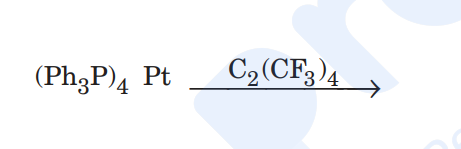
The major product of the following reaction in :
FeCl2 . 4H2O and FeCl3 . 6H2O can be distinguished by 57Fe Mössbauer spectroscopy. The INCORRECT statement from the following is :
The point group of Cis - [PtCl2(NH3)2] is :
Covalent multinuclear bonds are found in the solid state structures of :
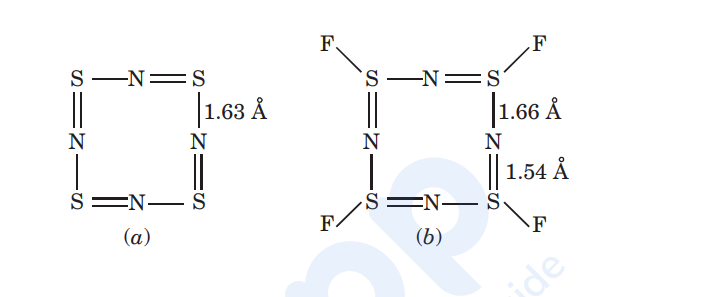
The structures of tetrasulphur tetranitride (a) and tetrathiazyl tetrafluoride (b) are given below. The statement that correctly describes the structures is :
Between NF3 and NH3 :
In an axially symmetric field, the first NQR transition energy for I = $\frac{3}{2}$ is :
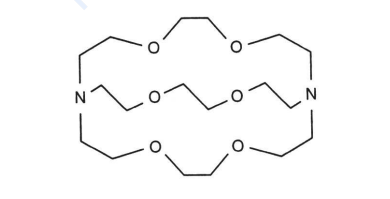
Alkali metals form strong complexes with cryptate ligands. The structure of one such crypt given below is of :
Important Questions from Structure of Atom
- How many moles of He atoms are present in its 20 u mass ?
Which of the following electron transition in hydrogen atom will require largest amount of energy?
A species having 8 electrons in the third shell is very reactive while the other species having 8 electrons in the third shell is very inactive they are :
Which of the following is the general formula for saturated hydrocarbons?
Which one of the following is the average atomic mass of chlorine atom?