The solutions of (i) [Cr(OH2)6]3+ ions are pale blue-green, but the chromite ion (ii) [CrO4]2- is an intense yellow due to :
d-d transition in (i) and charge transfer transition in (ii)
The clue is the intensity contrast: one solution is pale, the other intense. That difference is diagnostic of the type of electronic transition responsible.
(i) [Cr(OH2)6]3+ — d-d transition. Chromium is Cr(III), a d3 ion, so partly filled d orbitals are available and the colour arises from promoting an electron within the d manifold. In a centrosymmetric octahedral complex such transitions are Laporte forbidden (g → g) and also spin constrained, so molar absorptivities are low, typically only a few to a few tens of dm3 mol-1 cm-1. Weak absorption gives a pale colour, exactly as observed.
(ii) [CrO4]2- — charge transfer transition. Here chromium is Cr(VI), which is d0. With no d electrons at all, a d-d transition is impossible, so the colour cannot come from that origin. Instead an electron is promoted from an oxygen lone-pair orbital to an empty metal d orbital — a ligand-to-metal charge transfer (LMCT). Such transitions are both Laporte and spin allowed, giving molar absorptivities of the order of 103-104, hence the intense yellow.
The d0 configuration is the decisive test: it rules out options that assign a d-d transition to the chromate ion, and the pale colour of the aqua ion rules out options that assign charge transfer to it.
Hence the colours are due to a d-d transition in (i) and a charge transfer transition in (ii).
Similar Questions
The oxyacids of sulphur having direct S-S bonds are :
The point group of Cis - [PtCl2(NH3)2] is :
Covalent multinuclear bonds are found in the solid state structures of :
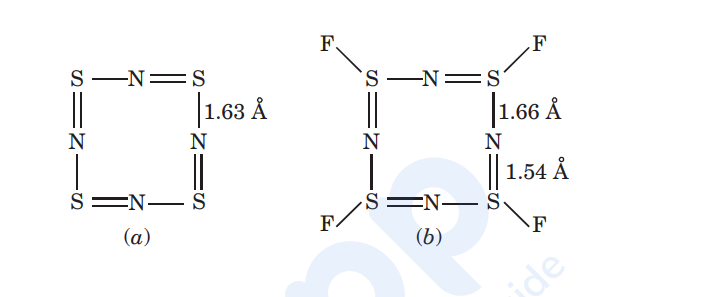
The structures of tetrasulphur tetranitride (a) and tetrathiazyl tetrafluoride (b) are given below. The statement that correctly describes the structures is :
Between NF3 and NH3 :
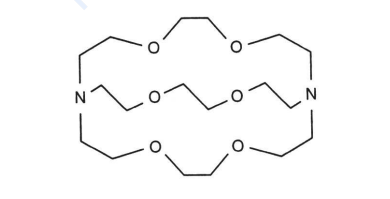
Alkali metals form strong complexes with cryptate ligands. The structure of one such crypt given below is of :
In the 19F NMR spectrum of ClF3, the number of signals and multiplicity at room temperature are (19F; I = \(\tfrac{1}{2}\)) :
Identify (X) and (Y) in the following transformation :

For the reaction with [Cr(OH2)6]2+, the inner-sphere redox reaction proceeds the fastest for :
Kurnakov test addition of thiourea (Th) to cis-Platin yields [Pt(Th)4]Cl2. In a similar process, trans-Platin will react with thiourea to yield :
Important Questions from Structure of Atom
- How many moles of He atoms are present in its 20 u mass ?
Which of the following electron transition in hydrogen atom will require largest amount of energy?
A species having 8 electrons in the third shell is very reactive while the other species having 8 electrons in the third shell is very inactive they are :
Which of the following is the general formula for saturated hydrocarbons?
Which one of the following is the average atomic mass of chlorine atom?