Between NF3 and NH3 :
NH3 has a higher bond angle than NF3 because NF3 is less basic than NH3
Both molecules are trigonal pyramidal with one lone pair on nitrogen, so the comparison is about how far the bond pairs are pushed together. The experimental angles are NH3 107.8° and NF3 102.3° — so it is ammonia that has the larger angle, which immediately eliminates the three options claiming the reverse.
The reason lies in electronegativity and where the bonding electron density sits. In NH3, nitrogen (3.04) is more electronegative than hydrogen (2.20), so each bonding pair is drawn towards nitrogen. Those pairs are then close together near the central atom and repel one another strongly, opening the H-N-H angle.
In NF3, fluorine (3.98) is more electronegative than nitrogen, so each bonding pair is pulled away from nitrogen and towards fluorine. The bond pairs are further from the centre, mutual repulsion between them is reduced, and the lone pair on nitrogen can press them closer together, closing the F-N-F angle.
The same electron withdrawal explains the basicity remark in the correct option. Because the three fluorines drain electron density from nitrogen, the lone pair in NF3 is far less available for donation, making NF3 a very weak base while NH3 is a good one. Reduced electron density around nitrogen and a narrower bond angle are two consequences of the same cause.
The long N-F bond distance is not the operative factor, and the N-F bond is covalent rather than ionic, so those explanations fail on their own terms.
Hence NH3 has a higher bond angle than NF3, and NF3 is the weaker base.
Similar Questions
The species that contain a vacant d x2 - y2 orbital is :
The solutions of
(i) [Cr(OH2)6]3+ ions are pale blue-green, but the chromite ion
(ii) [CrO4]2- is an intense yellow due to :
The major product of the following reaction in :
FeCl2 . 4H2O and FeCl3 . 6H2O can be distinguished by 57Fe Mössbauer spectroscopy. The INCORRECT statement from the following is :
The oxyacids of sulphur having direct S-S bonds are :
The point group of Cis - [PtCl2(NH3)2] is :
Covalent multinuclear bonds are found in the solid state structures of :
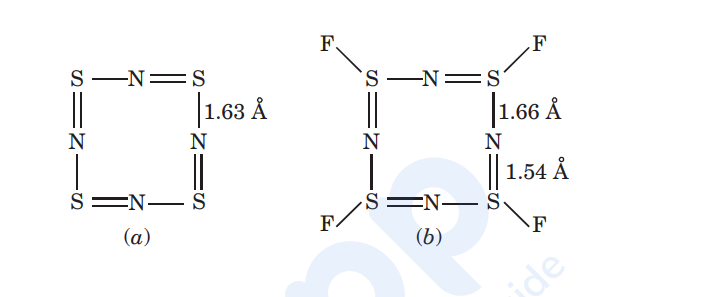
The structures of tetrasulphur tetranitride (a) and tetrathiazyl tetrafluoride (b) are given below. The statement that correctly describes the structures is :
In an axially symmetric field, the first NQR transition energy for I = $\frac{3}{2}$ is :
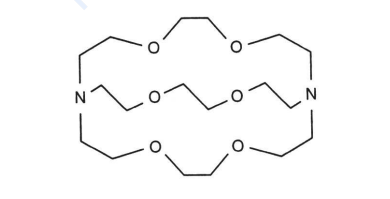
Alkali metals form strong complexes with cryptate ligands. The structure of one such crypt given below is of :
Important Questions from Structure of Atom
- How many moles of He atoms are present in its 20 u mass ?
Which of the following electron transition in hydrogen atom will require largest amount of energy?
A species having 8 electrons in the third shell is very reactive while the other species having 8 electrons in the third shell is very inactive they are :
Which of the following is the general formula for saturated hydrocarbons?
Which one of the following is the average atomic mass of chlorine atom?