The species that contain a vacant d x2 - y2 orbital is :
[Ni(CN)4]2-
All four species are nickel complexes, so the question turns on the oxidation state, the d-electron count and above all the geometry, because geometry decides where dx2-y2 sits in energy.
[Ni(CN)4]2- is the answer. Nickel is Ni(II), a d8 ion, and cyanide is a strong-field ligand, so the complex is square planar and diamagnetic. In a square-planar field the ligands lie along the x and y axes, pointing straight at the lobes of dx2-y2. That orbital is therefore pushed far above the other four, and the eight d electrons fill dxy, dxz, dyz and dz2 completely, leaving dx2-y2 empty.
[Ni(en)3]2+ is octahedral Ni(II), d8. In an octahedral field the configuration is t2g6eg2, and the two eg electrons occupy dz2 and dx2-y2 singly. The orbital is half filled, not vacant, which is why the complex is paramagnetic with two unpaired electrons.
[NiCl4]2- is tetrahedral Ni(II), d8, because chloride is a weak-field ligand. The tetrahedral splitting places e (dz2, dx2-y2) below t2, so the e set is filled and dx2-y2 carries electrons.
[Ni(CO)4] is tetrahedral Ni(0), a d10 system. Every d orbital is doubly occupied, so none is vacant.
Hence the species with a vacant dx2-y2 orbital is [Ni(CN)4]2-.
Similar Questions
The oxyacids of sulphur having direct S-S bonds are :
The point group of Cis - [PtCl2(NH3)2] is :
Covalent multinuclear bonds are found in the solid state structures of :
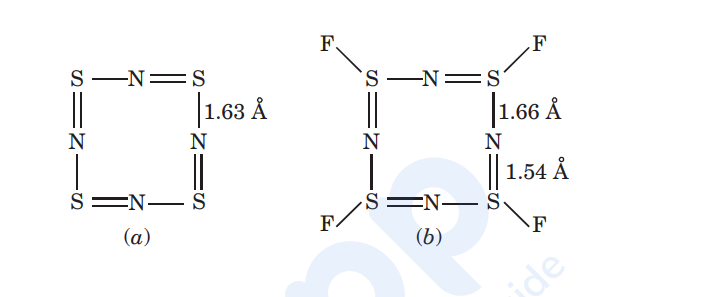
The structures of tetrasulphur tetranitride (a) and tetrathiazyl tetrafluoride (b) are given below. The statement that correctly describes the structures is :
Between NF3 and NH3 :
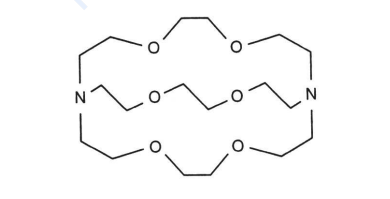
Alkali metals form strong complexes with cryptate ligands. The structure of one such crypt given below is of :
In the 19F NMR spectrum of ClF3, the number of signals and multiplicity at room temperature are (19F; I = \(\tfrac{1}{2}\)) :
Identify (X) and (Y) in the following transformation :

For the reaction with [Cr(OH2)6]2+, the inner-sphere redox reaction proceeds the fastest for :
Kurnakov test addition of thiourea (Th) to cis-Platin yields [Pt(Th)4]Cl2. In a similar process, trans-Platin will react with thiourea to yield :
Important Questions from Structure of Atom
- How many moles of He atoms are present in its 20 u mass ?
Which of the following electron transition in hydrogen atom will require largest amount of energy?
A species having 8 electrons in the third shell is very reactive while the other species having 8 electrons in the third shell is very inactive they are :
Which of the following is the general formula for saturated hydrocarbons?
Which one of the following is the average atomic mass of chlorine atom?