FeCl2 . 4H2O and FeCl3 . 6H2O can be distinguished by 57Fe Mössbauer spectroscopy. The INCORRECT statement from the following is :
Both compounds show the same isomer shift
The two salts differ in iron oxidation state: FeCl2·4H2O is Fe(II), d6, and FeCl3·6H2O is Fe(III), d5. Mössbauer spectroscopy reports two parameters that both respond to that difference, so the question asks which statement contradicts them.
"Both compounds show the same isomer shift" is the incorrect statement. The isomer shift measures the s-electron density at the nucleus. Fe(II) has one more d electron than Fe(III), and that extra d electron shields the 3s and 4s electrons from the nuclear charge, lowering the s-density at the nucleus. Lower s-density gives a larger isomer shift, so Fe(II) and Fe(III) have characteristically different values — roughly 1.1-1.4 mm s-1 for high-spin Fe(II) against 0.3-0.5 mm s-1 for high-spin Fe(III). This difference is precisely what lets Mössbauer distinguish the two salts, so claiming they are the same is wrong.
"Both compounds are high spin" is correct. Water and chloride are weak-field ligands, so both complexes are high spin: Fe(II) is t2g4eg2 with four unpaired electrons, Fe(III) is t2g3eg2 with five.
"Quadrupole splitting of FeCl2·4H2O is higher" is correct, and follows from symmetry of the d-electron cloud. High-spin Fe(III) is d5 with one electron in every d orbital, giving a nearly spherical, symmetric charge distribution and hence a very small electric field gradient. High-spin Fe(II) has one extra electron in a single t2g orbital, which makes the distribution markedly asymmetric and produces a large field gradient and therefore large quadrupole splitting.
"The isomer shift of FeCl2·4H2O is higher" is correct for the shielding reason given above.
Hence the incorrect statement is that both compounds show the same isomer shift.
Similar Questions
The oxyacids of sulphur having direct S-S bonds are :
The point group of Cis - [PtCl2(NH3)2] is :
Covalent multinuclear bonds are found in the solid state structures of :
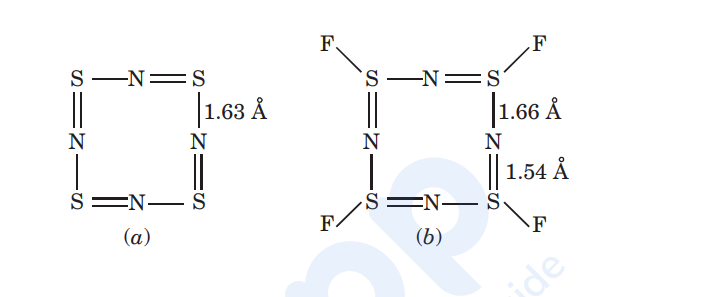
The structures of tetrasulphur tetranitride (a) and tetrathiazyl tetrafluoride (b) are given below. The statement that correctly describes the structures is :
Between NF3 and NH3 :
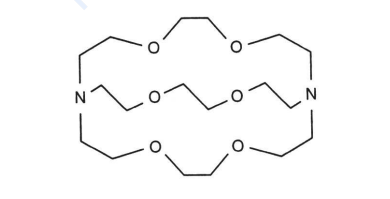
Alkali metals form strong complexes with cryptate ligands. The structure of one such crypt given below is of :
In the 19F NMR spectrum of ClF3, the number of signals and multiplicity at room temperature are (19F; I = \(\tfrac{1}{2}\)) :
Identify (X) and (Y) in the following transformation :

For the reaction with [Cr(OH2)6]2+, the inner-sphere redox reaction proceeds the fastest for :
Kurnakov test addition of thiourea (Th) to cis-Platin yields [Pt(Th)4]Cl2. In a similar process, trans-Platin will react with thiourea to yield :
Important Questions from Structure of Atom
- How many moles of He atoms are present in its 20 u mass ?
Which of the following electron transition in hydrogen atom will require largest amount of energy?
A species having 8 electrons in the third shell is very reactive while the other species having 8 electrons in the third shell is very inactive they are :
Which of the following is the general formula for saturated hydrocarbons?
Which one of the following is the average atomic mass of chlorine atom?