The major product of the following reaction in :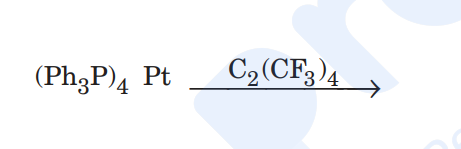
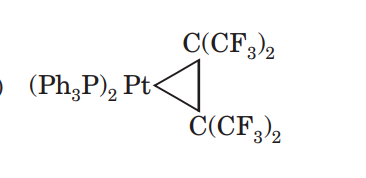
This question is built on drawn structures, so the options cannot be reproduced as text. The chemistry behind the official answer is explained below.
Pt(PPh3)4 is a 18-electron Pt(0) complex that readily loses two triphenylphosphine ligands in solution to generate the reactive 14-electron fragment Pt(PPh3)2. That fragment is the species which actually reacts.
C2(CF3)4 is perfluoro-2-butene, (CF3)2C=C(CF3)2. The four strongly electron-withdrawing CF3 groups make it an exceptionally good π acceptor, so it binds the electron-rich Pt(0) centre very strongly.
The product is the η2-alkene complex (Ph3P)2Pt(η2-C2(CF3)4), a trigonal-planar 16-electron Pt complex retaining just two phosphines. Because back donation from Pt into the alkene π* is so extensive with perfluorinated alkenes, the C-C bond lengthens towards a single bond and the carbons pyramidalise — the bonding is better described by the metallacyclopropane (Dewar-Chatt-Duncanson) limit than by simple side-on π coordination.
The correct option is therefore the one showing two PPh3 ligands retained on platinum with the perfluorinated alkene bound side-on through both carbons; options retaining all four phosphines, or showing two separate carbene units, do not correspond to this well-known substitution chemistry.
Per the official final answer key the answer is option (C).
Similar Questions
The oxyacids of sulphur having direct S-S bonds are :
The point group of Cis - [PtCl2(NH3)2] is :
Covalent multinuclear bonds are found in the solid state structures of :
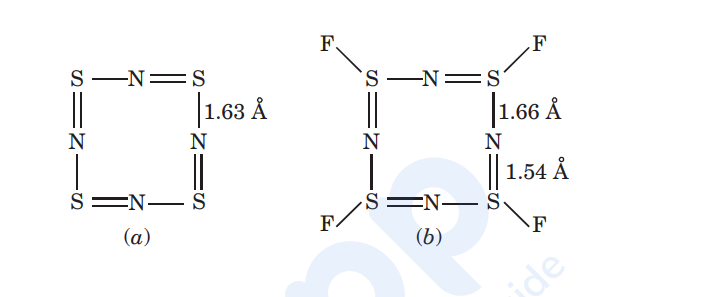
The structures of tetrasulphur tetranitride (a) and tetrathiazyl tetrafluoride (b) are given below. The statement that correctly describes the structures is :
Between NF3 and NH3 :
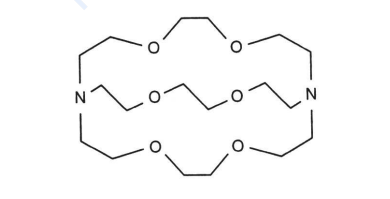
Alkali metals form strong complexes with cryptate ligands. The structure of one such crypt given below is of :
In the 19F NMR spectrum of ClF3, the number of signals and multiplicity at room temperature are (19F; I = \(\tfrac{1}{2}\)) :
Identify (X) and (Y) in the following transformation :

For the reaction with [Cr(OH2)6]2+, the inner-sphere redox reaction proceeds the fastest for :
Kurnakov test addition of thiourea (Th) to cis-Platin yields [Pt(Th)4]Cl2. In a similar process, trans-Platin will react with thiourea to yield :
Important Questions from Structure of Atom
- How many moles of He atoms are present in its 20 u mass ?
Which of the following electron transition in hydrogen atom will require largest amount of energy?
A species having 8 electrons in the third shell is very reactive while the other species having 8 electrons in the third shell is very inactive they are :
Which of the following is the general formula for saturated hydrocarbons?
Which one of the following is the average atomic mass of chlorine atom?