The sides of a triangle are in the ratio 1/2 : 1/3 : 1/4 and its perimeter is 104 cm. The length of the longest side (in cm) is:
48
Calculating Triangle Side Lengths from Ratio and Perimeter
This problem asks us to find the length of the longest side of a triangle when the ratio of its sides and its perimeter are known. The sides are in a fractional ratio, which we first need to convert into a simple integer ratio.
Converting the Side Ratio to Integers
The given ratio of the sides is \( \frac{1}{2} : \frac{1}{3} : \frac{1}{4} \). To work with whole numbers, we find the least common multiple (LCM) of the denominators 2, 3, and 4. The LCM of 2, 3, and 4 is 12.
We multiply each part of the ratio by the LCM (12):
- First side part: \( \frac{1}{2} \times 12 = 6 \)
- Second side part: \( \frac{1}{3} \times 12 = 4 \)
- Third side part: \( \frac{1}{4} \times 12 = 3 \)
So, the ratio of the sides of the triangle is \( 6 : 4 : 3 \).
Setting Up the Sides and Perimeter Equation
Let the sides of the triangle be \( 6x \), \( 4x \), and \( 3x \), where \( x \) is a common multiplier. The perimeter of a triangle is the sum of the lengths of its three sides.
Given that the perimeter is 104 cm, we can write the equation:
\( 6x + 4x + 3x = 104 \)
Solving for the Value of \( x \)
Combine the terms on the left side of the equation:
\( (6 + 4 + 3)x = 104 \)
\( 13x = 104 \)
Now, solve for \( x \) by dividing the perimeter by the sum of the ratio parts:
\( x = \frac{104}{13} \)
\( x = 8 \)
The common multiplier \( x \) is 8.
Calculating the Length of Each Triangle Side
Now we can find the actual length of each side by substituting the value of \( x \) back into our expressions for the sides:
- Length of the first side: \( 6x = 6 \times 8 = 48 \) cm
- Length of the second side: \( 4x = 4 \times 8 = 32 \) cm
- Length of the third side: \( 3x = 3 \times 8 = 24 \) cm
The lengths of the sides of the triangle are 48 cm, 32 cm, and 24 cm.
Finding the Longest Side of the Triangle
We need to identify the longest side among the calculated lengths: 48 cm, 32 cm, and 24 cm.
Comparing these values, we see that 48 cm is the greatest length.
Therefore, the length of the longest side is 48 cm.
Revision Table: Triangle Side Ratio and Perimeter Problem
| Step | Description | Calculation/Result |
|---|---|---|
| 1 | Original Ratio | \( \frac{1}{2} : \frac{1}{3} : \frac{1}{4} \) |
| 2 | LCM of Denominators (2, 3, 4) | 12 |
| 3 | Ratio in Integers (Multiply by LCM) | \( 6 : 4 : 3 \) |
| 4 | Represent Sides | \( 6x, 4x, 3x \) |
| 5 | Perimeter Equation | \( 6x + 4x + 3x = 104 \) |
| 6 | Solve for \( x \) | \( 13x = 104 \implies x = 8 \) |
| 7 | Calculate Side Lengths | 48 cm, 32 cm, 24 cm |
| 8 | Identify Longest Side | 48 cm |
Additional Information: Triangle Properties and Ratio Concepts
Understanding ratios and perimeters is key to solving this type of geometry problem.
- Ratio: A ratio is a comparison of two or more quantities. In this case, it tells us the relative sizes of the triangle's sides. The ratio \( 6:4:3 \) means that for every 6 units of length on one side, there are 4 units on another and 3 units on the third.
- Perimeter: The perimeter of any polygon, including a triangle, is the total distance around its boundary. It is calculated by summing the lengths of all its sides.
- Triangle Inequality Theorem: A valid triangle can only be formed if the sum of the lengths of any two sides is greater than the length of the third side. In our case, the sides are 24, 32, and 48. Let's check:
- \( 24 + 32 = 56 > 48 \) (True)
- \( 24 + 48 = 72 > 32 \) (True)
- \( 32 + 48 = 80 > 24 \) (True)
Using a ratio with a common multiplier like \( x \) allows us to represent the side lengths while maintaining their relative proportions given by the ratio.
Similar Questions
In ∆ABC, the perpendiculars drawn from A, B and C meet the opposite sides at points D, E and F, respectively. AD, BE and CF intersect at point P. If ∠EPD = 110° and the bisectors of ∠A and ∠B meet at point Q, then ∠AQB = ?
In a circle of diameter 20 cm, chords AB and CD are parallel to each other. BC is diameter. If AB is 6 cm from the centre of the circle, what is the length (in cm) of the chord CD?
In ΔABC, D and E are the points on sides AB and AC, respectively and DE ∥ BC. BC = 8 cm and DE = 5 cm. If the area of ΔADE = 45 cm 2, then what is the area (in cm 2) of ΔABC ?
A farmer's land is in the shape of a trapezium which has its parallel sides measuring 2.56 yards and 3.44 yards and the distance between the parallelsides in 1.44 yards. The cost of ploughing the land is Rs 1800 per square yard. What amount will (in Rs) have to be spent in order to plough the entire land?
In a trapezium ABCD, AB and CD are parallel sides and ∠ ADC = 90°. If AB = 15 cm, CD = 40 cm and diagonal AC = 41 cm. Then the area of the trapezium ABCD is
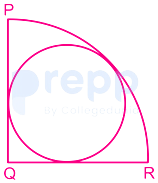
In the given figure, PQR is a quadrant whose radius is 7 cm. A circle is inscribed in the quadrant as shown in the figure. What is the area (in cm 2) of the circle?
In ΔABC, ∠A is a right angle. The length of AC and BC are 6 cm and 10 cm respectively. Point D is on AB such that BD = 4 cm. What is the length of CD?
If the radius of the circumcircle of an equilateral triangle is 8 cm, then the measure of radius of its incircle is:
The height of an equilateral triangle is 18 cm. Its area is:
In an equilateral triangle ABC, G is the centroid. Each side of the triangle is 6 cm. The length of AG is:
Important Questions from Plane Figures
- A rectangular grassy plot is 38 m long and 32 m wide. It has a gravel path of uniform width on the inside having an area of $600 \text{ m}^2$. The width of the path is:
- A river, 2 m deep and 45 m wide is flowing at the speed of 3 km per hour. The quantity of water that runs into the sea per minute is:
A regular hexagonal garden with each side measuring 14 metres is surrounded by a circular jogging track that has a radius of 21 metres from the centre of the hexagon. Find the sum of the perimeters of both shapes.
(Use $\pi = \frac{22}{7}$)- If a circle and a square have the same perimeter, then
What is the area of this parallelogram in sq.cm.? The measurements are in cms.