In ∆ABC, the perpendiculars drawn from A, B and C meet the opposite sides at points D, E and F, respectively. AD, BE and CF intersect at point P. If ∠EPD = 110° and the bisectors of ∠A and ∠B meet at point Q, then ∠AQB = ?
125°
This problem involves understanding the properties of a triangle, its altitudes and orthocenter, and its angle bisectors and incenter.
We are given a triangle \(\triangle ABC\) with altitudes \(AD\), \(BE\), and \(CF\). These altitudes intersect at the orthocenter, denoted as \(P\). We are given that \(\angle EPD = 110^\circ\). We are also told that the angle bisectors of \(\angle A\) and \(\angle B\) meet at point \(Q\), which is the incenter of the triangle.
Our goal is to find the measure of \(\angle AQB\).
Let's first use the information about the orthocenter \(P\) and the angle \(\angle EPD\).
Understanding the Orthocenter Angle
The orthocenter \(P\) is the intersection point of the altitudes. \(AD\) is perpendicular to \(BC\) (so \(\angle ADB = 90^\circ\) and \(\angle ADC = 90^\circ\)), and \(BE\) is perpendicular to \(AC\) (so \(\angle BEA = 90^\circ\) and \(\angle BEC = 90^\circ\)).
Consider the quadrilateral \(CEPD\). The sum of angles in a quadrilateral is \(360^\circ\). \(\angle PEC = 90^\circ\) (since \(BE\) is an altitude to \(AC\)) \(\angle PDC = 90^\circ\) (since \(AD\) is an altitude to \(BC\)) We are given \(\angle EPD = 110^\circ\). The fourth angle in quadrilateral \(CEPD\) is \(\angle ECD\), which is the same as \(\angle ACB\) or \(\angle C\).
So, in quadrilateral \(CEPD\):
\[ \angle PEC + \angle PDC + \angle EPD + \angle ECD = 360^\circ \] \[ 90^\circ + 90^\circ + 110^\circ + \angle C = 360^\circ \] \[ 290^\circ + \angle C = 360^\circ \] \[ \angle C = 360^\circ - 290^\circ \] \[ \angle C = 70^\circ \]Thus, the angle \(\angle C\) of triangle \(\triangle ABC\) is \(70^\circ\).
Alternatively, there is a property that the angle formed by two altitudes at the orthocenter (like \(\angle EPD\), which is formed by altitudes \(AD\) and \(BE\)) is supplementary to the angle of the triangle at the vertex from which the other altitude originates (in this case, \(\angle C\)). That is, \(\angle EPD = 180^\circ - \angle C\). Using this property:
\[ 110^\circ = 180^\circ - \angle C \] \[ \angle C = 180^\circ - 110^\circ \] \[ \angle C = 70^\circ \]Both methods give the same result for \(\angle C\).
Understanding the Incenter Angle
Point \(Q\) is the intersection of the angle bisectors of \(\angle A\) and \(\angle B\). This means \(Q\) is the incenter of \(\triangle ABC\).
The angle formed by the angle bisectors of two vertices (say \(\angle A\) and \(\angle B\)) at the incenter \(Q\) is related to the angle at the third vertex (\(\angle C\)) by the formula:
\[ \angle AQB = 90^\circ + \frac{\angle C}{2} \]Now we can substitute the value of \(\angle C = 70^\circ\) that we found:
\[ \angle AQB = 90^\circ + \frac{70^\circ}{2} \] \[ \angle AQB = 90^\circ + 35^\circ \] \[ \angle AQB = 125^\circ \]Therefore, the measure of \(\angle AQB\) is \(125^\circ\).
Summary of Steps:
- Identify that P is the orthocenter and Q is the incenter.
- Use the given orthocenter angle \(\angle EPD\) to find \(\angle C\) using the property \(\angle EPD = 180^\circ - \angle C\) (or by considering quadrilateral CEPD). We found \(\angle C = 70^\circ\).
- Use the property relating the incenter angle \(\angle AQB\) to \(\angle C\): \(\angle AQB = 90^\circ + \frac{\angle C}{2}\).
- Substitute the value of \(\angle C\) to calculate \(\angle AQB\). We found \(\angle AQB = 125^\circ\).
This matches one of the given options.
Revision Table: Key Concepts in Triangle Geometry
| Concept | Definition | Key Angle Property (relevant to this problem) |
|---|---|---|
| Altitude | A segment from a vertex perpendicular to the opposite side. | Meet at the Orthocenter. |
| Orthocenter (P) | The intersection point of the altitudes of a triangle. | Angle between altitudes from A and B = \(180^\circ - \angle C\). |
| Angle Bisector | A segment that divides a vertex angle into two equal angles. | Meet at the Incenter. |
| Incenter (Q) | The intersection point of the angle bisectors of a triangle. | Angle between angle bisectors of A and B = \(90^\circ + \frac{\angle C}{2}\). |
Additional Information on Triangle Centers
A triangle has several special points, called centers, formed by the intersection of specific lines:
- Orthocenter: Intersection of altitudes. The orthocenter's position depends on the triangle type (inside for acute, outside for obtuse, at the vertex for right-angled).
- Incenter: Intersection of angle bisectors. It is equidistant from the sides of the triangle and is the center of the inscribed circle (incircle). The incenter is always inside the triangle.
- Circumcenter: Intersection of perpendicular bisectors of the sides. It is equidistant from the vertices and is the center of the circumscribed circle (circumcircle). Its position depends on the triangle type.
- Centroid: Intersection of medians (lines from vertices to the midpoint of the opposite side). It is the triangle's center of mass. The centroid is always inside the triangle and divides each median in a 2:1 ratio.
The properties used in this problem, relating angles at the orthocenter and incenter to the angles of the triangle, are fundamental in triangle geometry.
Similar Questions
In a circle of diameter 20 cm, chords AB and CD are parallel to each other. BC is diameter. If AB is 6 cm from the centre of the circle, what is the length (in cm) of the chord CD?
In ΔABC, D and E are the points on sides AB and AC, respectively and DE ∥ BC. BC = 8 cm and DE = 5 cm. If the area of ΔADE = 45 cm 2, then what is the area (in cm 2) of ΔABC ?
A farmer's land is in the shape of a trapezium which has its parallel sides measuring 2.56 yards and 3.44 yards and the distance between the parallelsides in 1.44 yards. The cost of ploughing the land is Rs 1800 per square yard. What amount will (in Rs) have to be spent in order to plough the entire land?
In a trapezium ABCD, AB and CD are parallel sides and ∠ ADC = 90°. If AB = 15 cm, CD = 40 cm and diagonal AC = 41 cm. Then the area of the trapezium ABCD is
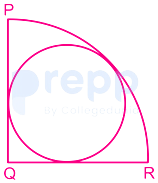
In the given figure, PQR is a quadrant whose radius is 7 cm. A circle is inscribed in the quadrant as shown in the figure. What is the area (in cm 2) of the circle?
In ΔABC, ∠A is a right angle. The length of AC and BC are 6 cm and 10 cm respectively. Point D is on AB such that BD = 4 cm. What is the length of CD?
If the radius of the circumcircle of an equilateral triangle is 8 cm, then the measure of radius of its incircle is:
The height of an equilateral triangle is 18 cm. Its area is:
The sides of a triangle are in the ratio 1/2 : 1/3 : 1/4 and its perimeter is 104 cm. The length of the longest side (in cm) is:
In an equilateral triangle ABC, G is the centroid. Each side of the triangle is 6 cm. The length of AG is:
Important Questions from Plane Figures
- A rectangular grassy plot is 38 m long and 32 m wide. It has a gravel path of uniform width on the inside having an area of $600 \text{ m}^2$. The width of the path is:
- A river, 2 m deep and 45 m wide is flowing at the speed of 3 km per hour. The quantity of water that runs into the sea per minute is:
A regular hexagonal garden with each side measuring 14 metres is surrounded by a circular jogging track that has a radius of 21 metres from the centre of the hexagon. Find the sum of the perimeters of both shapes.
(Use $\pi = \frac{22}{7}$)- If a circle and a square have the same perimeter, then
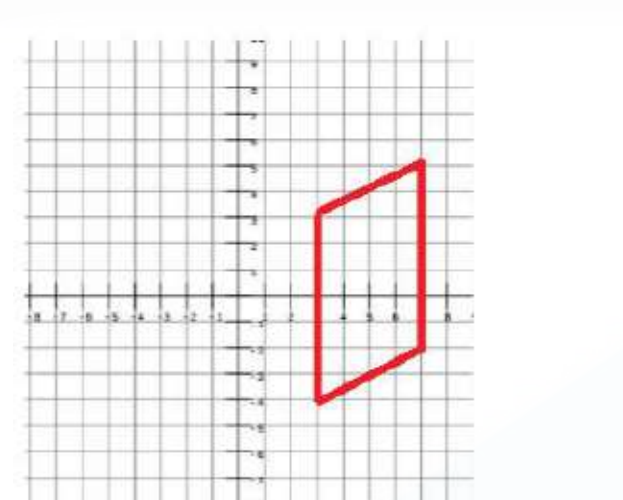
What is the area of this parallelogram in sq.cm.? The measurements are in cms.