In ΔABC, D and E are the points on sides AB and AC, respectively and DE ∥ BC. BC = 8 cm and DE = 5 cm. If the area of ΔADE = 45 cm 2, then what is the area (in cm 2) of ΔABC ?
115.2
Solving for Triangle Area Using Similar Triangles
The question asks us to find the area of ΔABC given that D and E are points on sides AB and AC respectively, DE is parallel to BC, the lengths of BC and DE are 8 cm and 5 cm respectively, and the area of ΔADE is 45 cm$^2$.
Understanding the Geometry: Parallel Lines and Similar Triangles
When a line segment connects two sides of a triangle and is parallel to the third side, it creates a smaller triangle that is similar to the original triangle. In this case, since DE ∥ BC, the line segment DE divides ΔABC such that ΔADE is similar to ΔABC.
Two triangles are similar if their corresponding angles are equal and their corresponding sides are proportional. Because DE ∥ BC:
- ∠ADE = ∠ABC (corresponding angles)
- ∠AED = ∠ACB (corresponding angles)
- ∠DAE = ∠BAC (common angle)
Therefore, by AAA similarity criterion, ΔADE ∼ ΔABC.
Ratio of Areas of Similar Triangles
A key property of similar triangles is that the ratio of their areas is equal to the square of the ratio of their corresponding sides.
For similar triangles ΔADE and ΔABC, the ratio of their areas is:
$$ \frac{\text{Area}(\Delta ADE)}{\text{Area}(\Delta ABC)} = \left(\frac{DE}{BC}\right)^2 = \left(\frac{AD}{AB}\right)^2 = \left(\frac{AE}{AC}\right)^2 $$
Calculating the Area of Triangle ABC
We are given the following information:
- DE = 5 cm
- BC = 8 cm
- Area(ΔADE) = 45 cm$^2$
Using the property of the ratio of areas of similar triangles, we have:
$$ \frac{\text{Area}(\Delta ADE)}{\text{Area}(\Delta ABC)} = \left(\frac{DE}{BC}\right)^2 $$
Substitute the given values into the equation:
$$ \frac{45}{\text{Area}(\Delta ABC)} = \left(\frac{5}{8}\right)^2 $$
Calculate the square of the ratio of the sides:
$$ \left(\frac{5}{8}\right)^2 = \frac{5^2}{8^2} = \frac{25}{64} $$
So, the equation becomes:
$$ \frac{45}{\text{Area}(\Delta ABC)} = \frac{25}{64} $$
Now, we need to solve for Area(ΔABC). We can do this by cross-multiplication or by rearranging the equation:
$$ \text{Area}(\Delta ABC) = 45 \times \frac{64}{25} $$
Simplify the expression:
$$ \text{Area}(\Delta ABC) = \frac{45 \times 64}{25} $$
We can simplify this by dividing 45 and 25 by their common factor, 5:
$$ \text{Area}(\Delta ABC) = \frac{(9 \times 5) \times 64}{(5 \times 5)} = \frac{9 \times 64}{5} $$
Now, calculate $9 \times 64$:
$$ 9 \times 64 = 576 $$
So, the area is:
$$ \text{Area}(\Delta ABC) = \frac{576}{5} $$
Finally, perform the division:
$$ 576 \div 5 = 115.2 $$
Thus, the area of ΔABC is 115.2 cm$^2$.
| Given Value | Value (cm or cm$^2$) |
|---|---|
| DE | 5 |
| BC | 8 |
| Area(ΔADE) | 45 |
| Ratio of sides (DE/BC) | $5/8$ |
| Ratio of areas ((DE/BC)$^2$) | $25/64$ |
| Calculated Area(ΔABC) | $115.2$ |
The area of ΔABC is 115.2 cm$^2$. This matches one of the provided options.
Revision Table: Key Concepts for Similar Triangles
| Concept | Description |
|---|---|
| Similar Triangles | Triangles with the same shape but possibly different sizes. Corresponding angles are equal, and corresponding sides are proportional. |
| DE ∥ BC Theorem | If a line is drawn parallel to one side of a triangle intersecting the other two sides, then it divides the two sides proportionally and forms a triangle similar to the original triangle. |
| Ratio of Areas | The ratio of the areas of two similar triangles is equal to the square of the ratio of their corresponding sides. If $\Delta ABC \sim \Delta XYZ$, then $\frac{\text{Area}(\Delta ABC)}{\text{Area}(\Delta XYZ)} = \left(\frac{AB}{XY}\right)^2 = \left(\frac{BC}{YZ}\right)^2 = \left(\frac{AC}{XZ}\right)^2$. |
Additional Information: Applications of Similar Triangles
Similar triangles are a fundamental concept in geometry and have many practical applications. Understanding their properties, especially the relationship between side lengths and areas, is crucial for solving various problems.
- Scaling and Proportions: Similar triangles are used in architecture, engineering, and cartography for scaling maps, blueprints, and models.
- Indirect Measurement: You can use similar triangles to find the height of tall objects (like trees or buildings) or the distance across objects (like rivers) that are difficult to measure directly. This involves setting up a similar triangle whose measurements are accessible.
- Trigonometry Basis: The trigonometric ratios (sine, cosine, tangent) are defined based on the properties of similar right triangles. For any given angle, the ratio of sides in a right triangle is constant, regardless of the triangle's size.
- Geometric Proofs: Similar triangles are frequently used as tools in proving other geometric theorems.
Mastering the properties of similar triangles, including the area ratio theorem used in this problem, is essential for success in geometry.
Similar Questions
In ∆ABC, the perpendiculars drawn from A, B and C meet the opposite sides at points D, E and F, respectively. AD, BE and CF intersect at point P. If ∠EPD = 110° and the bisectors of ∠A and ∠B meet at point Q, then ∠AQB = ?
In a circle of diameter 20 cm, chords AB and CD are parallel to each other. BC is diameter. If AB is 6 cm from the centre of the circle, what is the length (in cm) of the chord CD?
A farmer's land is in the shape of a trapezium which has its parallel sides measuring 2.56 yards and 3.44 yards and the distance between the parallelsides in 1.44 yards. The cost of ploughing the land is Rs 1800 per square yard. What amount will (in Rs) have to be spent in order to plough the entire land?
In a trapezium ABCD, AB and CD are parallel sides and ∠ ADC = 90°. If AB = 15 cm, CD = 40 cm and diagonal AC = 41 cm. Then the area of the trapezium ABCD is
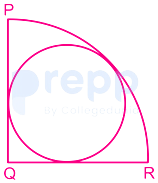
In the given figure, PQR is a quadrant whose radius is 7 cm. A circle is inscribed in the quadrant as shown in the figure. What is the area (in cm 2) of the circle?
In ΔABC, ∠A is a right angle. The length of AC and BC are 6 cm and 10 cm respectively. Point D is on AB such that BD = 4 cm. What is the length of CD?
If the radius of the circumcircle of an equilateral triangle is 8 cm, then the measure of radius of its incircle is:
The height of an equilateral triangle is 18 cm. Its area is:
The sides of a triangle are in the ratio 1/2 : 1/3 : 1/4 and its perimeter is 104 cm. The length of the longest side (in cm) is:
In an equilateral triangle ABC, G is the centroid. Each side of the triangle is 6 cm. The length of AG is:
Important Questions from Plane Figures
- A rectangular grassy plot is 38 m long and 32 m wide. It has a gravel path of uniform width on the inside having an area of $600 \text{ m}^2$. The width of the path is:
- A river, 2 m deep and 45 m wide is flowing at the speed of 3 km per hour. The quantity of water that runs into the sea per minute is:
A regular hexagonal garden with each side measuring 14 metres is surrounded by a circular jogging track that has a radius of 21 metres from the centre of the hexagon. Find the sum of the perimeters of both shapes.
(Use $\pi = \frac{22}{7}$)- If a circle and a square have the same perimeter, then
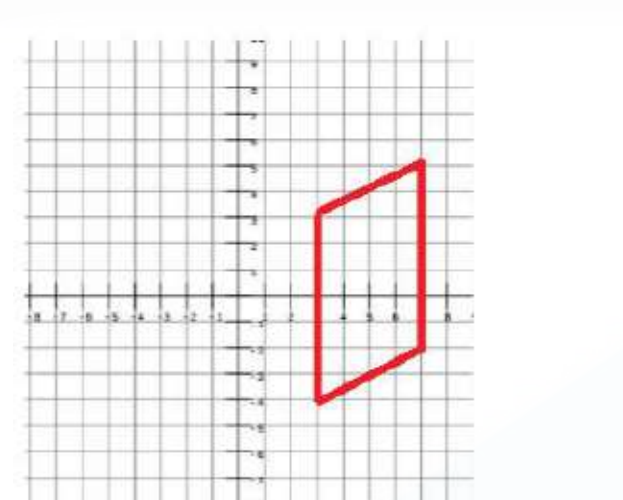
What is the area of this parallelogram in sq.cm.? The measurements are in cms.