In a trapezium ABCD, AB and CD are parallel sides and ∠ ADC = 90°. If AB = 15 cm, CD = 40 cm and diagonal AC = 41 cm. Then the area of the trapezium ABCD is
247.5 cm2
Calculating the Area of Trapezium ABCD
We are given a trapezium ABCD where sides AB and CD are parallel to each other (\(\text{AB} \parallel \text{CD}\)). We are also given that \(\angle \text{ADC} = 90^\circ\). This is a right trapezium, meaning that the side AD is perpendicular to both parallel sides AB and CD. Therefore, AD represents the height (h) of the trapezium.
We are provided with the following lengths:
- Length of parallel side AB = 15 cm
- Length of parallel side CD = 40 cm
- Length of diagonal AC = 41 cm
Finding the Height of the Trapezium
Since \(\angle \text{ADC} = 90^\circ\), triangle ADC is a right-angled triangle with the right angle at D. We can use the Pythagorean theorem in \(\triangle \text{ADC}\) to find the length of AD, which is the height of the trapezium.
The Pythagorean theorem states that in a right-angled triangle, the square of the hypotenuse (the side opposite the right angle) is equal to the sum of the squares of the other two sides.
In \(\triangle \text{ADC}\):
- Hypotenuse = AC = 41 cm
- One leg = CD = 40 cm
- Other leg = AD (which is the height, h)
According to the Pythagorean theorem:
\begin{equation*} \text{AD}^2 + \text{CD}^2 = \text{AC}^2 \end{equation*}
Substituting the given values:
\begin{equation*} \text{AD}^2 + (40 \, \text{cm})^2 = (41 \, \text{cm})^2 \end{equation*}
\begin{equation*} \text{AD}^2 + 1600 \, \text{cm}^2 = 1681 \, \text{cm}^2 \end{equation*}
Now, we solve for \(\text{AD}^2\):
\begin{equation*} \text{AD}^2 = 1681 \, \text{cm}^2 - 1600 \, \text{cm}^2 \end{equation*}
\begin{equation*} \text{AD}^2 = 81 \, \text{cm}^2 \end{equation*}
Taking the square root of both sides to find AD:
\begin{equation*} \text{AD} = \sqrt{81 \, \text{cm}^2} \end{equation*}
\begin{equation*} \text{AD} = 9 \, \text{cm} \end{equation*}
So, the height of the trapezium ABCD is 9 cm.
Calculating the Area of the Trapezium
The formula for the area of a trapezium is:
\begin{equation*} \text{Area} = \frac{1}{2} \times (\text{Sum of parallel sides}) \times \text{Height} \end{equation*}
In this case, the parallel sides are AB and CD, and the height is AD.
\begin{equation*} \text{Area} = \frac{1}{2} \times (\text{AB} + \text{CD}) \times \text{AD} \end{equation*}
Substituting the values AB = 15 cm, CD = 40 cm, and AD = 9 cm:
\begin{equation*} \text{Area} = \frac{1}{2} \times (15 \, \text{cm} + 40 \, \text{cm}) \times 9 \, \text{cm} \end{equation*}
\begin{equation*} \text{Area} = \frac{1}{2} \times (55 \, \text{cm}) \times 9 \, \text{cm} \end{equation*}
\begin{equation*} \text{Area} = \frac{1}{2} \times 495 \, \text{cm}^2 \end{equation*}
\begin{equation*} \text{Area} = 247.5 \, \text{cm}^2 \end{equation*}
Thus, the area of the trapezium ABCD is 247.5 cm2.
Revision Table: Trapezium Area Calculation
| Given Information | Calculated Information | Formula Used | Result |
|---|---|---|---|
| AB = 15 cm | Height (AD) | Pythagorean Theorem | AD = 9 cm |
| CD = 40 cm | Area of Trapezium | Area = \(\frac{1}{2}(a+b)h\) | Area = 247.5 cm2 |
| AC = 41 cm | |||
| \(\angle\)ADC = 90° | |||
| AB || CD |
Additional Information: Understanding Right Trapeziums and Area
A trapezium (or trapezoid in some regions) is a quadrilateral with at least one pair of parallel sides. The parallel sides are called bases, and the non-parallel sides are called legs.
A right trapezium is a trapezium in which at least one of the non-parallel sides is perpendicular to the parallel sides. In this question, side AD is perpendicular to both AB and CD because \(\angle \text{ADC} = 90^\circ\). This makes AD the height of the trapezium.
The area of any trapezium can be calculated using the formula:
\begin{equation*} \text{Area} = \frac{1}{2} \times (\text{sum of lengths of parallel sides}) \times (\text{height}) \end{equation*}
The height is the perpendicular distance between the two parallel sides.
The Pythagorean theorem is a fundamental concept in geometry that applies to right-angled triangles. It states that if 'a' and 'b' are the lengths of the legs of a right triangle and 'c' is the length of the hypotenuse, then \(a^2 + b^2 = c^2\). This theorem was crucial here to find the missing height using the diagonal and one base length.
Similar Questions
In ∆ABC, the perpendiculars drawn from A, B and C meet the opposite sides at points D, E and F, respectively. AD, BE and CF intersect at point P. If ∠EPD = 110° and the bisectors of ∠A and ∠B meet at point Q, then ∠AQB = ?
In a circle of diameter 20 cm, chords AB and CD are parallel to each other. BC is diameter. If AB is 6 cm from the centre of the circle, what is the length (in cm) of the chord CD?
In ΔABC, D and E are the points on sides AB and AC, respectively and DE ∥ BC. BC = 8 cm and DE = 5 cm. If the area of ΔADE = 45 cm 2, then what is the area (in cm 2) of ΔABC ?
A farmer's land is in the shape of a trapezium which has its parallel sides measuring 2.56 yards and 3.44 yards and the distance between the parallelsides in 1.44 yards. The cost of ploughing the land is Rs 1800 per square yard. What amount will (in Rs) have to be spent in order to plough the entire land?
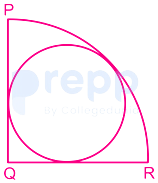
In the given figure, PQR is a quadrant whose radius is 7 cm. A circle is inscribed in the quadrant as shown in the figure. What is the area (in cm 2) of the circle?
In ΔABC, ∠A is a right angle. The length of AC and BC are 6 cm and 10 cm respectively. Point D is on AB such that BD = 4 cm. What is the length of CD?
If the radius of the circumcircle of an equilateral triangle is 8 cm, then the measure of radius of its incircle is:
The height of an equilateral triangle is 18 cm. Its area is:
The sides of a triangle are in the ratio 1/2 : 1/3 : 1/4 and its perimeter is 104 cm. The length of the longest side (in cm) is:
In an equilateral triangle ABC, G is the centroid. Each side of the triangle is 6 cm. The length of AG is:
Important Questions from Plane Figures
- A rectangular grassy plot is 38 m long and 32 m wide. It has a gravel path of uniform width on the inside having an area of $600 \text{ m}^2$. The width of the path is:
- A river, 2 m deep and 45 m wide is flowing at the speed of 3 km per hour. The quantity of water that runs into the sea per minute is:
A regular hexagonal garden with each side measuring 14 metres is surrounded by a circular jogging track that has a radius of 21 metres from the centre of the hexagon. Find the sum of the perimeters of both shapes.
(Use $\pi = \frac{22}{7}$)- If a circle and a square have the same perimeter, then
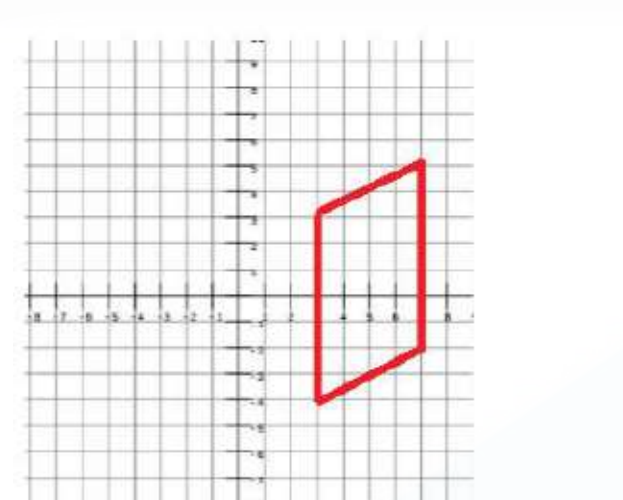
What is the area of this parallelogram in sq.cm.? The measurements are in cms.