
Calculating Rectangular Plot Gravel Path Width
The problem involves finding the uniform width of a gravel path inside a rectangular grassy plot given the plot dimensions and the path's area.
1. Initial Information
- Outer Rectangle (Grassy Plot) Length ($L$): 38 m
- Outer Rectangle Width ($W$): 32 m
- Area of the Gravel Path ($A_{path}$): $600 \text{ m}^2$
- Let the uniform width of the path be $x$ meters.
2. Dimensions of the Inner Rectangle
The path is inside the plot, so the inner dimensions (the grassy area excluding the path) are reduced by $2x$ (width $x$ on both sides).
- Inner Length ($l$): $L - 2x = 38 - 2x$ m
- Inner Width ($w$): $W - 2x = 32 - 2x$ m
For the inner dimensions to be valid, $38 - 2x > 0$ and $32 - 2x > 0$, which means $2x < 32$, or $x < 16$ m.
3. Area Calculation
The area of the outer rectangle ($A_{outer}$) is $L \times W$. The area of the inner rectangle ($A_{inner}$) is $l \times w$. The area of the path is the difference between these two areas.
Outer Area:
$A_{outer} = 38 \times 32 = 1216 \text{ m}^2$Inner Area:
$A_{inner} = (38 - 2x)(32 - 2x)$Path Area Equation:
$A_{path} = A_{outer} - A_{inner}$ $600 = 1216 - (38 - 2x)(32 - 2x)$4. Solving the Equation
Substitute the expression for $A_{inner}$:
$600 = 1216 - (1216 - 76x - 64x + 4x^2)$ $600 = 1216 - 1216 + 76x + 64x - 4x^2$ $600 = 140x - 4x^2$Rearrange into a standard quadratic equation ($ax^2 + bx + c = 0$):
$4x^2 - 140x + 600 = 0$Divide the entire equation by 4 to simplify:
$x^2 - 35x + 150 = 0$Factor the quadratic equation:
$(x - 5)(x - 30) = 0$This gives two possible values for $x$:
$x = 5$ or $x = 30$5. Final Answer Determination
We must consider the physical constraint that the width of the path cannot be larger than half of the plot's width. As determined earlier, $x < 16$ m.
- $x = 30$ m is not a valid solution because it is greater than 16 m.
- $x = 5$ m is a valid solution as it is less than 16 m.
Therefore, the width of the path is 5 m.
Important Questions from Plane Figures
- A river, 2 m deep and 45 m wide is flowing at the speed of 3 km per hour. The quantity of water that runs into the sea per minute is:
A regular hexagonal garden with each side measuring 14 metres is surrounded by a circular jogging track that has a radius of 21 metres from the centre of the hexagon. Find the sum of the perimeters of both shapes.
(Use $\pi = \frac{22}{7}$)- If a circle and a square have the same perimeter, then
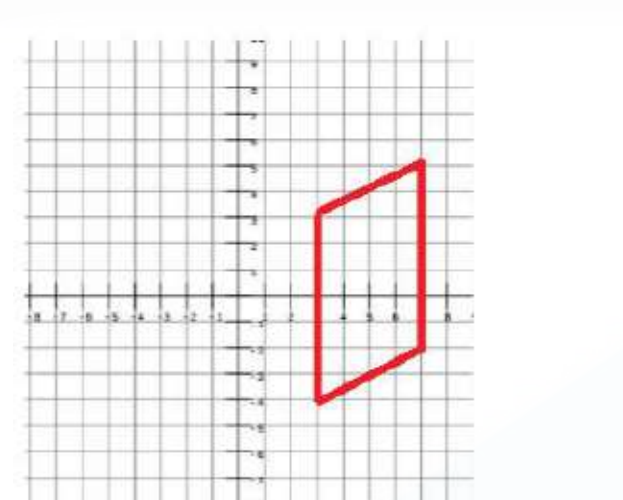
What is the area of this parallelogram in sq.cm.? The measurements are in cms.
- Two plates with diameters 3.5 cm and 2.5 cm are kept one above the other. The larger plate is placed at the bottom. What is the total area of the larger plate in sq. cm. that is visible?


