
Plate Dimensions and Visible Area
The question requires calculating the visible surface area of the bottom plate when a smaller plate is placed on top. This visible area is the total area of the larger plate minus the portion covered by the smaller plate.
Given Plate Measurements
- Larger plate diameter: $d_1 = 3.5$ cm
- Smaller plate diameter: $d_2 = 2.5$ cm
Calculate Plate Radii
Convert the diameters to radii using the formula $r = \frac{d}{2}$:
- Larger plate radius: $r_1 = \frac{3.5 \text{ cm}}{2} = 1.75$ cm
- Smaller plate radius: $r_2 = \frac{2.5 \text{ cm}}{2} = 1.25$ cm
Calculate Plate Areas
Use the area formula for a circle, $A = \pi r^2$, to find the area of each plate:
- Area of the larger plate: $A_1 = \pi r_1^2 = \pi (1.75)^2 = \pi(3.0625)$ sq. cm.
- Area of the smaller plate: $A_2 = \pi r_2^2 = \pi (1.25)^2 = \pi(1.5625)$ sq. cm.
Determine Visible Area of Larger Plate
Since the smaller plate covers part of the larger plate, the visible area is the difference between their areas:
Visible Area $= A_1 - A_2$
Visible Area $= \pi(3.0625) - \pi(1.5625)$
Visible Area $= \pi(3.0625 - 1.5625)$
Visible Area $= \pi(1.5)$
Visible Area $= 1.5\pi$ sq. cm.
Similar Questions
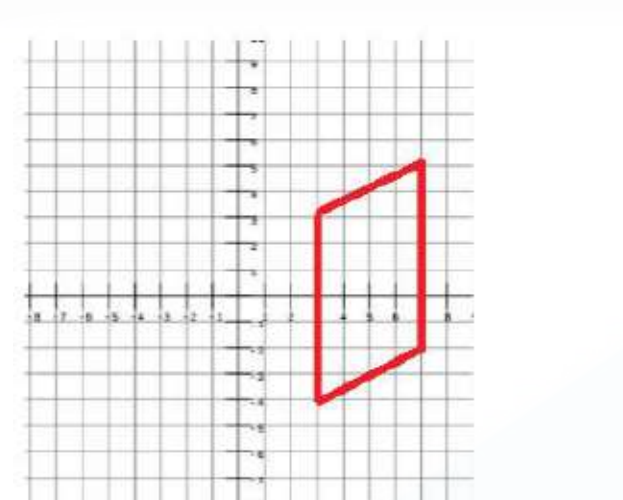
What is the area of this parallelogram in sq.cm.? The measurements are in cms.
Important Questions from Plane Figures
A wheel makes 4000 revolution is covering a distance of 60 km. The radius of the wheel is:
A person bought a rectangular piece of land whose length and breadth are in the ratio 7 : 5. If the cost of fencing the land is ₹2,880 at the rate of ₹15/m, then what is the length of the land?
If the diameter of a circle increases by 15%, then what will be the percentage increase in its area?
The areas of two squares are 16 : 9. The ratio of their perimeter is:
A square with maximum possible side is drawn in a circle of radius 12 cm. What is the area of square?



