
Calculate Square Area from Diagonal
To find the area of a square given its diagonal, we can use a direct formula derived from the Pythagorean theorem.
Square Properties and Formula
Let 's' be the side length of the square and 'd' be the diagonal length. In a square, the diagonal divides it into two right-angled isosceles triangles. Applying the Pythagorean theorem (\(a^2 + b^2 = c^2\)):
- \(s^2 + s^2 = d^2\)
- \(2s^2 = d^2\)
The area of the square (A) is \(s^2\). Substituting A into the equation:
- \(2A = d^2\)
- \(A = \frac{d^2}{2}\)
Area Calculation
Given the diagonal \(d = 4\) cm:
- Substitute the value of the diagonal into the formula: \(A = \frac{(4 \text{ cm})^2}{2}\)
- Calculate the square of the diagonal: \(A = \frac{16 \text{ cm}^2}{2}\)
- Compute the final area: \(A = 8 \text{ cm}^2\)
Therefore, the area of the square is 8 cm\(^2\).
Similar Questions
What is the area of this parallelogram in sq.cm.? The measurements are in cms.
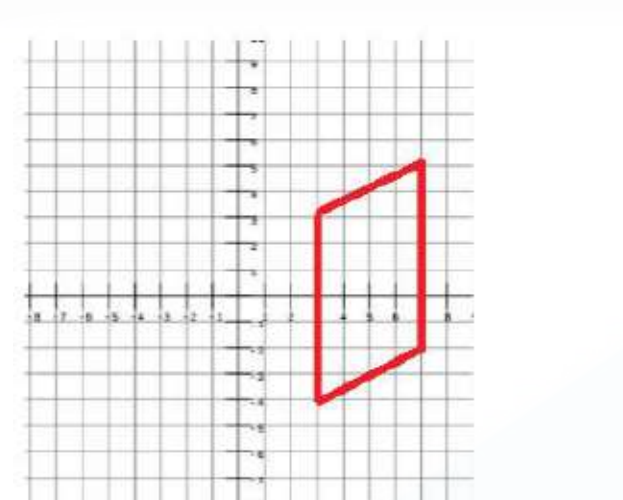
- Two plates with diameters 3.5 cm and 2.5 cm are kept one above the other. The larger plate is placed at the bottom. What is the total area of the larger plate in sq. cm. that is visible?
Important Questions from Plane Figures
A wheel makes 4000 revolution is covering a distance of 60 km. The radius of the wheel is:
A person bought a rectangular piece of land whose length and breadth are in the ratio 7 : 5. If the cost of fencing the land is ₹2,880 at the rate of ₹15/m, then what is the length of the land?
If the diameter of a circle increases by 15%, then what will be the percentage increase in its area?
The areas of two squares are 16 : 9. The ratio of their perimeter is:
A square with maximum possible side is drawn in a circle of radius 12 cm. What is the area of square?



