The height of an equilateral triangle is 18 cm. Its area is:
108√3 sq. cm.
Understanding the properties of an equilateral triangle is key to solving this problem. An equilateral triangle has all three sides equal in length, and all three internal angles equal to 60 degrees.
We are given the height of the equilateral triangle is 18 cm. We need to find its area.
Finding the Side Length of the Equilateral Triangle
The height of an equilateral triangle creates two 30-60-90 right-angled triangles. The height is opposite the 60-degree angle, and half of the base (which is half of the side of the equilateral triangle) is opposite the 30-degree angle. The relationship between the height (\(h\)) and the side (\(s\)) of an equilateral triangle is given by the formula:
\( h = \frac{\sqrt{3}}{2} \times s \)
We are given \( h = 18 \) cm. We can use this to find the side length \( s \).
\( 18 = \frac{\sqrt{3}}{2} \times s \)
To find \( s \), we rearrange the formula:
\( s = 18 \times \frac{2}{\sqrt{3}} \)
\( s = \frac{36}{\sqrt{3}} \)
To remove the square root from the denominator (rationalize), we multiply the numerator and the denominator by \(\sqrt{3}\):
\( s = \frac{36}{\sqrt{3}} \times \frac{\sqrt{3}}{\sqrt{3}} \)
\( s = \frac{36\sqrt{3}}{3} \)
\( s = 12\sqrt{3} \) cm
So, the side length of the equilateral triangle is \( 12\sqrt{3} \) cm.
Calculating the Area of the Equilateral Triangle
The formula for the area of an equilateral triangle with side length \( s \) is:
\( \text{Area} = \frac{\sqrt{3}}{4} \times s^2 \)
Now we substitute the side length \( s = 12\sqrt{3} \) cm into the area formula:
\( \text{Area} = \frac{\sqrt{3}}{4} \times (12\sqrt{3})^2 \)
First, let's calculate \( (12\sqrt{3})^2 \):
\( (12\sqrt{3})^2 = (12 \times \sqrt{3}) \times (12 \times \sqrt{3}) \)
\( (12\sqrt{3})^2 = 12 \times 12 \times \sqrt{3} \times \sqrt{3} \)
\( (12\sqrt{3})^2 = 144 \times 3 \)
\( (12\sqrt{3})^2 = 432 \)
Now substitute this back into the area formula:
\( \text{Area} = \frac{\sqrt{3}}{4} \times 432 \)
\( \text{Area} = \frac{432\sqrt{3}}{4} \)
Divide 432 by 4:
\( \text{Area} = 108\sqrt{3} \)
The unit of the area will be square centimeters (sq. cm) because the height was given in centimeters.
Thus, the area of the equilateral triangle is \( 108\sqrt{3} \) sq. cm.
Comparing with Options
Let's look at the given options:
- Option 1: \(36\sqrt{3}\) sq. m. (Incorrect unit)
- Option 2: \(108\sqrt{3}\) sq. cm. (Matches our result)
- Option 3: 108 sq. cm. (Does not match our result)
- Option 4: \(96\sqrt{3}\) sq. m. (Incorrect unit)
Our calculated area, \( 108\sqrt{3} \) sq. cm, matches Option 2.
| Concept | Formula | Value (for this problem) |
|---|---|---|
| Height of Equilateral Triangle | \( h = \frac{\sqrt{3}}{2} s \) | 18 cm |
| Side of Equilateral Triangle | \( s = \frac{2h}{\sqrt{3}} \) | \( 12\sqrt{3} \) cm |
| Area of Equilateral Triangle | \( \text{Area} = \frac{\sqrt{3}}{4} s^2 \) | \( 108\sqrt{3} \) sq. cm |
Revision Table: Equilateral Triangle Formulas
| Property | Formula (in terms of side \(s\)) | Formula (in terms of height \(h\)) |
|---|---|---|
| Side Length | \( s \) | \( s = \frac{2h}{\sqrt{3}} \) |
| Height | \( h = \frac{\sqrt{3}}{2} s \) | \( h \) |
| Area | \( \text{Area} = \frac{\sqrt{3}}{4} s^2 \) | \( \text{Area} = \frac{h^2}{\sqrt{3}} \) |
| Perimeter | \( 3s \) | \( \frac{6h}{\sqrt{3}} = 2\sqrt{3}h \) |
Additional Information: Geometry of Equilateral Triangles
Equilateral triangles are a special type of triangle with many unique properties. Because all sides are equal, all angles are also equal, each measuring 60 degrees.
- Symmetry: Equilateral triangles have high rotational and reflectional symmetry. There are three lines of symmetry, and it has rotational symmetry of order 3.
- Centroid, Orthocenter, Circumcenter, Incenter: In an equilateral triangle, the centroid, orthocenter, circumcenter, and incenter all coincide at the same point. This point divides the medians (which are also altitudes and angle bisectors) in a 2:1 ratio.
- Relationship between height and side: The formula \( h = \frac{\sqrt{3}}{2} s \) is derived directly from the Pythagorean theorem applied to one of the 30-60-90 triangles formed by the height. If the hypotenuse is \( s \), the short leg is \( s/2 \), and the long leg (height) is \(\sqrt{3} \times (s/2)\).
- Area derivation: The area formula \( \text{Area} = \frac{\sqrt{3}}{4} s^2 \) can be derived from the general triangle area formula \( \text{Area} = \frac{1}{2} \times \text{base} \times \text{height} \). Using base \( s \) and height \( h = \frac{\sqrt{3}}{2} s \), we get \( \text{Area} = \frac{1}{2} \times s \times \frac{\sqrt{3}}{2} s = \frac{\sqrt{3}}{4} s^2 \). Alternatively, using the formula \( \text{Area} = \frac{1}{2}ab \sin C \) with \( a=b=s \) and \( C=60^\circ \), we get \( \text{Area} = \frac{1}{2} s^2 \sin 60^\circ = \frac{1}{2} s^2 \frac{\sqrt{3}}{2} = \frac{\sqrt{3}}{4} s^2 \).
Similar Questions
In ∆ABC, the perpendiculars drawn from A, B and C meet the opposite sides at points D, E and F, respectively. AD, BE and CF intersect at point P. If ∠EPD = 110° and the bisectors of ∠A and ∠B meet at point Q, then ∠AQB = ?
In a circle of diameter 20 cm, chords AB and CD are parallel to each other. BC is diameter. If AB is 6 cm from the centre of the circle, what is the length (in cm) of the chord CD?
In ΔABC, D and E are the points on sides AB and AC, respectively and DE ∥ BC. BC = 8 cm and DE = 5 cm. If the area of ΔADE = 45 cm 2, then what is the area (in cm 2) of ΔABC ?
A farmer's land is in the shape of a trapezium which has its parallel sides measuring 2.56 yards and 3.44 yards and the distance between the parallelsides in 1.44 yards. The cost of ploughing the land is Rs 1800 per square yard. What amount will (in Rs) have to be spent in order to plough the entire land?
In a trapezium ABCD, AB and CD are parallel sides and ∠ ADC = 90°. If AB = 15 cm, CD = 40 cm and diagonal AC = 41 cm. Then the area of the trapezium ABCD is
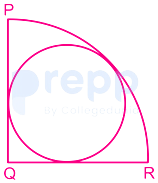
In the given figure, PQR is a quadrant whose radius is 7 cm. A circle is inscribed in the quadrant as shown in the figure. What is the area (in cm 2) of the circle?
In ΔABC, ∠A is a right angle. The length of AC and BC are 6 cm and 10 cm respectively. Point D is on AB such that BD = 4 cm. What is the length of CD?
If the radius of the circumcircle of an equilateral triangle is 8 cm, then the measure of radius of its incircle is:
The sides of a triangle are in the ratio 1/2 : 1/3 : 1/4 and its perimeter is 104 cm. The length of the longest side (in cm) is:
In an equilateral triangle ABC, G is the centroid. Each side of the triangle is 6 cm. The length of AG is:
Important Questions from Plane Figures
- A rectangular grassy plot is 38 m long and 32 m wide. It has a gravel path of uniform width on the inside having an area of $600 \text{ m}^2$. The width of the path is:
- A river, 2 m deep and 45 m wide is flowing at the speed of 3 km per hour. The quantity of water that runs into the sea per minute is:
A regular hexagonal garden with each side measuring 14 metres is surrounded by a circular jogging track that has a radius of 21 metres from the centre of the hexagon. Find the sum of the perimeters of both shapes.
(Use $\pi = \frac{22}{7}$)- If a circle and a square have the same perimeter, then
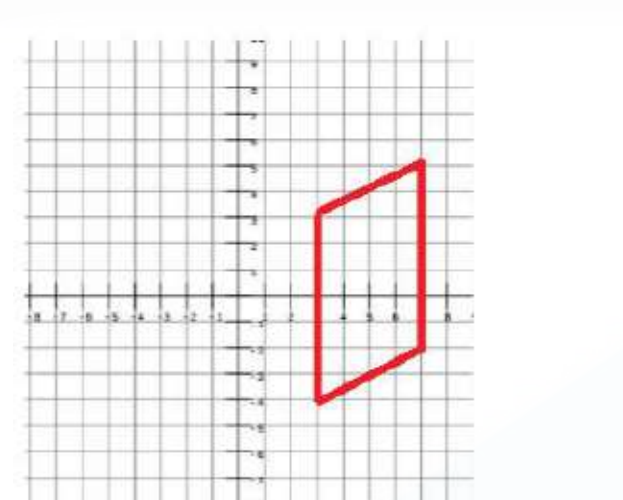
What is the area of this parallelogram in sq.cm.? The measurements are in cms.