The secular determinant for a heteronuclear diatomic molecule is :
(αA - E) (αB - E) - β2 = 0
The decisive feature is the word heteronuclear, and it turns on the Coulomb integrals.
The two atoms are different, so their Coulomb integrals must differ. In a heteronuclear molecule A-B the atoms have different electronegativities and therefore different atomic orbital energies, written \(\alpha_A\) and \(\alpha_B\). Any expression using a single \(\alpha\) and squaring the term \((\alpha - E)^{2}\) describes a homonuclear molecule, where the two atoms are identical. That immediately eliminates the two options written that way.
The secular determinant is
\(\begin{vmatrix} \alpha_A - E & \beta \\ \beta & \alpha_B - E \end{vmatrix} = 0\),
which expands to \((\alpha_A - E)(\alpha_B - E) - \beta^{2} = 0\).
The overlap integral is neglected here. In the general treatment the off-diagonal elements are \(\beta - ES\), because the two atomic orbitals are not orthogonal. But the standard Hückel (zero-overlap) approximation sets \(S = 0\), reducing those elements to a bare \(\beta\). This is the usual convention in which secular determinants are quoted, and it is the form required here.
Solving the resulting quadratic gives two roots — one below both \(\alpha_A\) and \(\alpha_B\) (bonding) and one above both (antibonding).
The consequence of \(\alpha_A \ne \alpha_B\) is chemically important: the molecular orbitals are unequally weighted. The bonding MO resembles the orbital of the more electronegative atom and the antibonding MO resembles the other, and that unequal mixing is precisely what produces bond polarity. The larger the gap between \(\alpha_A\) and \(\alpha_B\), the more ionic the bond and the weaker the covalent interaction.
Hence the secular determinant is (αA - E)(αB - E) - β2 = 0.
Similar Questions
The species that contain a vacant d x2 - y2 orbital is :
FeCl2 . 4H2O and FeCl3 . 6H2O can be distinguished by 57Fe Mössbauer spectroscopy. The INCORRECT statement from the following is :
The solutions of
(i) [Cr(OH2)6]3+ ions are pale blue-green, but the chromite ion
(ii) [CrO4]2- is an intense yellow due to :
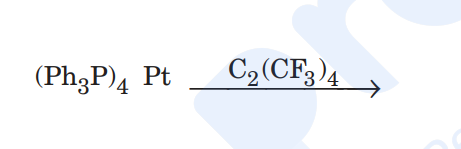
The major product of the following reaction in :
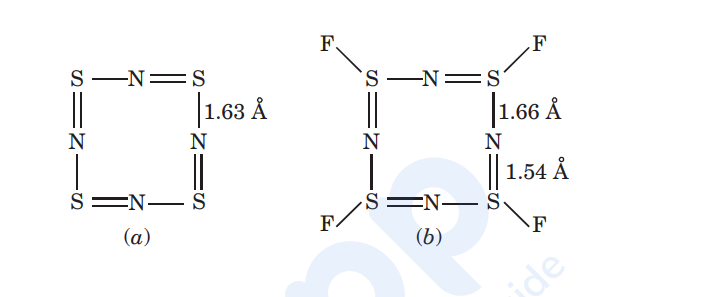
The structures of tetrasulphur tetranitride (a) and tetrathiazyl tetrafluoride (b) are given below. The statement that correctly describes the structures is :
In an axially symmetric field, the first NQR transition energy for I = $\frac{3}{2}$ is :
In the 19F NMR spectrum of ClF3, the number of signals and multiplicity at room temperature are (19F; I = \(\tfrac{1}{2}\)) :
Between NF3 and NH3 :
Identify (X) and (Y) in the following transformation :

The oxyacids of sulphur having direct S-S bonds are :
Important Questions from Structure of Atom
According to J.J. Thomson model of atom, positive charge is - Idenfity
- How many moles of He atoms are present in its 20 u mass ?
Which of the following electron transition in hydrogen atom will require largest amount of energy?
A species having 8 electrons in the third shell is very reactive while the other species having 8 electrons in the third shell is very inactive they are :
Which of the following is the general formula for saturated hydrocarbons?