
The Telephone Model of Communication was first developed in the area of
Information theory
The Telephone Model of Communication is another name for the Shannon and Weaver model, sometimes also called the transmission model or the mathematical model of communication.
It was developed in 1948 to 1949 by Claude Shannon, an engineer at Bell Telephone Laboratories, with Warren Weaver. Shannon's concern was a strictly technical one: how to send a signal through a telephone cable so that what arrives at the far end resembles what was sent. His paper A Mathematical Theory of Communication founded the discipline of information theory, and that is the area in which this model originated.
The model's structure reflects its telephone origins directly. An information source produces a message, a transmitter encodes it into a signal, the signal travels through a channel where noise may distort it, a receiver decodes it, and it reaches a destination. The mouthpiece is the transmitter, the cable is the channel, the earpiece is the receiver.
Its lasting contribution to communication studies is the concept of noise, and its best known limitation is that it is linear: it treats communication as a one way flow and has no place for feedback, which later circular models supplied.
Technological theory is not a recognised field in which this model was framed, though the model is certainly technological in inspiration. Dispersion theory and minimal effects theory belong to media effects research - minimal effects being the finding that mass media influence audiences less directly than was once assumed - and neither produced this model.
Hence the Telephone Model was first developed in the area of information theory.
Similar Questions
Given below are two statements:
Statement I : The linear model of communication is used for generating intentional results.
Statement II : The linear model of communication was the basis of propaganda during the World War II.
In the light of the above statements, choose the correct answer from the options given below:
Swapping of encoder-decoder roles in communication happens due to
In the communication process, signs derive meanings through:
Match the following.
Set – I (Communication elements) Set – II (Description of process part) (a) Sender (i) Brain (b) Receiver (iv) Sensory organs (c) Message (ii) Electro-magnetic impulses (d) Medium (iii) The central nervous system
Choose the correct answer from the options given below:Choose the correct sequence of communication from the options given below:
In a classroom situation, a teacher organizes group discussion to help arrive at a solution of a problem. In terms of a model of communication used, it will be called
Which of the following sequence correctly depicts the linear communication model between teacher and students.
Signs are considered as secondary products of :
Find the odd one from below:
Feedback makes the classroom communication process:
(a) Linear
(b) Circular
(c) Complete
(d) Interactive
(e) Disorganized
Important Questions from Process of Communication
- Arrnage the steps of message development in sequential order:
A. Encoding message
B. Transmission message
C. Formulation of meaning
D. Submitting message
E. Development of message
Choose the correct answer from the options given below: - Arrange the elements of Westley and MacLean Model in sequential order:
A. Feedback
B. Senders Sensory experience
C. Environment
D. Message to the reciever
E. Gate keeper who controls the flow of information
Choose the correct answer from the options given below: The faces of a cube are numbered 1 to 6. Four different positions of the cube are shown below :
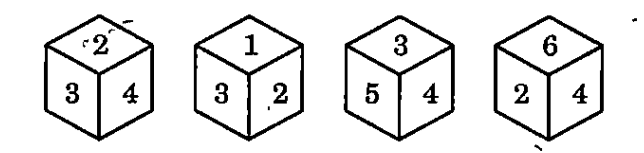
The number on the face opposite to 2 is:- Communication can be seen as processes of information transmission governed by three levels of semiotic rules:
- Which one of the following models use only three elements to explain the process of communication ?



