
In the classroom, the teacher sends the message either as words or images. The students are really
Decoders
The answer follows from the direction in which the message is travelling in the situation described.
Encoding is the work of the sender. It means converting an idea into a form that can be transmitted - words, images, gestures, symbols. In the situation given it is the teacher who does this: the teacher has something to convey and puts it into words or images.
Decoding is the work of the receiver. It means taking the signals that arrive and extracting meaning from them. The students hear the words or see the images and must interpret them to arrive at the idea the teacher intended. They are therefore the decoders.
Whether decoding succeeds depends on how far teacher and students share the same code - the same language, the same technical vocabulary, the same frame of reference. Where they do not, the message received differs from the message sent, which is one of the standard explanations of why teaching sometimes fails even when it is clearly delivered.
It is worth adding that these roles are not permanently fixed. In a two way classroom the students encode when they answer or ask questions, and the teacher then decodes. The question, however, describes the moment at which the teacher is sending, so at that moment the students are receiving and decoding.
Agitators and propagators are not terms in the communication process at all. An agitator stirs up feeling on an issue and a propagator spreads a doctrine; neither names the receiving end of a message.
Hence in the situation described the students are really decoders.
Similar Questions
Given below are two statements:
Statement I : The linear model of communication is used for generating intentional results.
Statement II : The linear model of communication was the basis of propaganda during the World War II.
In the light of the above statements, choose the correct answer from the options given below:
Swapping of encoder-decoder roles in communication happens due to
In the communication process, signs derive meanings through:
Match the following.
Set – I (Communication elements) Set – II (Description of process part) (a) Sender (i) Brain (b) Receiver (iv) Sensory organs (c) Message (ii) Electro-magnetic impulses (d) Medium (iii) The central nervous system
Choose the correct answer from the options given below:Choose the correct sequence of communication from the options given below:
In a classroom situation, a teacher organizes group discussion to help arrive at a solution of a problem. In terms of a model of communication used, it will be called
Which of the following sequence correctly depicts the linear communication model between teacher and students.
Signs are considered as secondary products of :
Find the odd one from below:
Feedback makes the classroom communication process:
(a) Linear
(b) Circular
(c) Complete
(d) Interactive
(e) Disorganized
Important Questions from Process of Communication
- Arrnage the steps of message development in sequential order:
A. Encoding message
B. Transmission message
C. Formulation of meaning
D. Submitting message
E. Development of message
Choose the correct answer from the options given below: - Arrange the elements of Westley and MacLean Model in sequential order:
A. Feedback
B. Senders Sensory experience
C. Environment
D. Message to the reciever
E. Gate keeper who controls the flow of information
Choose the correct answer from the options given below: The faces of a cube are numbered 1 to 6. Four different positions of the cube are shown below :
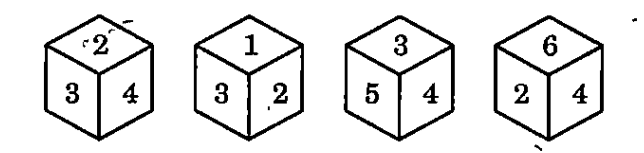
The number on the face opposite to 2 is:- Communication can be seen as processes of information transmission governed by three levels of semiotic rules:
- Which one of the following models use only three elements to explain the process of communication ?



