
Consider the following statements: I. The areas of two similar triangles are in the ratio of the squares of the corresponding medians. II. The areas of two similar triangles are in the ratio of the squares of the corresponding heights. Which of the statements given above is/are correct?
Both I and II
For two similar triangles, the ratio of their areas equals the square of the ratio of any pair of corresponding linear elements — sides, medians, altitudes (heights), angle bisectors, or circumradii. Hence both Statement I and Statement II are correct.
Similar Questions
ABC is a triangle right angled at A and AD is perpendicular to BC, If BD = 8 cm and DC = 12.5 cm, then what is AD equal to?
If ABC is a right-angled triangle with AC as its hypotenuse, then which one of the following is correct?
In the figure given below, ABC is a triangle with AB perpendicular to BC. Further BD is perpendicular to AC. If AD = 9 cm and DC = 4 cm, then what is the length of BD?
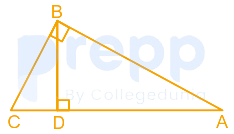
ABC is a triangle right angled at B. If AB = 5 cm and BC = 10 cm, then what is the length of the perpendicular drawn from the vertex B to the hypotenuse?
Which one of the following is correct in respect of a right-angled triangle?
Consider the following statements:
1. The perimeter of a triangle is greater than the sum of its three medians.
2. In any triangle ABC, if D is any point on BC, then AB + BC + CA > 2AD.
Which of the above statements is/are correct?Consider the following inequalities in respect of any triangle ABC:
1. AC - AB < BC
2. BC - AC < AB
3. AB - BC < AC
Which of the above are correct?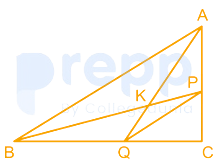
ABC is a triangle right angled at C as shown in the figure below. Which one of the following is correct?
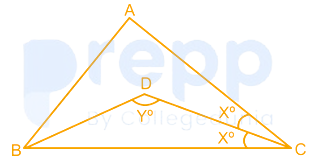
In the figure given below, ∠A = 80° and ∠ABC = 60°, BD and CD bisects angles B and C respectively. What are the values of x and y respectively?
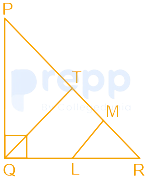
In the figure given below, PQR is a non-isosceles right-angles triangle, right angled at Q. If LM and QT are parallel and QT = PT, then what is ∠RLM equal to?
Important Questions from Triangles, Congruence and Similarity
In a $\Delta ABC$, $\angle C = (9/4) \angle B = (3/2) (\angle A+\angle B)$. Find the measure of the angles.
- The areas of two similar triangles $\Delta$XYZ and $\Delta$LMN are 49 cm$^2$ and 9 cm$^2$, respectively. If LM = 9 cm, then the length of XY is:
Triangles \(PQR\) and \(ABC\) are similar triangles. Triangle \(ABC\) have the following sides
\(AB = 12 \text{ cm}\),
\(AC = 15 \text{ cm}\),
\(CB = 21 \text{ cm}\).
Triangle \(PQR\) have the following sides:
\(PQ = 4 \text{ cm}\),
\(RQ = 7 \text{ cm}\).
What is the length of side \(PR\)?
For a pair of similar triangles, the angles made at \(Q\) is same in both the triangles \(PQR\) and \(LQJ\).
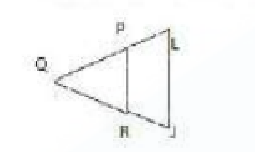
If the length of side \(QJ\) is 10 cm and \(QR\) is 5 cm, what is the ratio of their total areas?- In $\Delta ABC$ $\overline{PQ} \parallel \overline{AB}$. P and Q are on BC and CA respectively. If CQ : QA = 1 : 3 and CP = 4, then what is the value of BC?



