Sharp absorbance in case of silver and gold nanoparticles observed in UV-vis spectroscopy is attributed to :
Oscillation of free electrons on metal surface
The intense colours of gold and silver colloids — ruby red and yellow respectively — come from localised surface plasmon resonance (LSPR).
The mechanism is as follows. A noble metal has a sea of delocalised conduction electrons. When light strikes a particle much smaller than the wavelength, the oscillating electric field of the light displaces that whole electron cloud to one side of the particle, and the exposed positive lattice pulls it back. The result is a collective, coherent oscillation of the free electrons at the particle surface. At the frequency where the driving field matches the natural frequency of that oscillation, absorption becomes resonant and therefore very strong and sharp.
Several familiar observations follow directly. The resonance frequency depends on particle size and shape, so gold spheres of about 20 nm absorb near 520 nm and appear red, while larger or rod-shaped particles shift towards longer wavelengths. It also depends on the refractive index of the surrounding medium, which is the basis of LSPR biosensing. And the extinction coefficients are enormous, thousands of times those of organic dyes, which is why the colours are so vivid.
Turning to the other options: lattice phonon vibrations lie in the infrared and involve nuclear motion, far too low in energy for UV-visible absorption. Size quantisation is genuinely important for semiconductor quantum dots, where confinement widens the band gap, but metals have no band gap and their optical response is plasmonic rather than excitonic. Interparticle interaction does shift and broaden the band when particles aggregate — the reason a gold sol turns blue on aggregation — but that is a modification of the plasmon resonance, not its origin, and it broadens rather than sharpens the absorbance.
Hence the sharp absorbance is due to oscillation of free electrons on the metal surface.
Similar Questions
The species that contain a vacant d x2 - y2 orbital is :
FeCl2 . 4H2O and FeCl3 . 6H2O can be distinguished by 57Fe Mössbauer spectroscopy. The INCORRECT statement from the following is :
The solutions of
(i) [Cr(OH2)6]3+ ions are pale blue-green, but the chromite ion
(ii) [CrO4]2- is an intense yellow due to :
The major product of the following reaction in :
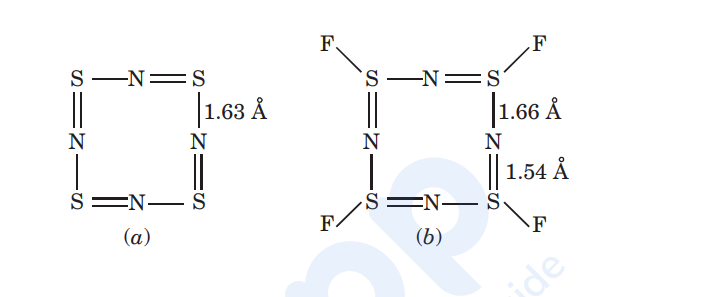
The structures of tetrasulphur tetranitride (a) and tetrathiazyl tetrafluoride (b) are given below. The statement that correctly describes the structures is :
In an axially symmetric field, the first NQR transition energy for I = $\frac{3}{2}$ is :
In the 19F NMR spectrum of ClF3, the number of signals and multiplicity at room temperature are (19F; I = \(\tfrac{1}{2}\)) :
Between NF3 and NH3 :
Identify (X) and (Y) in the following transformation :

The oxyacids of sulphur having direct S-S bonds are :
Important Questions from Structure of Atom
According to J.J. Thomson model of atom, positive charge is - Idenfity
- How many moles of He atoms are present in its 20 u mass ?
Which of the following electron transition in hydrogen atom will require largest amount of energy?
A species having 8 electrons in the third shell is very reactive while the other species having 8 electrons in the third shell is very inactive they are :
Which of the following is the general formula for saturated hydrocarbons?