
Read the following statements regarding Thevenin’s equivalent circuit : (a) The Thevenin’s voltage is calculated across the short circuit terminals. (b) The Thevenin’s voltage is calculated at the open circuit terminals. (c) The connection in the circuit is open if any voltage source is present. (d) The connection in the circuit is shorted if any voltage source is present. Which of the above statements are incorrect ?
(a) and (c)
Read the question carefully — it asks which statements are incorrect, so the true ones must be rejected. The statements come in two contradictory pairs, so exactly one of each pair is wrong.
Pair 1 — how VTh is found. The Thevenin voltage is the voltage that appears across the terminals when the load is removed, i.e. the open-circuit voltage:
\(V_{Th}=V_{OC}\)
So (b) is correct, and (a) is incorrect. Measuring across short-circuited terminals would always give zero volts — what a short circuit gives you is the Norton current, \(I_N=I_{SC}\), and the two are linked by \(R_{Th}=V_{OC}/I_{SC}\).
Pair 2 — how sources are treated when finding RTh. Every independent source is replaced by its internal resistance:
| Source | Replaced by | Because its ideal internal resistance is |
|---|---|---|
| Voltage source | short circuit | zero |
| Current source | open circuit | infinite |
So (d) is correct and (c) is incorrect — it applies the current-source rule to a voltage source.
The incorrect statements are therefore (a) and (c).
Why the rules are what they are. Deactivating a source means forcing its contribution to zero while leaving its resistance in place. Setting a voltage source to zero volts is exactly what a short circuit does; setting a current source to zero amps is exactly what an open circuit does. Getting this backwards is the single most common error in Thevenin problems.
One caution. These substitutions apply only to independent sources. A dependent source must be left in the circuit; RTh is then found by applying a 1 V test source at the terminals and computing \(R_{Th}=V_{test}/I_{test}\).
Hence, the incorrect statements are (a) and (c).
Similar Questions
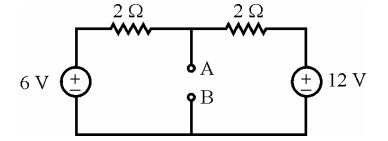
The Thevenin's equivalent across AB is
Which equivalent circuits are dual ?
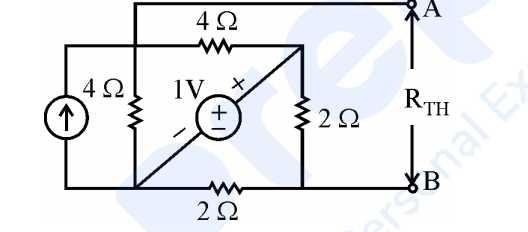
For the n/w, find RTH
The principle of superposition is the property of
In Thevenin equivalent circuit which is incorrect :
Find out which of the following statements is wrong ?
The principle of superposition is useful for
Consider the networks shown in the following figures (a) and (b) :

The above networks are :
Match the following :
List - I List - II (a) Superposition Theorem (i) Ratio between V and I is constant in different loops (b) Maximum Power Transfer Theorem (ii) Ideal current source with parallel Resistor (c) Norton's Theorem (iii) Load impedance is a complex conjugate (d) Reciprocity Theorem (iv) Not valid to Power of the circuit Codes :
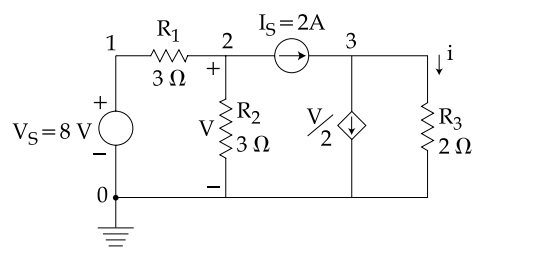
Find the value of i using the above circuit by making use of the superposition theorem.
A linear two terminal circuit can be replaced by an equivalent circuit consisting of a voltage source Vt in series with a resistor Rt where Rt is the ratio of
1. open circuit voltage to the short circuit current at the terminal pair.
2. short circuit current to the short circuit voltage at the terminal.
3. Open circuit voltage to the open circuit current at the terminal pair.
4. the independent sources are turned off.
Important Questions from Network Theorems
- Which of the following is essential for reciprocity theorem to be applicable?
A linear element satisfies the property (ies) of:
KVL gives the law of conservation of
The maximum power transfer theorem is used in
Millman’s theorem yields:



