
Read the passage and answer the questions that follow based on your understanding of the passage : General methods of n/w analysis become laborious and time consuming for large and complex network. For such situations the solution is network theorems. Besides, the other features of n/w theorems are (A) they are applicable to a useful and fairly wide class of networks, (B) their conclusions are simple and (C) they sometimes provide good physical insight into the problems. The maximum power transfer implies that the load impedance must be the complex conjugate of the source impedance. The superposition theorem is valid for any linear, time invariant or time varying. It is useful in circuit analysis when the n/w has large number of sources. Thevenin's or Norton's theorem is applicable to any number of time invariant or time varying n/w. It is useful when only one part of the n/w is varying, while the other part remains constant. Thevenin's equivalent ckt is the voltage source equivalent at the terminals concerned. Millman's theorem is the extension of Thevenin's or Norton's theorem for a number of Current or Voltage sources respectively. The substitution theorem is applicable to any network and can be applied to a branch which is not coupled to other branches of the network. Tellegen's theorem is applicable to any lumped n/w regardless of the type of elements, which may be linear or non-linear, time varying or time invariant.
In Thevenin equivalent circuit which is incorrect :
Independent voltage sources are open circuited.
An independent voltage source is deactivated by shorting it, not by opening it — so option 1 is the incorrect statement.
The rule and its reasoning. To find \(R_{TH}\) the sources must be set to zero while leaving their internal resistances in place. "Zero" means something different for each type:
| Source | Set to zero means | Replace with |
|---|---|---|
| Independent voltage | V = 0 across it | Short circuit |
| Independent current | I = 0 through it | Open circuit |
An ideal voltage source of zero volts is a component with no voltage across it whatever current flows — which is a piece of wire. Opening it would be quite different: an open circuit passes no current, which is how a current source is zeroed. Option 1 applies the current-source rule to a voltage source, and option 4 states that same rule correctly for the source it belongs to.
A check that removes any doubt. Take a 10 V source in series with 5 Ω. Shorting the source leaves 5 Ω — the correct Thevenin resistance, as a source transformation confirms. Opening it would leave an infinite resistance, so no load could draw current at all, which is plainly wrong.
Option 3 is also defective, which is why the answer is flagged. Dependent sources must not be removed. A controlled source is not an independent supply of energy but part of the network's behaviour — the transconductance of a transistor, for instance — and deleting it would change the network being modelled. When dependent sources are present, \(R_{TH}\) cannot be found by inspection at all; instead one either
\(R_{TH}=\dfrac{V_{OC}}{I_{SC}}\)
or applies a 1 V test source at the terminals with all independent sources deactivated and computes \(R_{TH}=1/I_{test}\). Since a network containing only dependent sources can give a Thevenin voltage of zero with a finite, and sometimes negative, resistance, the test-source method is the general one.
So two options are strictly wrong. Option 1 is the classic, unambiguous error the question is testing — it directly contradicts option 2, and one of that pair must be the answer — and it is keyed accordingly.
Hence, the incorrect statement is that independent voltage sources are open circuited.
Similar Questions
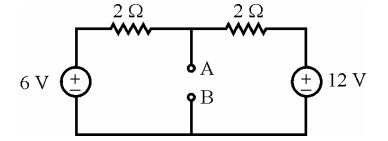
The Thevenin's equivalent across AB is
Which equivalent circuits are dual ?
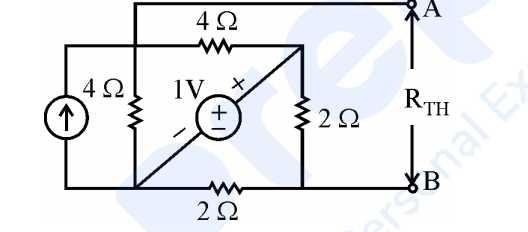
For the n/w, find RTH
The principle of superposition is the property of
Find out which of the following statements is wrong ?
The principle of superposition is useful for
Read the following statements regarding Thevenin’s equivalent circuit :
(a) The Thevenin’s voltage is calculated across the short circuit terminals.
(b) The Thevenin’s voltage is calculated at the open circuit terminals.
(c) The connection in the circuit is open if any voltage source is present.
(d) The connection in the circuit is shorted if any voltage source is present.
Which of the above statements are incorrect ?
Consider the networks shown in the following figures (a) and (b) :

The above networks are :
Match the following :
List - I List - II (a) Superposition Theorem (i) Ratio between V and I is constant in different loops (b) Maximum Power Transfer Theorem (ii) Ideal current source with parallel Resistor (c) Norton's Theorem (iii) Load impedance is a complex conjugate (d) Reciprocity Theorem (iv) Not valid to Power of the circuit Codes :
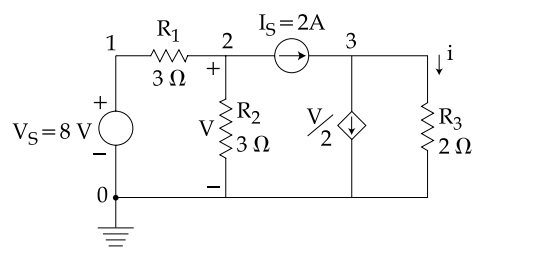
Find the value of i using the above circuit by making use of the superposition theorem.
A linear two terminal circuit can be replaced by an equivalent circuit consisting of a voltage source Vt in series with a resistor Rt where Rt is the ratio of
1. open circuit voltage to the short circuit current at the terminal pair.
2. short circuit current to the short circuit voltage at the terminal.
3. Open circuit voltage to the open circuit current at the terminal pair.
4. the independent sources are turned off.
Important Questions from Network Theorems
- Which of the following is essential for reciprocity theorem to be applicable?
A linear element satisfies the property (ies) of:
KVL gives the law of conservation of
The maximum power transfer theorem is used in
Millman’s theorem yields:



