
The Thevenin's equivalent across AB is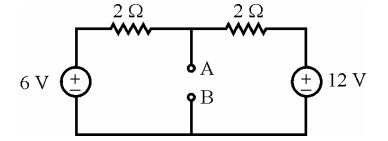
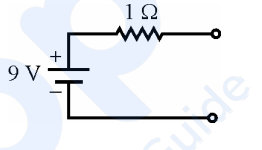
A Thevenin equivalent needs two numbers — the open-circuit voltage and the resistance looking back in — and here each takes one line.
Step 1 — the open-circuit voltage. With terminals A and B left open, no current leaves node A, so the current arriving through one 2 Ω resistor must leave through the other. Applying KCL at A with B as reference:
\(\dfrac{V_{A}-6}{2}+\dfrac{V_{A}-12}{2}=0\)
\(2V_{A}-18=0\quad\Rightarrow\quad V_{TH}=V_{A}=9\ \text{V}\)
The answer is simply the average of the two source voltages, which it must be because the two resistances are equal — a useful check.
Step 2 — the Thevenin resistance. Deactivate the independent sources: an ideal voltage source becomes a short circuit, so both 2 Ω resistors now run from A straight to B, in parallel:
\(R_{TH}=2\parallel2=\dfrac{2\times2}{2+2}=1\ \Omega\)
So the equivalent is 9 V in series with 1 Ω — option 2.
| Option | V | R | Verdict |
|---|---|---|---|
| 1 | 6 V | 2 Ω | ✗ One source only, sources not combined |
| 2 | 9 V | 1 Ω | ✓ |
| 3 | 12 V | 4 Ω | ✗ Resistors added instead of paralleled |
| 4 | 18 V | 2 Ω | ✗ Sources added as if in series |
The distractors are each built on one specific error : option 4 adds the two sources as though they were in series aiding, option 3 adds the resistances in series, and option 1 ignores the right-hand branch entirely. Working the two steps separately makes all three impossible.
A cross-check by source transformation. Convert each branch to its Norton form: 6 V with 2 Ω becomes 3 A with 2 Ω, and 12 V with 2 Ω becomes 6 A with 2 Ω. In parallel these give 9 A driving 1 Ω, and converting back gives 9 V in series with 1 Ω — the same result by a different route.
Why the equivalent is worth having : whatever load is now connected across AB, its current is \(9/(1+R_{L})\), and maximum power reaches it when \(R_{L}=1\ \Omega\) — conclusions the original two-source circuit does not display at a glance.
Hence, the Thevenin equivalent is 9 V in series with 1 Ω.
Similar Questions
Which equivalent circuits are dual ?
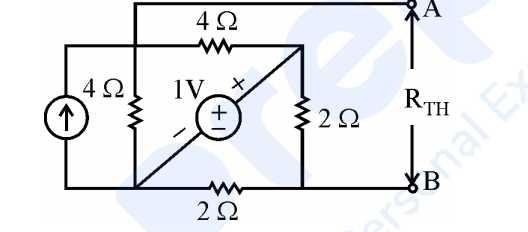
For the n/w, find RTH
The principle of superposition is the property of
In Thevenin equivalent circuit which is incorrect :
Find out which of the following statements is wrong ?
The principle of superposition is useful for
Read the following statements regarding Thevenin’s equivalent circuit :
(a) The Thevenin’s voltage is calculated across the short circuit terminals.
(b) The Thevenin’s voltage is calculated at the open circuit terminals.
(c) The connection in the circuit is open if any voltage source is present.
(d) The connection in the circuit is shorted if any voltage source is present.
Which of the above statements are incorrect ?
Consider the networks shown in the following figures (a) and (b) :

The above networks are :
Match the following :
List - I List - II (a) Superposition Theorem (i) Ratio between V and I is constant in different loops (b) Maximum Power Transfer Theorem (ii) Ideal current source with parallel Resistor (c) Norton's Theorem (iii) Load impedance is a complex conjugate (d) Reciprocity Theorem (iv) Not valid to Power of the circuit Codes :
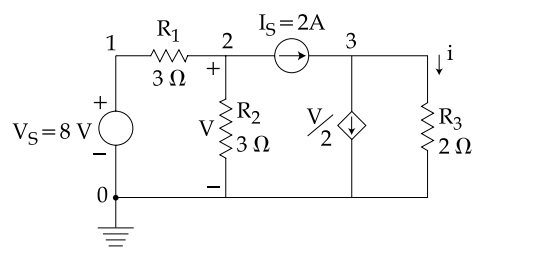
Find the value of i using the above circuit by making use of the superposition theorem.
A linear two terminal circuit can be replaced by an equivalent circuit consisting of a voltage source Vt in series with a resistor Rt where Rt is the ratio of
1. open circuit voltage to the short circuit current at the terminal pair.
2. short circuit current to the short circuit voltage at the terminal.
3. Open circuit voltage to the open circuit current at the terminal pair.
4. the independent sources are turned off.
Important Questions from Network Theorems
- Which of the following is essential for reciprocity theorem to be applicable?
A linear element satisfies the property (ies) of:
KVL gives the law of conservation of
The maximum power transfer theorem is used in
Millman’s theorem yields:



