
Read the passage and answer the questions that follow based on your understanding of the passage : General methods of n/w analysis become laborious and time consuming for large and complex network. For such situations the solution is network theorems. Besides, the other features of n/w theorems are (A) they are applicable to a useful and fairly wide class of networks, (B) their conclusions are simple and (C) they sometimes provide good physical insight into the problems. The maximum power transfer implies that the load impedance must be the complex conjugate of the source impedance. The superposition theorem is valid for any linear, time invariant or time varying. It is useful in circuit analysis when the n/w has large number of sources. Thevenin's or Norton's theorem is applicable to any number of time invariant or time varying n/w. It is useful when only one part of the n/w is varying, while the other part remains constant. Thevenin's equivalent ckt is the voltage source equivalent at the terminals concerned. Millman's theorem is the extension of Thevenin's or Norton's theorem for a number of Current or Voltage sources respectively. The substitution theorem is applicable to any network and can be applied to a branch which is not coupled to other branches of the network. Tellegen's theorem is applicable to any lumped n/w regardless of the type of elements, which may be linear or non-linear, time varying or time invariant.
For the n/w, find RTH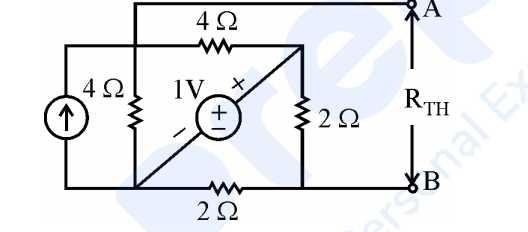
3 Ω
Deactivate both sources first, then reduce what is left by inspection.
Step 1 — deactivate the sources. The rules are the ones the previous question tested:
| Source | Becomes | Effect here |
|---|---|---|
| Independent current source | Open circuit | Its branch vanishes entirely |
| Independent 1 V source | Short circuit | Node M is joined to node P |
The short across the 1 V source is what collapses the network, so it is worth stating plainly: with M and P joined, every element connected to either is now connected to both.
Step 2 — combine the two 4 Ω resistors. One runs from A to the bottom node, the other from A to M — and M is now the same node. Both therefore run from A to the same point, in parallel:
\(4\parallel4=\dfrac{4\times4}{4+4}=2\ \Omega\)
Step 3 — combine the two 2 Ω resistors. One runs from M to B and the other from P to B; since M and P are the same node, they too are in parallel:
\(2\parallel2=\dfrac{2\times2}{2+2}=1\ \Omega\)
Step 4 — add the two results in series. The 2 Ω carries the path from A down to the joined node, and the 1 Ω carries it on to B:
\(R_{TH}=2+1=3\ \Omega\)
— option 2.
Two checks on the result. First, the answer must lie below the smallest single path from A to B, which is \(4+2=6\ \Omega\), and it does — parallel paths can only reduce resistance. Second, note that 6 Ω is offered as option 4: it is what one obtains by forgetting the short and taking a single series path, which is the error the question is built to catch. Option 3, 4 Ω, comes from combining only one of the two pairs.
Why the sequence matters. Deactivating the sources before attempting any simplification is essential — with the 1 V source still in place, M and P are distinct nodes and none of the parallel combinations above exists. The whole reduction depends on that one short circuit.
Hence, RTH = 3 Ω.
Similar Questions
The Thevenin's equivalent across AB is
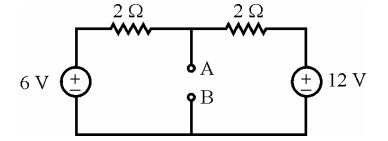
Which equivalent circuits are dual ?
The principle of superposition is the property of
In Thevenin equivalent circuit which is incorrect :
Find out which of the following statements is wrong ?
The principle of superposition is useful for
Read the following statements regarding Thevenin’s equivalent circuit :
(a) The Thevenin’s voltage is calculated across the short circuit terminals.
(b) The Thevenin’s voltage is calculated at the open circuit terminals.
(c) The connection in the circuit is open if any voltage source is present.
(d) The connection in the circuit is shorted if any voltage source is present.
Which of the above statements are incorrect ?
Consider the networks shown in the following figures (a) and (b) :

The above networks are :
Match the following :
List - I List - II (a) Superposition Theorem (i) Ratio between V and I is constant in different loops (b) Maximum Power Transfer Theorem (ii) Ideal current source with parallel Resistor (c) Norton's Theorem (iii) Load impedance is a complex conjugate (d) Reciprocity Theorem (iv) Not valid to Power of the circuit Codes :
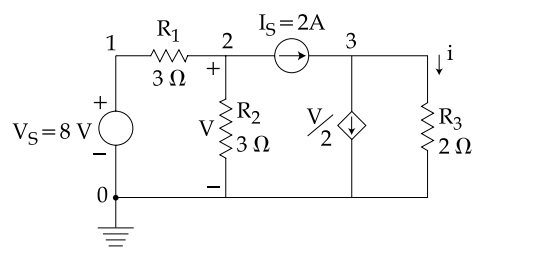
Find the value of i using the above circuit by making use of the superposition theorem.
A linear two terminal circuit can be replaced by an equivalent circuit consisting of a voltage source Vt in series with a resistor Rt where Rt is the ratio of
1. open circuit voltage to the short circuit current at the terminal pair.
2. short circuit current to the short circuit voltage at the terminal.
3. Open circuit voltage to the open circuit current at the terminal pair.
4. the independent sources are turned off.
Important Questions from Network Theorems
- Which of the following is essential for reciprocity theorem to be applicable?
A linear element satisfies the property (ies) of:
KVL gives the law of conservation of
The maximum power transfer theorem is used in
Millman’s theorem yields:



