
Match the following : Codes :List - I List - II (a) Superposition Theorem (i) Ratio between V and I is constant in different loops (b) Maximum Power Transfer Theorem (ii) Ideal current source with parallel Resistor (c) Norton's Theorem (iii) Load impedance is a complex conjugate (d) Reciprocity Theorem (iv) Not valid to Power of the circuit
(a)-(iv), (b)-(iii), (c)-(ii), (d)-(i)
Each phrase in List-II states the single most characteristic fact about its theorem.
(a) Superposition → (iv) not valid for power. The theorem says that in a linear network the response to several sources is the sum of the responses to each acting alone. It works for voltage and current because they are linear in the sources, but power goes as the square of them:
\(P=\left(I_{1}+I_{2}\right)^{2}R\ \ne\ I_{1}^{2}R+I_{2}^{2}R\)
The cross term \(2I_{1}I_{2}R\) is what superposition throws away, so powers must never be added this way — always superpose the currents first and compute the power from the total.
(b) Maximum power transfer → (iii) load is a complex conjugate. For an AC source of internal impedance \(Z_{S}=R_{S}+jX_{S}\), the maximum power reaches the load when
\(Z_{L}=Z_{S}^{*}=R_{S}-jX_{S}\)
The conjugate cancels the reactance so the circuit is purely resistive, and the equal resistances then split the source voltage evenly. The transfer efficiency at that point is only 50 %, which is why the condition is used in signal and communication circuits but never in power distribution.
(c) Norton → (ii) ideal current source with a parallel resistor. Norton's equivalent is the dual of Thevenin's, with \(I_{N}=\dfrac{V_{Th}}{R_{Th}}\) and the same resistance moved from series to parallel.
(d) Reciprocity → (i) the ratio of V to I is constant when source and response are interchanged. In a linear, passive, bilateral network, a source in one branch producing a response in another gives exactly the same ratio if the two are swapped — the transfer impedance is unchanged. The theorem fails as soon as a dependent source, a transistor or any non-bilateral element is present.
| Theorem | Key fact | Code |
|---|---|---|
| Superposition | Linear quantities only | (iv) |
| Max power transfer | Conjugate match | (iii) |
| Norton | Current source with shunt R | (ii) |
| Reciprocity | Transfer ratio unchanged | (i) |
The order (iv), (iii), (ii), (i) is option 3.
Hence, the correct match is (a)-(iv), (b)-(iii), (c)-(ii), (d)-(i).
Similar Questions
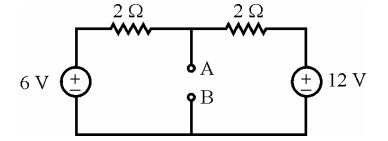
The Thevenin's equivalent across AB is
Which equivalent circuits are dual ?
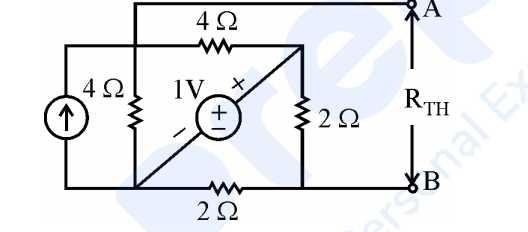
For the n/w, find RTH
The principle of superposition is the property of
In Thevenin equivalent circuit which is incorrect :
Find out which of the following statements is wrong ?
The principle of superposition is useful for
Read the following statements regarding Thevenin’s equivalent circuit :
(a) The Thevenin’s voltage is calculated across the short circuit terminals.
(b) The Thevenin’s voltage is calculated at the open circuit terminals.
(c) The connection in the circuit is open if any voltage source is present.
(d) The connection in the circuit is shorted if any voltage source is present.
Which of the above statements are incorrect ?
Consider the networks shown in the following figures (a) and (b) :

The above networks are :
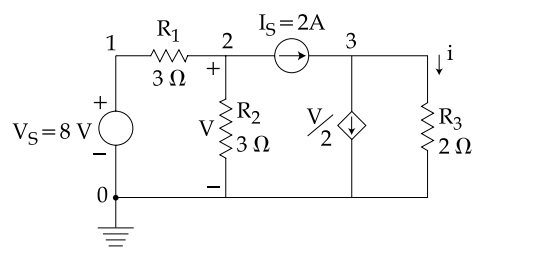
Find the value of i using the above circuit by making use of the superposition theorem.
A linear two terminal circuit can be replaced by an equivalent circuit consisting of a voltage source Vt in series with a resistor Rt where Rt is the ratio of
1. open circuit voltage to the short circuit current at the terminal pair.
2. short circuit current to the short circuit voltage at the terminal.
3. Open circuit voltage to the open circuit current at the terminal pair.
4. the independent sources are turned off.
Important Questions from Network Theorems
- Which of the following is essential for reciprocity theorem to be applicable?
A linear element satisfies the property (ies) of:
KVL gives the law of conservation of
The maximum power transfer theorem is used in
Millman’s theorem yields:



