
Consider the networks shown in the following figures (a) and (b) : The above networks are :
Reciprocal network of each other
To determine the relationship between the two given networks in figures (a) and (b), let's analyze the properties that define reciprocal networks.
A reciprocal network is one where the transfer impedance is symmetric, meaning that if you apply a voltage in one direction and observe the resulting current, you'll get the same result if you swap the positions of the voltage and current sources. Mathematically, this condition is represented as:
\(Z_{12} = Z_{21}\)
In figure (a), the input is provided by a source \(V_1 = V_S\), leading to current \(I_1\) entering the network and \(I_2\) exiting it at the far side. Likewise, in figure (b), the roles of input and output are reversed which means:
- The source is now \(V_2 = V_S\), leading to a new current \(I'_1\) in place of \(I_2\) from the first figure.
By checking whether these configurations give equivalent responses from the network, if the transfer functions across both configurations are equal or symmetric, the networks are reciprocal.
According to the properties of reciprocal networks and the explained figures, the circuit configurations ensure that:
\(Z_{12} = Z_{21}\)
Therefore, the correct answer is that the given networks are Reciprocal network of each other. This is supported by the symmetry in their configurations as they sustain the reciprocal property by swapping source and output.
Similar Questions
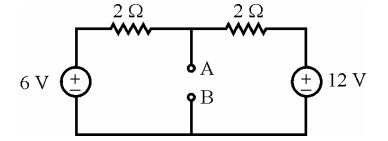
The Thevenin's equivalent across AB is
Which equivalent circuits are dual ?
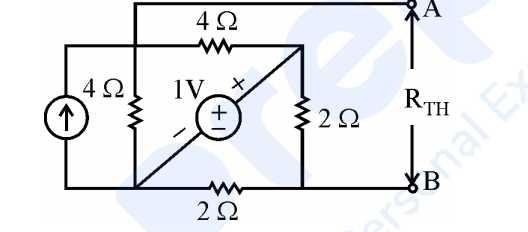
For the n/w, find RTH
The principle of superposition is the property of
In Thevenin equivalent circuit which is incorrect :
Find out which of the following statements is wrong ?
The principle of superposition is useful for
Read the following statements regarding Thevenin’s equivalent circuit :
(a) The Thevenin’s voltage is calculated across the short circuit terminals.
(b) The Thevenin’s voltage is calculated at the open circuit terminals.
(c) The connection in the circuit is open if any voltage source is present.
(d) The connection in the circuit is shorted if any voltage source is present.
Which of the above statements are incorrect ?
Match the following :
List - I List - II (a) Superposition Theorem (i) Ratio between V and I is constant in different loops (b) Maximum Power Transfer Theorem (ii) Ideal current source with parallel Resistor (c) Norton's Theorem (iii) Load impedance is a complex conjugate (d) Reciprocity Theorem (iv) Not valid to Power of the circuit Codes :
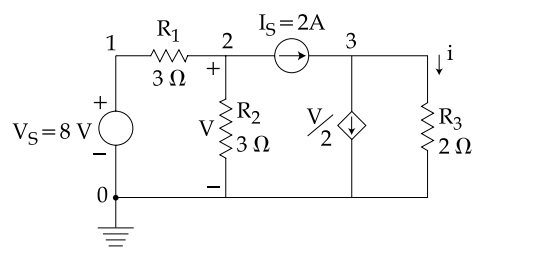
Find the value of i using the above circuit by making use of the superposition theorem.
A linear two terminal circuit can be replaced by an equivalent circuit consisting of a voltage source Vt in series with a resistor Rt where Rt is the ratio of
1. open circuit voltage to the short circuit current at the terminal pair.
2. short circuit current to the short circuit voltage at the terminal.
3. Open circuit voltage to the open circuit current at the terminal pair.
4. the independent sources are turned off.
Important Questions from Network Theorems
- Which of the following is essential for reciprocity theorem to be applicable?
A linear element satisfies the property (ies) of:
KVL gives the law of conservation of
The maximum power transfer theorem is used in
Millman’s theorem yields:



