
Find the value of i using the above circuit by making use of the superposition theorem.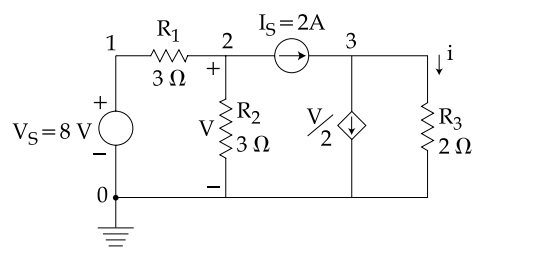
1.5 A
Node analysis settles this quickly, and the dependent source is the reason superposition must be applied with care.
Step 1 — find V at node 2. Write KCL there, remembering that the 2 A source pulls a fixed current out towards node 3:
\(\dfrac{8-V}{3}=\dfrac{V}{3}+2\)
\(8-V=V+6\quad\Rightarrow\quad 2V=2\quad\Rightarrow\quad V=1\ \text{V}\)
Step 2 — the dependent source now has a value.
\(\dfrac{V}{2}=\dfrac{1}{2}=0.5\ \text{A}\)
Step 3 — apply KCL at node 3. The 2 A arrives from the independent source, the controlled source removes 0.5 A, and the remainder leaves through R3:
\(i=2-0.5=1.5\ \text{A}\)
which is option 2.
| Contribution at node 3 | Current |
|---|---|
| Independent 2 A source | +2 A |
| Dependent source V/2 | −0.5 A |
| Through R3 | 1.5 A |
The rule the question is really testing. Superposition may be applied only to the independent sources; a dependent source is never deactivated, because its value is not an input to the circuit but a response to it. Killing it would destroy the very constraint that defines the network. So the correct procedure is: consider the 8 V source alone with the 2 A source open-circuited, then the 2 A source alone with the 8 V source short-circuited, keeping the controlled source live in both passes, and add the two answers.
A check on the result. R3 then drops \(1.5\times2=3\ \text{V}\), a modest voltage consistent with a 1 V node and a half-amp controlled source — and the answer is comfortably less than the 2 A being injected, exactly as the subtracting controlled source requires. Had the controlled source been drawn feeding into the node instead, the answer would have been 2.5 A, which is not offered; the option set therefore confirms the sense of the arrow in the figure.
Why controlled sources matter : they are how transistors and op-amps enter linear analysis, and their presence also destroys reciprocity, so a network containing one cannot be checked with the reciprocity theorem.
Hence, the current is 1.5 A.
Similar Questions
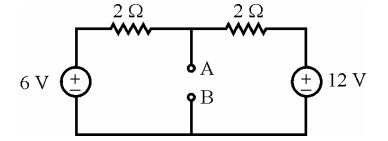
The Thevenin's equivalent across AB is
Which equivalent circuits are dual ?
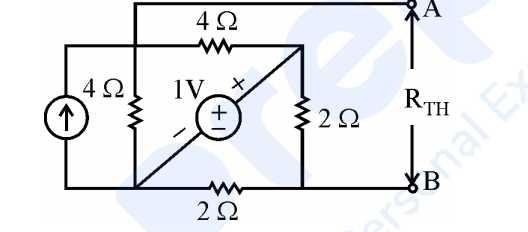
For the n/w, find RTH
The principle of superposition is the property of
In Thevenin equivalent circuit which is incorrect :
Find out which of the following statements is wrong ?
The principle of superposition is useful for
Read the following statements regarding Thevenin’s equivalent circuit :
(a) The Thevenin’s voltage is calculated across the short circuit terminals.
(b) The Thevenin’s voltage is calculated at the open circuit terminals.
(c) The connection in the circuit is open if any voltage source is present.
(d) The connection in the circuit is shorted if any voltage source is present.
Which of the above statements are incorrect ?
Consider the networks shown in the following figures (a) and (b) :

The above networks are :
Match the following :
List - I List - II (a) Superposition Theorem (i) Ratio between V and I is constant in different loops (b) Maximum Power Transfer Theorem (ii) Ideal current source with parallel Resistor (c) Norton's Theorem (iii) Load impedance is a complex conjugate (d) Reciprocity Theorem (iv) Not valid to Power of the circuit Codes :
A linear two terminal circuit can be replaced by an equivalent circuit consisting of a voltage source Vt in series with a resistor Rt where Rt is the ratio of
1. open circuit voltage to the short circuit current at the terminal pair.
2. short circuit current to the short circuit voltage at the terminal.
3. Open circuit voltage to the open circuit current at the terminal pair.
4. the independent sources are turned off.
Important Questions from Network Theorems
- Which of the following is essential for reciprocity theorem to be applicable?
A linear element satisfies the property (ies) of:
KVL gives the law of conservation of
The maximum power transfer theorem is used in
Millman’s theorem yields:



