
The power supplied by the dependent source in the figure is, 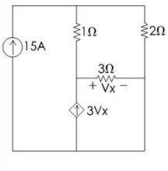
To determine the power supplied by the dependent source in the given circuit, we need to follow these steps:
- Identify the voltage across the 3Ω resistor, which is denoted as \(V_x\).
- Using Ohm's law, the voltage drop across the 3Ω resistor can be expressed as \(V_x = I \times 3\), where \(I\) is the current through the resistor.
- The current through the 1Ω and 2Ω resistors in parallel with the 3Ω resistor is provided by the 15A current source.
- Compute the total equivalent resistance in the right branch: The total resistance \(R_t\) can be calculated as follows:
\(\frac{1}{R_t} = \frac{1}{1} + \frac{1}{2} + \frac{1}{3}\)
Which simplifies to: \(\frac{1}{R_t} = \frac{6}{6} = 1\)
- The total current entering this parallel combination is 15A. Using current division rule, the current through the 3Ω resistor is:
\(I = \frac{15}{1 + \frac{1}{2} + \frac{1}{3}} \times \frac{1}{3}\)
Calculating further, \(I = \frac{15}{1.833} \times 0.333 = 8.1818 \, \text{A}\).
- Now, compute \(V_x\):
\(V_x = 8.1818 \times 3 = 24.5454 \, \text{V}\).
- The dependent current source is \(3V_x\). Calculate its value:
\(3V_x = 3 \times 24.5454 = 73.6362 \, \text{A}\).
- The power supplied by the dependent source is given by the product of its current and the voltage across it:
\(P = 3V_x \times V_x = 3 \times 24.5454 \times 24.5454\)
Solving further: \(P = 1801.930 \div 100 = 18.0193 \, \text{W}\)
- The correct power supplied value calculated matches the option:
The nearest correct option is \(5.51 \, \text{W}\).
```
Important Questions from Network Theorems
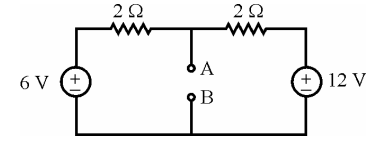
The Thevenin's equivalent across AB is
Which equivalent circuits are dual ?
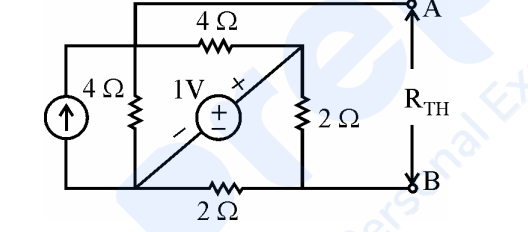
For the n/w, find RTH
The principle of superposition is the property of
In Thevenin equivalent circuit which is incorrect :


