[NO2]+ has a shape similar to :
SiO2
Work out the shape of the nitronium ion by counting electron domains on nitrogen.
Nitrogen contributes 5 valence electrons; the positive charge removes one, leaving 4. Both are used in double bonds to the two oxygens, so nitrogen has two bonding domains and no lone pair — an AX2 system. Two domains arrange themselves as far apart as possible, giving a linear ion, O=N=O, with a bond angle of exactly 180° and sp hybridisation.
Now test the options for the same geometry.
SO2 is AX2E: sulphur retains a lone pair, so the molecule is bent, about 119°.
H2O is AX2E2: two lone pairs compress the angle to 104.5°, strongly bent.
O3 is AX2E on the central oxygen, again bent, about 117°.
SiO2 as a discrete molecule has silicon with two double bonds and no lone pair — AX2, therefore linear, matching [NO2]+.
Two further points are worth noting. Nitronium is isoelectronic with CO2 and N2O, all 16-valence-electron AX2 species and all linear — a useful family to recognise. And the geometry has real chemical consequence: [NO2]+ is the electrophile in aromatic nitration, generated from HNO3 and H2SO4, and its linear, charge-concentrated form is what makes it so reactive. Note also the contrast with the neutral radical NO2, which has a single unpaired electron on nitrogen and is therefore bent at about 134°.
Hence [NO2]+ has a shape similar to SiO2.
Similar Questions
The species that contain a vacant d x2 - y2 orbital is :
FeCl2 . 4H2O and FeCl3 . 6H2O can be distinguished by 57Fe Mössbauer spectroscopy. The INCORRECT statement from the following is :
The solutions of
(i) [Cr(OH2)6]3+ ions are pale blue-green, but the chromite ion
(ii) [CrO4]2- is an intense yellow due to :
The major product of the following reaction in :
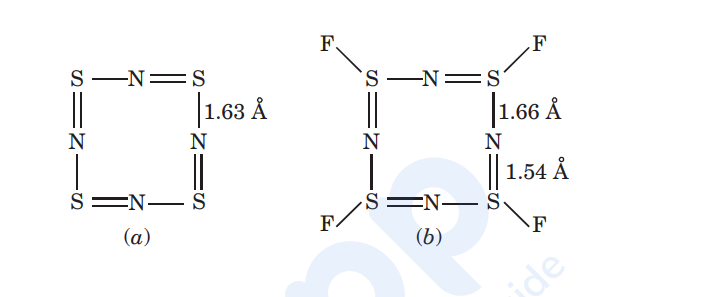
The structures of tetrasulphur tetranitride (a) and tetrathiazyl tetrafluoride (b) are given below. The statement that correctly describes the structures is :
In an axially symmetric field, the first NQR transition energy for I = $\frac{3}{2}$ is :
In the 19F NMR spectrum of ClF3, the number of signals and multiplicity at room temperature are (19F; I = \(\tfrac{1}{2}\)) :
Between NF3 and NH3 :
Identify (X) and (Y) in the following transformation :

The oxyacids of sulphur having direct S-S bonds are :
Important Questions from Structure of Atom
According to J.J. Thomson model of atom, positive charge is - Idenfity
- How many moles of He atoms are present in its 20 u mass ?
Which of the following electron transition in hydrogen atom will require largest amount of energy?
A species having 8 electrons in the third shell is very reactive while the other species having 8 electrons in the third shell is very inactive they are :
Which of the following is the general formula for saturated hydrocarbons?