
In a triangle PQR, X is a point on PR and Y is a point on QR such that PR = 10 cm, RX = 4 cm, YR = 2 cm, QR = 5 cm. Which one of the following is correct?
XY is parallel to PQ
Analyzing Triangle PQR and Proportionality
The question describes a triangle PQR and points X and Y on sides PR and QR respectively. We are given the lengths of PR, RX, YR, and QR. We need to determine the relationship between the line segment XY and the side PQ.
Let's list the given lengths:
- PR = 10 cm
- RX = 4 cm
- YR = 2 cm
- QR = 5 cm
Since X is on PR and Y is on QR, we can find the lengths of the remaining segments PX and QY.
- PX = PR - RX = 10 cm - 4 cm = 6 cm
- QY = QR - YR = 5 cm - 2 cm = 3 cm
Checking for Proportionality in Triangle PQR
To determine the relationship between XY and PQ, we can check if the line segment XY divides the sides PR and QR proportionally. The converse of the Basic Proportionality Theorem (BPT) states that if a line divides any two sides of a triangle in the same ratio, then the line is parallel to the third side.
Let's calculate the ratios of the segments from the common vertex R:
- Ratio on side PR: \(\frac{RX}{RP}\)
- Ratio on side QR: \(\frac{RY}{RQ}\)
Substituting the given values:
- \(\frac{RX}{RP} = \frac{4 \text{ cm}}{10 \text{ cm}} = \frac{4}{10} = \frac{2}{5}\)
- \(\frac{RY}{RQ} = \frac{2 \text{ cm}}{5 \text{ cm}} = \frac{2}{5}\)
We observe that \(\frac{RX}{RP} = \frac{RY}{RQ} = \frac{2}{5}\).
Applying the Converse of Basic Proportionality Theorem
Since the line segment XY divides the sides PR and QR of triangle PQR proportionally (with vertex R being the common point for the ratios), according to the converse of the Basic Proportionality Theorem, the line XY must be parallel to the side PQ.
Therefore, XY is parallel to PQ.
Analyzing the Options
Let's examine the given options based on our findings:
- Option 1: XY is parallel to PQ. This matches our conclusion from the proportionality test.
- Option 2: PQ = 2 XY. If XY is parallel to PQ, then triangle RXY is similar to triangle RPQ. The ratio of corresponding sides is equal to the proportionality constant we found, but taken from the larger triangle to the smaller triangle, i.e., \(\frac{RP}{RX} = \frac{RQ}{RY}\).
- \(\frac{RP}{RX} = \frac{10 \text{ cm}}{4 \text{ cm}} = \frac{10}{4} = \frac{5}{2}\)
- \(\frac{RQ}{RY} = \frac{5 \text{ cm}}{2 \text{ cm}} = \frac{5}{2}\)
- Option 3: PX = QY. We calculated PX = 6 cm and QY = 3 cm. Since \(6 \neq 3\), this option is incorrect.
- Option 4: PQ = 3 XY. From our similarity calculation, \(PQ = 2.5 XY\). So, \(PQ = 3 XY\) is incorrect.
Based on the analysis, only the first option is correct.
| Segment | Length (cm) |
|---|---|
| PR | 10 |
| RX | 4 |
| PX | 6 |
| QR | 5 |
| YR | 2 |
| QY | 3 |
| Ratio | Calculation | Value |
|---|---|---|
| \(\frac{RX}{RP}\) | \(\frac{4}{10}\) | \(\frac{2}{5}\) |
| \(\frac{RY}{RQ}\) | \(\frac{2}{5}\) | \(\frac{2}{5}\) |
Conclusion on Triangle Proportionality
The ratios \(\frac{RX}{RP}\) and \(\frac{RY}{RQ}\) are equal. This proportionality confirms that XY is parallel to PQ according to the converse of the Basic Proportionality Theorem. The other options regarding the lengths of PX, QY, and the ratio of PQ to XY are not supported by the given information and calculations.
Revision Table: Key Concepts for Triangle Problems
| Concept | Description | Relevance Here |
|---|---|---|
| Basic Proportionality Theorem (BPT) | If a line is drawn parallel to one side of a triangle intersecting the other two sides, then it divides the two sides in the same ratio. | Used to understand the property that parallelism implies proportionality. |
| Converse of BPT | If a line divides any two sides of a triangle in the same ratio, then the line is parallel to the third side. | This is the primary theorem used to solve this specific problem, showing proportionality implies parallelism. |
| Similar Triangles | Two triangles are similar if their corresponding angles are equal and their corresponding sides are in proportion. | If XY || PQ, then \(\triangle RXY \sim \triangle RPQ\), which implies corresponding sides are proportional (\(\frac{RX}{RP} = \frac{RY}{RQ} = \frac{XY}{PQ}\)). |
Additional Information: Understanding Basic Proportionality Theorem (BPT) and Converse
The Basic Proportionality Theorem (also known as Thales's Theorem) and its converse are fundamental in understanding the geometry of triangles, particularly when dealing with parallel lines intersecting the sides.
Basic Proportionality Theorem (BPT):
Consider a triangle ABC. If a line DE is drawn parallel to BC, intersecting AB at D and AC at E, then \(\frac{AD}{DB} = \frac{AE}{EC}\).
Converse of Basic Proportionality Theorem:
Consider a triangle ABC. If a line DE intersects sides AB and AC at points D and E respectively such that \(\frac{AD}{DB} = \frac{AE}{EC}\), then the line DE is parallel to BC.
In our problem, with triangle PQR and line segment XY, we checked if \(\frac{RX}{XP} = \frac{RY}{YQ}\). However, the proportionality in BPT and its converse relates segments created by the intersecting line on the sides. The ratios are typically taken from a vertex or between the points on the side. The ratios \(\frac{RX}{RP}\) and \(\frac{RY}{RQ}\) are also valid for proving similarity, which in turn implies parallelism when angles are considered, or directly applying the converse to the full sides RP and RQ divided at X and Y relative to vertex R.
If \(\frac{RX}{XP} = \frac{RY}{YQ}\), then XY || PQ. Let's check this ratio:
- \(\frac{RX}{XP} = \frac{4}{6} = \frac{2}{3}\)
- \(\frac{RY}{YQ} = \frac{2}{3}\)
Since \(\frac{RX}{XP} = \frac{RY}{YQ} = \frac{2}{3}\), the line segment XY divides sides PR and QR proportionally. Therefore, by the converse of BPT, XY is parallel to PQ. Both methods of checking proportionality (using \(\frac{RX}{RP} = \frac{RY}{RQ}\) or \(\frac{RX}{XP} = \frac{RY}{YQ}\)) lead to the same conclusion of parallelism, provided the points X and Y are on the sides and the ratios are calculated consistently from a vertex (R) or based on the segments created by the line (XY).
Similar Questions
What is the area of quadrilateral ABCD?
ABC is a triangle right angled at A and AD is perpendicular to BC, If BD = 8 cm and DC = 12.5 cm, then what is AD equal to?
If ABC is a right-angled triangle with AC as its hypotenuse, then which one of the following is correct?
In the figure given below, ABC is a triangle with AB perpendicular to BC. Further BD is perpendicular to AC. If AD = 9 cm and DC = 4 cm, then what is the length of BD?
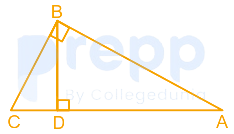
ABC is a triangle right angled at B. If AB = 5 cm and BC = 10 cm, then what is the length of the perpendicular drawn from the vertex B to the hypotenuse?
Which one of the following is correct in respect of a right-angled triangle?
Consider the following statements:
1. The perimeter of a triangle is greater than the sum of its three medians.
2. In any triangle ABC, if D is any point on BC, then AB + BC + CA > 2AD.
Which of the above statements is/are correct?Consider the following inequalities in respect of any triangle ABC:
1. AC - AB < BC
2. BC - AC < AB
3. AB - BC < AC
Which of the above are correct?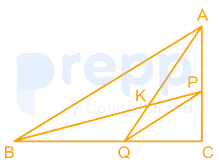
ABC is a triangle right angled at C as shown in the figure below. Which one of the following is correct?
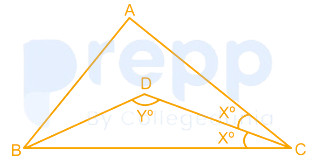
In the figure given below, ∠A = 80° and ∠ABC = 60°, BD and CD bisects angles B and C respectively. What are the values of x and y respectively?
Important Questions from Triangles, Congruence and Similarity
G is the centroid of the equilateral triangle ABC. If AB = 8√ 3 cm, then the length of AG is equal to:
If sides of a triangle are 12 cm, 15 cm and 21 cm, then what is the inradius (in cm) of the triangle?
What is the area of quadrilateral ABCD?
It is given that ΔABC ~ ΔXYZ and Area ΔABC : Area ΔXYZ = 81 : 25. If AB = 18 cm, BC = 10 cm, CA = 15 cm, then what is the side XZ (in cm)?
Sides of two similar triangles are in the ratio 4 ∶ 9. Area of these triangles are in the ratio:



