
In a half wave rectifier the open circuit voltage from the secondary of the transformer is VS = Vm sin ωt, then the peak value of load current will be (Rf is dynamic resistance of diode and RS is resistance of transformer secondary)
\(\dfrac{V_m}{R_S+R_f+R_L}\)
Draw the conducting loop. During the positive half cycle the diode conducts, and the circuit is a single series loop containing three resistances in the current's path:
the transformer secondary winding resistance RS, the diode's forward (dynamic) resistance Rf, and the load RL.
Step 1 — apply Ohm's law to the loop. Since they are all in series, they simply add:
\(i(t)=\dfrac{V_m\sin\omega t}{R_S+R_f+R_L}\)
Step 2 — take the peak. The maximum occurs when \(\sin\omega t=1\):
\(I_m=\dfrac{V_m}{R_S+R_f+R_L}\)
which is option 2.
Why every resistance must appear with a plus sign. Series resistances always add; a minus sign would mean one element supplies energy, which a passive resistance cannot do. On that ground alone options 3 and 4 fall away — and option 3 is self-defeating in a second way, since \(R_f+R_S-R_f\) collapses to just RS. Option 1 simply forgets the diode altogether, which would be the ideal-diode approximation rather than the practical one the question asks for.
Where this expression leads. The remaining half-wave results all follow from Im:
| Quantity | Half-wave value |
|---|---|
| DC (average) current | \(I_{dc}=I_m/\pi\) |
| RMS current | \(I_{rms}=I_m/2\) |
| Ripple factor | 1.21 |
| Maximum efficiency | 40.6 % |
| PIV of the diode | Vm |
The practical significance of RS + Rf. Together they form the rectifier's internal resistance, so the DC output voltage falls as load current rises:
\(V_{dc}=\dfrac{V_m}{\pi}-I_{dc}(R_S+R_f)\)
That is the regulation characteristic of the supply, and it is the reason a stiff transformer (low RS) and a low-resistance diode are wanted in a power rectifier.
Hence, the peak load current is \(\dfrac{V_m}{R_S+R_f+R_L}\).
Similar Questions
Consider the following rectifier circuits :
1. Half-wave rectifier without filter
2. Full-wave rectifier without filter
3. Full-wave rectifier with series inductance filter
4. Full-wave rectifier with capacitance filterThe sequence of these rectifier circuits in decreasing order of the ripple factor is
Assertion (A) : Capacitor input filter gives a high output voltage which drops as the load is increased.
Reason (R) : Capacitor input filters produce more heating in the rectifiers.
For the different values of 'L' while keeping 'RL' as constant, following graph is obtained from the given circuit.
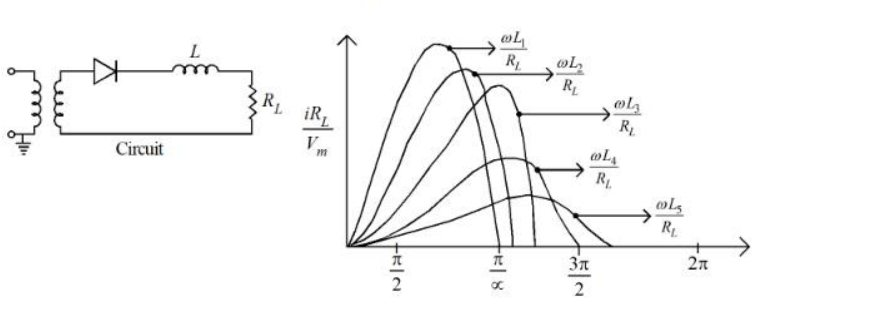
Choose the correct ascending order from the options given below for the different values of ' L ' :
The ratio of peak to peak input ripple voltage to peak to peak ripple output voltage is known as:
Read the statements:
A. The O/P frequency of a half wave rectifier is equal to the input frequency
B. The O/P frequency of a full wave rectifier is double to the input frequency
C. The regulation of an excellent rectifier should be zero.
D. ripple factor in the full wave rectifier is 1.2.
Choose the correct statements from the options given below:
Statements regarding rectifier are :
A. RMS value of current in a half wave rectifier is \(\frac{I_m}{\sqrt{2}}\)
B. PIV of diode in a full wave bridge rectifier is Vm volts.
C. TUF and rectification efficiency for a rectifier are same parametrs.
D. Rectifier converts A.C. to rippled DC not pure D.C.
Choose the correct answer from the options given below:
In a rectifier the ripple factor can be expressed as
(a) \(\dfrac{I_{rms}}{I_{dc}}\) (b) \(\sqrt\dfrac{I_{dc}}{I_{rms}}\) (c) \(\sqrt{\left(\dfrac{I_{rms}}{I_{dc}}\right)^{2}-1}\) (d) \(\sqrt{1-\left(\dfrac{I_{rms}}{I_{dc}}\right)^{2}}\)
Which one of the above is correct ?
For a full-wave rectifier, which of the following statements are correct ?
(a) \(V_{dc}=\dfrac{2V_P}{\pi}\)
(b) \(f_{out}=2f_{in}\)
(c) \(V_{dc}=\dfrac{2\pi}{V_P}\)
(d) \(I_{dc}=\dfrac{I_m}{\sqrt{\pi}}\)
Options :
As compared to a full-wave rectifier using two diodes, the four diode bridge rectifier has the dominant advantage of :
In rectifiers :
(a) The efficiency of rectification is given by \(\eta=\dfrac{P_{ac}}{P_{dc}}\)
(b) The AC component on the output side : \(V_{ac}=\sqrt{V_{rms}^{2}-V_{dc}^{2}}\)
(c) Form factor is given by : \(FF=\dfrac{V_{dc}}{V_{rms}}\)
(d) Ripple factor is given by : \(RF=\sqrt{\left(\dfrac{V_{rms}}{V_{dc}}\right)^{2}-1}\)
Of these statements :
Important Questions from Rectifier Circuits
PIV of a non conducting diode in a bridge rectifier is
The no-load output voltage of an ideal half wave rectifier is _______.
What is the minimum PIV required for a diode used in a full-wave rectifier circuit using a center-tapped transformer with a secondary voltage of 50V-0-50 V (rms)?
One of the following is a negative resistance device
Which of the following is NOT true for a rectifier?



