Hyperfine lines expected in the EPR spectrum of tetranuclear rhodium (I = \(\tfrac{1}{2}\)) complex :
5
The number of hyperfine lines produced by a set of equivalent nuclei is given by
\(\text{number of lines} = 2nI + 1\)
where \(n\) is the number of equivalent nuclei and \(I\) the nuclear spin of each.
Substitute the values. The complex is tetranuclear, so \(n = 4\), and rhodium has \(I = \tfrac{1}{2}\):
\(2 \times 4 \times \tfrac{1}{2} + 1 = 4 + 1 = 5\) lines.
For spin-\(\tfrac{1}{2}\) nuclei this reduces to the familiar \(n + 1\) rule, the same rule that governs multiplicity in NMR.
The intensities follow the binomial coefficients, here 1 : 4 : 6 : 4 : 1. The reason is combinatorial: the five lines correspond to total nuclear spin projections of +2, +1, 0, -1, -2, and there is only one way to have all four rhodium spins aligned but six ways to have two up and two down. The central line is therefore the most intense.
Two conditions underlie the simple formula, and both are stated or implied in the question. The four rhodium nuclei must be equivalent — if they were inequivalent, each would split the signal independently and up to \(2^{4} = 16\) lines could appear. And the unpaired electron must interact with all four, which is what makes the observation informative: seeing five equally spaced lines is direct evidence that the unpaired electron is delocalised over the whole tetranuclear cluster rather than localised on one metal centre.
Hence 5 hyperfine lines are expected.
Similar Questions
The species that contain a vacant d x2 - y2 orbital is :
FeCl2 . 4H2O and FeCl3 . 6H2O can be distinguished by 57Fe Mössbauer spectroscopy. The INCORRECT statement from the following is :
The solutions of
(i) [Cr(OH2)6]3+ ions are pale blue-green, but the chromite ion
(ii) [CrO4]2- is an intense yellow due to :
The major product of the following reaction in :
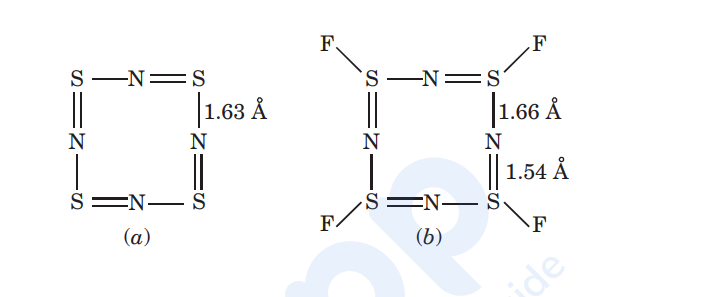
The structures of tetrasulphur tetranitride (a) and tetrathiazyl tetrafluoride (b) are given below. The statement that correctly describes the structures is :
In an axially symmetric field, the first NQR transition energy for I = $\frac{3}{2}$ is :
In the 19F NMR spectrum of ClF3, the number of signals and multiplicity at room temperature are (19F; I = \(\tfrac{1}{2}\)) :
Between NF3 and NH3 :
Identify (X) and (Y) in the following transformation :

The oxyacids of sulphur having direct S-S bonds are :
Important Questions from Structure of Atom
According to J.J. Thomson model of atom, positive charge is - Idenfity
- How many moles of He atoms are present in its 20 u mass ?
Which of the following electron transition in hydrogen atom will require largest amount of energy?
A species having 8 electrons in the third shell is very reactive while the other species having 8 electrons in the third shell is very inactive they are :
Which of the following is the general formula for saturated hydrocarbons?