
Given below are two statements:
Statement I: Wilbur Schramm's model of communication had interpreters acting as both encoders and decoders.
Statement II: Wilbur Schramm was one of the first scholars to consider communication as an interactive process.
In the light of the above statements, choose the correct answer from the options given below:
Both Statement I and Statement II are true
Both statements describe the contribution of Wilbur Schramm, a foundational figure in communication studies, and both are true.
Statement I is true. In Schramm's circular model of communication (1954), he replaced the fixed roles of "sender" and "receiver" with the single role of the interpreter. Each participant acts as an interpreter who simultaneously performs all three functions — encoding, decoding and interpreting — so a person encodes a message, sends it, and at the same time decodes and interprets the messages coming back. This treatment of both parties as encoders and decoders was a decisive break from earlier one-way linear models.
Statement II is true. Schramm was indeed among the first scholars to conceptualise communication as a two-way, interactive (circular) process rather than a mere one-directional transmission from source to destination. His model foregrounded the ideas of the field of experience (communication succeeds where the experiences of the two parties overlap), continuous feedback, and the building of shared meaning, all of which mark communication as interactive.
Because both the description of interpreters as encoders-and-decoders and the recognition of Schramm as an early proponent of interactive communication are accurate, the answer is Both Statement I and Statement II are true.
Similar Questions
Given below are two statements:
Statement I : The linear model of communication is used for generating intentional results.
Statement II : The linear model of communication was the basis of propaganda during the World War II.
In the light of the above statements, choose the correct answer from the options given below:
Swapping of encoder-decoder roles in communication happens due to
In the communication process, signs derive meanings through:
Match the following.
Set – I (Communication elements) Set – II (Description of process part) (a) Sender (i) Brain (b) Receiver (iv) Sensory organs (c) Message (ii) Electro-magnetic impulses (d) Medium (iii) The central nervous system
Choose the correct answer from the options given below:Choose the correct sequence of communication from the options given below:
In a classroom situation, a teacher organizes group discussion to help arrive at a solution of a problem. In terms of a model of communication used, it will be called
Which of the following sequence correctly depicts the linear communication model between teacher and students.
Signs are considered as secondary products of :
Find the odd one from below:
Feedback makes the classroom communication process:
(a) Linear
(b) Circular
(c) Complete
(d) Interactive
(e) Disorganized
Important Questions from Process of Communication
- Arrnage the steps of message development in sequential order:
A. Encoding message
B. Transmission message
C. Formulation of meaning
D. Submitting message
E. Development of message
Choose the correct answer from the options given below: - Arrange the elements of Westley and MacLean Model in sequential order:
A. Feedback
B. Senders Sensory experience
C. Environment
D. Message to the reciever
E. Gate keeper who controls the flow of information
Choose the correct answer from the options given below: The faces of a cube are numbered 1 to 6. Four different positions of the cube are shown below :
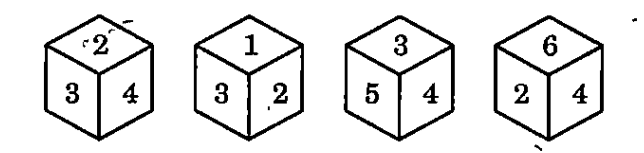
The number on the face opposite to 2 is:- Communication can be seen as processes of information transmission governed by three levels of semiotic rules:
- Which one of the following models use only three elements to explain the process of communication ?



