(Take Planck's constant as $6.6 \times 10^{-34} \text{ J s}$)
Understanding the Photoelectric Effect Condition
The photoelectric effect happens only if the energy of the incident photon ($E_{photon}$) meets or exceeds the metal's work function ($\phi$).
Photon energy is calculated using $E_{photon} = \frac{hc}{\lambda}$, where $h$ is Planck's constant, $c$ is the speed of light, and $\lambda$ is the wavelength.
The condition for the effect is: $ \frac{hc}{\lambda} \ge \phi $ This means the effect occurs for wavelengths $\lambda \le \frac{hc}{\phi}$.
Conversely, the effect *does not* occur if the photon energy is less than the work function: $ \frac{hc}{\lambda} < \phi $ This condition implies the effect is absent for wavelengths $\lambda > \frac{hc}{\phi}$. The critical wavelength $\lambda_0 = \frac{hc}{\phi}$ is known as the threshold wavelength.
Calculating the Threshold Wavelength
We are given:
- Work function, $\phi = 6.6 \text{ eV}$
- Planck's constant, $h = 6.6 \times 10^{-34} \text{ J s}$
- Speed of light, $c \approx 3 \times 10^8 \text{ m/s}$
- Conversion factor, $1 \text{ eV} \approx 1.602 \times 10^{-19} \text{ J}$
First, calculate the value of $hc$:
$ hc = (6.6 \times 10^{-34} \text{ J s}) \times (3 \times 10^8 \text{ m/s}) = 1.98 \times 10^{-25} \text{ J m} $Next, convert the work function $\phi$ from electron volts (eV) to Joules (J):
$ \phi = 6.6 \text{ eV} \times (1.602 \times 10^{-19} \text{ J/eV}) \approx 1.05732 \times 10^{-18} \text{ J} $Now, calculate the threshold wavelength $\lambda_0$ using the formula $\lambda_0 = \frac{hc}{\phi}$:
$ \lambda_0 = \frac{1.98 \times 10^{-25} \text{ J m}}{1.05732 \times 10^{-18} \text{ J}} \approx 1.8726 \times 10^{-7} \text{ m} $Convert this threshold wavelength to nanometers (nm):
$ \lambda_0 \approx 1.8726 \times 10^{-7} \text{ m} \times \frac{10^9 \text{ nm}}{1 \text{ m}} \approx 187.3 \text{ nm} $Identifying the Wavelength Without Photoelectric Effect
The photoelectric effect will not occur for incident radiation wavelengths ($\lambda$) that are greater than the threshold wavelength ($\lambda_0$).
We need to find the option where $\lambda > 187.3 \text{ nm}$. Let's check the given options:
- Option 1: $50 \text{ nm}$ ($50 < 187.3$) - Effect occurs.
- Option 2: $100 \text{ nm}$ ($100 < 187.3$) - Effect occurs.
- Option 3: $150 \text{ nm}$ ($150 < 187.3$) - Effect occurs.
- Option 4: $200 \text{ nm}$ ($200 > 187.3$) - Effect does NOT occur.
Therefore, the wavelength of incident radiation that does not give rise to the photoelectric effect is $200 \text{ nm}$.
Similar Questions
Match List I with List II :
List I List II A. $E = h\nu$ I. de Broglie wavelength B. Interference II. Particle nature of light C. $\lambda = h/p$ III. Wave nature of light D. Compton effect IV. Energy of photon
Choose the correct answer from the options given below :In the first excited state of hydrogen atom, the energy of its electron is $-3.4 \text{ eV}$. The radial distance of the electron from the hydrogen nucleus in this case is approximately :
(Take $1 \text{ eV} = 1.6 \times 10^{-19} \text{ J}, \text{ e} = 1.6 \times 10^{-19} \text{ C}$ and $\frac{1}{4\pi\varepsilon_0} = 9 \times 10^9 \text{ N m}^2/\text{C}^2$)Four statements are given (A is mass number) :
A. The volume of a nucleus is proportional to $A^{1/3}$.
B. The volume of a nucleus is proportional to A.
C. The difference in mass of an atom and its nucleus is called the mass defect.
D. The difference in mass of a nucleus and its constituent nucleons is called the mass defect.
Choose the correct answer from the options given below :- An unknown nucleus has a nuclear density of $2.29 \times 10^{17} \text{ kg/m}^3$ and mass of $19.926 \times 10^{-27} \text{ kg}$. Its mass number A is approximately :
(Take $R_0 = 1.2 \times 10^{-15} \text{ m}$, $4\pi = 12.56$) - A beam of light falls on a metal surface such that photo-electrons are generated. If power of the light source starts to decrease linearly with time $t$, then variation of the photocurrent $I$ and magnitude of the stopping potential $|V|$ with time is best represented by :
- A ray of light with wavelength $\lambda$ is incident on three different photo-electric cells namely 1, 2 and 3. The threshold wavelength of these photo-electric cells are $\lambda_1$, $\lambda_2$, and $\lambda_3$, respectively and the magnitude of stopping potentials of these cells are $V_1$, $V_2$ and $V_3$, respectively. The relation between $\lambda$ and threshold wavelengths are $\lambda_1 < \lambda$, $\lambda_2 > \lambda$ and $\lambda_3 \gg \lambda$. The correct option is :
- In Geiger-Marsden experiment, the number of scattered $\alpha$-particles $N(\theta)$ is plotted as a function of scattering angle $\theta$. Which of the following options represents the correct plot ?
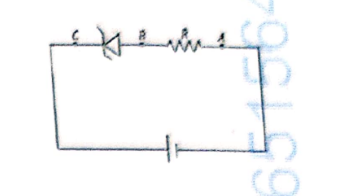
An ideal Zener diode with breakdown voltage of $-3\text{ V}$ is reverse biased with a negative input voltage $V_i = -5\text{ V}$. The magnitude of voltage difference between points B and A is :
- Consider the following nuclear reaction :
$$^{238}\text{U} \rightarrow ^{234}\text{Th} + ^{4}\text{He}$$
Take masses of $^{238}\text{U}$, $^{234}\text{Th}$ and $^{4}\text{He}$ as $238.050\text{ u}$, $234.043\text{ u}$ and $4.003\text{ u}$, respectively. The Q value for the reaction, in keV, is :
[Given : $1\text{ u} = 931.5\text{ MeV c}^{-2}$] - A photon and an electron, each of $20\text{ eV}$ energy, move in free space. The ratio of linear momentum of electron $p_e$ to that of photon $p_{ph}$, $\frac{p_e}{p_{ph}}$ is :
(Take speed of light $= 3 \times 10^8\text{ ms}^{-1}$, charge of electron $= -1.6 \times 10^{-19}\text{ C}$ and mass of electron $= 9 \times 10^{-31}\text{ kg}$)
Important Questions from Modern Physics
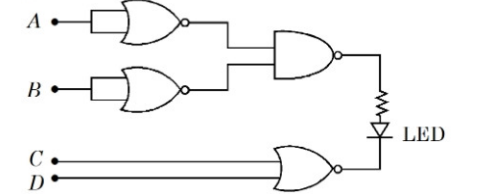
Find the correct combination of A, B, C and D inputs which can cause the LED to glow.
- The minimum frequency of photon required to break a particle of mass 15.348 amu into 4 $\alpha$ particles is _________ kHz.
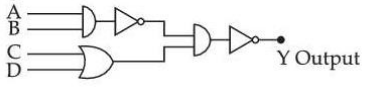
[mass of He nucleus = 4.002 amu, $1 \text{ amu} = 1.66 \times 10^{-27} \text{ kg}, h = 6.6 \times 10^{-34} \text{ J.s} \text{ and } c = 3 \times 10^8 \text{ m/s}$] The correct truth table for the given input data of the following logic gate is :
- Two electrons are moving in orbits of two hydrogen like atoms with speeds $3 \times 10^5 \text{ m/s}$ and $2.5 \times 10^5 \text{ m/s}$ respectively. If the radii of these orbits are nearly same then the possible order of energy states are ______ respectively.
- Given below are two statements:
Statement I: For all elements, greater the mass of the nucleus, greater is the binding energy per nucleon.
Statement II: For all elements, nuclei with less binding energy per nucleon transforms to nuclei with greater binding energy per nucleon.
In the light of the above statements, choose the correct answer from the options given below