Match List I with List II :List I List II A. $E = h\nu$ I. de Broglie wavelength B. Interference II. Particle nature of light C. $\lambda = h/p$ III. Wave nature of light D. Compton effect IV. Energy of photon
Choose the correct answer from the options given below :
A-IV, B-III, C-I, D-II
To solve the given match-making problem between two lists, we need to correctly associate the concepts in List I (representing famous physics equations/concepts) with their corresponding descriptions in List II.
- Matching:
- \(A: E = h\nu\) - This formula represents the energy of a photon, with \(E\) as energy, \(h\) as Planck's constant, and \(\nu\) as the frequency of the photon. Thus, this matches with IV: Energy of photon.
- B: Interference - This phenomenon is associated with the wave nature of light, where light waves overlap and produce regions of constructive and destructive interference. Thus, this matches with III: Wave nature of light.
- \(C: \lambda = h/p\) - This is the de Broglie wavelength, which describes the wave properties of particles like electrons. Here, \(\lambda\) is the wavelength, \(h\) is Planck’s constant, and \(p\) is momentum. Thus, this matches with I: de Broglie wavelength.
- D: Compton effect - This effect provides evidence for the particle nature of light, showcasing the change in wavelength of X-rays when they are scattered, as predicted by the particle theory of light. Thus, this matches with II: Particle nature of light.
- Conclusion: The correct associations from List I to List II are:
- A-IV: E = h\nu corresponds to the energy of a photon.
- B-III: Interference is related to the wave nature of light.
- C-I: \lambda = h/p is the de Broglie wavelength.
- D-II: Compton effect explains the particle nature of light.
- Correct Option: Based on the correct associations, the correct answer is:
A-IV, B-III, C-I, D-II
Similar Questions
In the first excited state of hydrogen atom, the energy of its electron is $-3.4 \text{ eV}$. The radial distance of the electron from the hydrogen nucleus in this case is approximately :
(Take $1 \text{ eV} = 1.6 \times 10^{-19} \text{ J}, \text{ e} = 1.6 \times 10^{-19} \text{ C}$ and $\frac{1}{4\pi\varepsilon_0} = 9 \times 10^9 \text{ N m}^2/\text{C}^2$)- An unknown nucleus has a nuclear density of $2.29 \times 10^{17} \text{ kg/m}^3$ and mass of $19.926 \times 10^{-27} \text{ kg}$. Its mass number A is approximately :
(Take $R_0 = 1.2 \times 10^{-15} \text{ m}$, $4\pi = 12.56$) Four statements are given (A is mass number) :
A. The volume of a nucleus is proportional to $A^{1/3}$.
B. The volume of a nucleus is proportional to A.
C. The difference in mass of an atom and its nucleus is called the mass defect.
D. The difference in mass of a nucleus and its constituent nucleons is called the mass defect.
Choose the correct answer from the options given below :- For a metal of work function $6.6 \text{ eV}$, which of the following wavelengths of incident radiation does not give rise to the photoelectric effect?
(Take Planck's constant as $6.6 \times 10^{-34} \text{ J s}$) - In Geiger-Marsden experiment, the number of scattered $\alpha$-particles $N(\theta)$ is plotted as a function of scattering angle $\theta$. Which of the following options represents the correct plot ?
- A beam of light falls on a metal surface such that photo-electrons are generated. If power of the light source starts to decrease linearly with time $t$, then variation of the photocurrent $I$ and magnitude of the stopping potential $|V|$ with time is best represented by :
- A ray of light with wavelength $\lambda$ is incident on three different photo-electric cells namely 1, 2 and 3. The threshold wavelength of these photo-electric cells are $\lambda_1$, $\lambda_2$, and $\lambda_3$, respectively and the magnitude of stopping potentials of these cells are $V_1$, $V_2$ and $V_3$, respectively. The relation between $\lambda$ and threshold wavelengths are $\lambda_1 < \lambda$, $\lambda_2 > \lambda$ and $\lambda_3 \gg \lambda$. The correct option is :
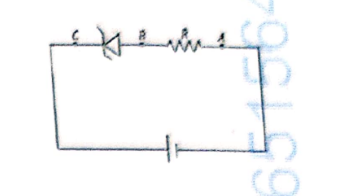
An ideal Zener diode with breakdown voltage of $-3\text{ V}$ is reverse biased with a negative input voltage $V_i = -5\text{ V}$. The magnitude of voltage difference between points B and A is :
- Consider the following nuclear reaction :
$$^{238}\text{U} \rightarrow ^{234}\text{Th} + ^{4}\text{He}$$
Take masses of $^{238}\text{U}$, $^{234}\text{Th}$ and $^{4}\text{He}$ as $238.050\text{ u}$, $234.043\text{ u}$ and $4.003\text{ u}$, respectively. The Q value for the reaction, in keV, is :
[Given : $1\text{ u} = 931.5\text{ MeV c}^{-2}$] - A photon and an electron, each of $20\text{ eV}$ energy, move in free space. The ratio of linear momentum of electron $p_e$ to that of photon $p_{ph}$, $\frac{p_e}{p_{ph}}$ is :
(Take speed of light $= 3 \times 10^8\text{ ms}^{-1}$, charge of electron $= -1.6 \times 10^{-19}\text{ C}$ and mass of electron $= 9 \times 10^{-31}\text{ kg}$)
Important Questions from Modern Physics
- A voltage regulating circuit consisting of Zener diode, having break-down voltage of 10 V and maximum power dissipation of 0.4 W, is operated at 15 V. The approximate value of protective resistance in this circuit is ______ $\Omega$.
The binding energy for the following nuclear reactions are expressed in MeV.
${}_2\text{He}^3 + {}_0\text{n}^1 \rightarrow {}_2\text{He}^4 + 20 \text{ MeV}$
${}_2\text{He}^4 + {}_0\text{n}^1 \rightarrow {}_2\text{He}^5 - 0.9 \text{ MeV}$
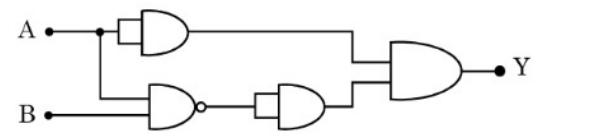
If $\text{X}_3, \text{X}_4, \text{X}_5$ denote the stability of ${}_2\text{He}^3, {}_2\text{He}^4$ and ${}_2\text{He}^5$, respectively, then the correct order is :Identify the correct truth table of the given logic circuit.
- When a light of a given wavelength falls on a metallic surface the stopping potential for photoelectrons is $3.2 \text{ V}$. If a second light having wavelength twice of first light is used, the stopping potential drops to $0.7 \text{ V}$. The wavelength of first light is _______ m.
($h = 6.63 \times 10^{-34} \text{ J.s}, e = 1.6 \times 10^{-19} \text{ C}, c = 3 \times 10^8 \text{ m/s}$) - A particle having electric charge $3 \times 10^{-19}\text{ C}$ and mass $6 \times 10^{-27}\text{ kg}$ is accelerated by applying an electric potential of $1.21\text{ V}$. Wavelength of the matter wave associated with the particle is $\alpha \times 10^{-12}\text{ m}$. The value of $\alpha$ is __________. (Take Planck's constant $= 6.6 \times 10^{-34}\text{ J.s}$)