Particle Wavelength Calculation Using de Broglie Relation
This solution details the calculation of the de Broglie wavelength ($\lambda$) for a charged particle accelerated by an electric potential ($V$). The goal is to find the value of $\alpha$ where the wavelength is expressed as $\alpha \times 10^{-12}\text{ m}$.
Given Information
- Particle Charge, $q = 3 \times 10^{-19}\text{ C}$
- Particle Mass, $m = 6 \times 10^{-27}\text{ kg}$
- Accelerating Potential, $V = 1.21\text{ V}$
- Planck's Constant, $h = 6.6 \times 10^{-34}\text{ J.s}$
- Wavelength Format: $\lambda = \alpha \times 10^{-12}\text{ m}$
Step 1: Calculate Kinetic Energy ($KE$)
The kinetic energy gained by the particle is equal to the work done by the electric potential:
$KE = qV$
Substituting the given values:
$KE = (3 \times 10^{-19}\text{ C}) \times (1.21\text{ V}) = 3.63 \times 10^{-19}\text{ J}$
Step 2: Calculate Momentum ($p$)
The relationship between kinetic energy and momentum is:
$KE = \frac{p^2}{2m}$
Solving for momentum:
$p = \sqrt{2m KE}$
Plugging in the values for $m$ and $KE$:
$p = \sqrt{2 \times (6 \times 10^{-27}\text{ kg}) \times (3.63 \times 10^{-19}\text{ J})}$
$p = \sqrt{43.56 \times 10^{-46}\text{ kg}^2\text{m}^2/\text{s}^2}$
$p = 6.6 \times 10^{-23}\text{ kg m/s}$
Step 3: Calculate de Broglie Wavelength ($\lambda$)
Use the de Broglie wavelength formula:
$\lambda = \frac{h}{p}$
Substitute the values of $h$ and $p$:
$\lambda = \frac{6.6 \times 10^{-34}\text{ J.s}}{6.6 \times 10^{-23}\text{ kg m/s}}$
$\lambda = 1 \times 10^{-11}\text{ m}$
Step 4: Determine the Value of $\alpha$
The calculated wavelength is $\lambda = 1 \times 10^{-11}\text{ m}$. We need to express this in the format $\alpha \times 10^{-12}\text{ m}$:
$1 \times 10^{-11}\text{ m} = 10 \times 10^{-12}\text{ m}$
By comparing $\alpha \times 10^{-12}\text{ m}$ with $10 \times 10^{-12}\text{ m}$, we find:
$\alpha = 10$
Similar Questions
- A voltage regulating circuit consisting of Zener diode, having break-down voltage of 10 V and maximum power dissipation of 0.4 W, is operated at 15 V. The approximate value of protective resistance in this circuit is ______ $\Omega$.
The binding energy for the following nuclear reactions are expressed in MeV.
${}_2\text{He}^3 + {}_0\text{n}^1 \rightarrow {}_2\text{He}^4 + 20 \text{ MeV}$
${}_2\text{He}^4 + {}_0\text{n}^1 \rightarrow {}_2\text{He}^5 - 0.9 \text{ MeV}$
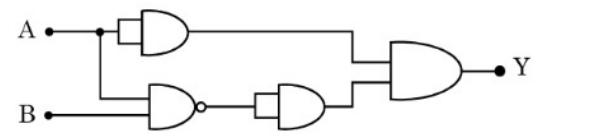
If $\text{X}_3, \text{X}_4, \text{X}_5$ denote the stability of ${}_2\text{He}^3, {}_2\text{He}^4$ and ${}_2\text{He}^5$, respectively, then the correct order is :Identify the correct truth table of the given logic circuit.
- When a light of a given wavelength falls on a metallic surface the stopping potential for photoelectrons is $3.2 \text{ V}$. If a second light having wavelength twice of first light is used, the stopping potential drops to $0.7 \text{ V}$. The wavelength of first light is _______ m.
($h = 6.63 \times 10^{-34} \text{ J.s}, e = 1.6 \times 10^{-19} \text{ C}, c = 3 \times 10^8 \text{ m/s}$) - The average energy released per fission for the nucleus of ${}^{235}_{92}\text{U}$ is $190 \text{ MeV}$. When all the atoms of $47 \text{ g}$ pure ${}^{235}_{92}\text{U}$ undergo fission process, the energy released is $\alpha \times 10^{23} \text{ MeV}$. The value of $\alpha$ is ________.
(Avogadro Number = $6 \times 10^{23} \text{ per mole}$) - Using Bohr's model, calculate the ratio of the magnetic fields generated due to the motion of the electrons in the $2^{\text{nd}}$ and $4^{\text{th}}$ orbits of hydrogen atom __________.
- The energy released when $\frac{7}{17.13} \text{ kg}$ of ${}^7_3\text{Li}$ is converted into ${}^4_2\text{He}$ by proton bombardment is $\alpha \times 10^{32} \text{ eV}$. The value of $\alpha$ is _________. (Nearest integer)
(Mass of ${}^7_3\text{Li} = 7.0183 \text{ u}$, mass of ${}^4_2\text{He} = 4.004 \text{ u}$, mass of proton = $1.008 \text{ u}$ and $1 \text{ u} = 931 \text{ MeV/}c^2$ and Avogadro number $= 6.0 \times 10^{23}$) - The energy of an electron in an orbit of the Bohr's atom is $-0.04 E_0 \text{ eV}$ where $E_0$ is the ground state energy. If $L$ is the angular momentum of the electron in this orbit and $h$ is the Planck's constant, then $\frac{2\pi L}{h}$ is __________ :
- A nuclear physicist performed an experiment on the scattering of alpha particles by thin metal foil of gold. The alpha particles were accelerated up to kinetic energy $3.2$ Mev. The estimation of the radius of the nucleus of gold element $(Z = 79)$ by him is $\times 10^{-16}$ m
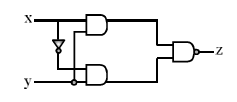
(Take $\frac{1}{4\pi \epsilon_0} = 9\times10^9 \frac{Nm^2}{C^2}$) Truth table for the following digital circuit will be :
Important Questions from Modern Physics
- A voltage regulating circuit consisting of Zener diode, having break-down voltage of 10 V and maximum power dissipation of 0.4 W, is operated at 15 V. The approximate value of protective resistance in this circuit is ______ $\Omega$.
The binding energy for the following nuclear reactions are expressed in MeV.
${}_2\text{He}^3 + {}_0\text{n}^1 \rightarrow {}_2\text{He}^4 + 20 \text{ MeV}$
${}_2\text{He}^4 + {}_0\text{n}^1 \rightarrow {}_2\text{He}^5 - 0.9 \text{ MeV}$
If $\text{X}_3, \text{X}_4, \text{X}_5$ denote the stability of ${}_2\text{He}^3, {}_2\text{He}^4$ and ${}_2\text{He}^5$, respectively, then the correct order is :Identify the correct truth table of the given logic circuit.
- When a light of a given wavelength falls on a metallic surface the stopping potential for photoelectrons is $3.2 \text{ V}$. If a second light having wavelength twice of first light is used, the stopping potential drops to $0.7 \text{ V}$. The wavelength of first light is _______ m.
($h = 6.63 \times 10^{-34} \text{ J.s}, e = 1.6 \times 10^{-19} \text{ C}, c = 3 \times 10^8 \text{ m/s}$) - The average energy released per fission for the nucleus of ${}^{235}_{92}\text{U}$ is $190 \text{ MeV}$. When all the atoms of $47 \text{ g}$ pure ${}^{235}_{92}\text{U}$ undergo fission process, the energy released is $\alpha \times 10^{23} \text{ MeV}$. The value of $\alpha$ is ________.
(Avogadro Number = $6 \times 10^{23} \text{ per mole}$)