
(electron concentration $= 5 \times 10^{28} \text{/m}^3$ and electron charge = $1.6 \times 10^{-19} \text{ C}$)
Calculate Electron Mobility in a Cylindrical Conductor
This solution details the steps to find the electron mobility ($\mu$) in a conductor based on its electrical properties and dimensions.
Given Parameters
- Length, $L = 2 \text{ m}$
- Area, $A = 0.2 \text{ mm}^2 = 0.2 \times 10^{-6} \text{ m}^2 = 2 \times 10^{-7} \text{ m}^2$
- Current, $I = 1.6 \text{ A}$
- Voltage, $V = 2 \text{ V}$
- Electron concentration, $n = 5 \times 10^{28} \text{ m}^{-3}$
- Electron charge, $e = 1.6 \times 10^{-19} \text{ C}$
- Mobility expression, $\mu = \alpha \times 10^{-3} \text{ m}^2\text{/V.s}$
Calculation Steps
Step 1: Calculate Electric Field ($E$)
The electric field inside the conductor is calculated using the voltage and length.
$ E = \frac{V}{L} = \frac{2 \text{ V}}{2 \text{ m}} = 1 \text{ V/m} $
Step 2: Calculate Current Density ($J$)
Current density is the current per unit area.
$ J = \frac{I}{A} = \frac{1.6 \text{ A}}{2 \times 10^{-7} \text{ m}^2} = 0.8 \times 10^{7} \text{ A/m}^2 = 8 \times 10^{6} \text{ A/m}^2 $
Step 3: Calculate Electron Mobility ($\mu$)
The relationship between current density, electron concentration, charge, and mobility is given by $J = n e \mu E$. We rearrange this to solve for $\mu$.
$ \mu = \frac{J}{n e E} $
Substitute the calculated and given values:
$ \mu = \frac{8 \times 10^{6} \text{ A/m}^2}{(5 \times 10^{28} \text{ m}^{-3}) \times (1.6 \times 10^{-19} \text{ C}) \times (1 \text{ V/m})} $
$ \mu = \frac{8 \times 10^{6}}{8 \times 10^{9}} \text{ m}^2\text{/V.s} $
$ \mu = 1 \times 10^{-3} \text{ m}^2\text{/V.s} $
Step 4: Determine the value of $\alpha$
The calculated mobility is $\mu = 1 \times 10^{-3} \text{ m}^2\text{/V.s}$. The problem states the mobility is $\alpha \times 10^{-3} \text{ m}^2\text{/V.s}$. Comparing these two expressions, we find:
$ \alpha = 1 $
Final Answer
The value of $\alpha$ is 1.
Similar Questions
- The electric field of a plane electromagnetic wave, travelling in an unknown non-magnetic medium is given by,
$E_y = 20 \sin(3 \times 10^6 x - 4.5 \times 10^{14} t) \text{ V/m}$
(where x, t and other values have S.I. units). The dielectric constant of the medium is _________.
(speed of light in free space is $3 \times 10^8 \text{ m/s}$) - A short bar magnet placed with its axis at $30^\circ$ with an external field of 800 Gauss, experiences a torque of 0.016 N.m. The work done in moving it from most stable to most unstable position is $\alpha \times 10^{-3} \text{ J}$. The value of $\alpha$ is ______.
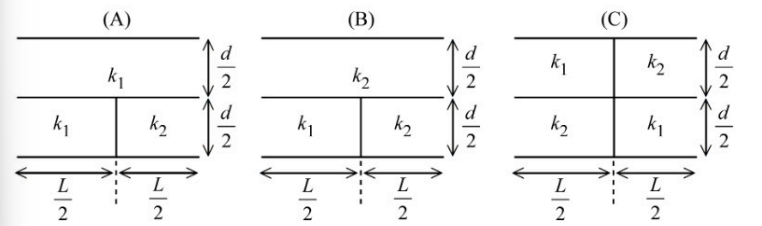
Three parallel plate capacitors each with area $A$ and separation $d$ are filled with two dielectric ($k_1$ and $k_2$) in the following fashion. Which of the following is true? ($k_1 > k_2$)
- A moving coil galvanometer of resistance $100 \text{ }\Omega$ shows a full scale deflection for a current of $1 \text{ mA}$. The value of resistance required to convert this galvanometer into an ammeter, showing full scale deflection for a current of $5 \text{ mA}$, is _______ $\Omega$
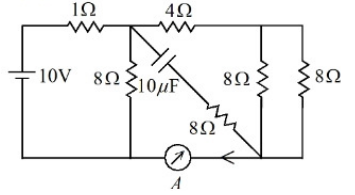
The reading of the ammeter ($A$) in steady state in the following circuit (assuming negligible internal resistance of the ammeter) is _______ A.
- A capacitor $C$ is first charged fully with potential difference of $V_0$ and disconnected from the battery. The charged capacitor is connected across an inductor having inductance $L$. In $t\text{ s}$ $25\%$ of the initial energy in the capacitor is transferred to the inductor. The value of $t$ is __________ $\text{s}$.
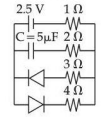
The charge stored by the capacitor $C$ in the given circuit in the steady state is __________ $\mu\text{C}$.
- An electromagnetic wave of frequency $100\text{ MHz}$ propagates through a medium of conductivity, $\sigma = 10\text{ mho/m}$. The ratio of maximum conduction current density to maximum displacement current density is __________.
$\left[ \text{Take } \frac{1}{4\pi\varepsilon_0} = 9 \times 10^9\text{ Nm}^2\text{/C}^2 \right]$ - An inductor stores $16\text{ J}$ of magnetic field energy and dissipates $32\text{ W}$ of thermal energy due to its resistance when an a.c. current of $2\text{ A}$ (rms) and frequency $50\text{ Hz}$ flows through it. The ratio of inductive reactance to its resistance is _________. ($\pi = 3.14$)
- A simple pendulum made of mass 10 g and a metallic wire of length 10 cm is suspended vertically in a uniform magnetic field of 2 T. The magnetic field direction is perpendicular to the plane of oscillations of the pendulum. If the pendulum is released from an angle of $60^\circ$ with vertical, then maximum induced EMF between the point of suspension and point of oscillation is ___________ mV. (Take $g = 10\text{ m/s}^2$)
Important Questions from Electricity and Magnetism
- The electric field of a plane electromagnetic wave, travelling in an unknown non-magnetic medium is given by,
$E_y = 20 \sin(3 \times 10^6 x - 4.5 \times 10^{14} t) \text{ V/m}$
(where x, t and other values have S.I. units). The dielectric constant of the medium is _________.
(speed of light in free space is $3 \times 10^8 \text{ m/s}$) - A short bar magnet placed with its axis at $30^\circ$ with an external field of 800 Gauss, experiences a torque of 0.016 N.m. The work done in moving it from most stable to most unstable position is $\alpha \times 10^{-3} \text{ J}$. The value of $\alpha$ is ______.
Three parallel plate capacitors each with area $A$ and separation $d$ are filled with two dielectric ($k_1$ and $k_2$) in the following fashion. Which of the following is true? ($k_1 > k_2$)
- A moving coil galvanometer of resistance $100 \text{ }\Omega$ shows a full scale deflection for a current of $1 \text{ mA}$. The value of resistance required to convert this galvanometer into an ammeter, showing full scale deflection for a current of $5 \text{ mA}$, is _______ $\Omega$
The reading of the ammeter ($A$) in steady state in the following circuit (assuming negligible internal resistance of the ammeter) is _______ A.



