
This problem involves calculating the work done on a bar magnet in an external magnetic field, using the given torque and magnetic field strength.
Understanding Torque and Magnetic Field
The torque ($\tau$) experienced by a magnetic dipole (like a bar magnet) in an external magnetic field ($B$) is given by the formula:
$ \tau = MB \sin \theta $
Where:
- $M$ is the magnetic dipole moment of the magnet.
- $B$ is the strength of the external magnetic field.
- $\theta$ is the angle between the axis of the magnet and the magnetic field.
We are given:
- $B = 800 \text{ Gauss}$
- $\theta = 30^\circ$
- $\tau = 0.016 \text{ N.m}$
First, convert the magnetic field from Gauss to Tesla (T):
$ 1 \text{ Gauss} = 10^{-4} \text{ T} $
$ B = 800 \times 10^{-4} \text{ T} = 0.08 \text{ T} $
Calculating Magnetic Moment (M)
Using the torque formula, we can find the magnetic dipole moment $M$:
$ 0.016 \text{ N.m} = M \times (0.08 \text{ T}) \times \sin(30^\circ) $
Since $\sin(30^\circ) = 0.5$:
$ 0.016 = M \times 0.08 \times 0.5 $
$ 0.016 = M \times 0.04 $
$ M = \frac{0.016}{0.04} = \frac{16}{40} = 0.4 \text{ A.m}^2 $
Calculating Work Done (W)
The work done ($W$) in moving a magnetic dipole from an angle $\theta_1$ to $\theta_2$ in a magnetic field is:
$ W = MB (\cos \theta_1 - \cos \theta_2) $
The most stable position corresponds to $\theta_1 = 0^\circ$ (parallel alignment).
The most unstable position corresponds to $\theta_2 = 180^\circ$ (anti-parallel alignment).
Substitute the values of $M$, $B$, $\theta_1$, and $\theta_2$:
$ W = (0.4 \text{ A.m}^2) \times (0.08 \text{ T}) \times (\cos 0^\circ - \cos 180^\circ) $
Since $\cos 0^\circ = 1$ and $\cos 180^\circ = -1$:
$ W = 0.032 \times (1 - (-1)) $
$ W = 0.032 \times (1 + 1) $
$ W = 0.032 \times 2 = 0.064 \text{ J} $
Finding the Value of $\alpha$
The problem states that the work done is $\alpha \times 10^{-3} \text{ J}$.
$ W = \alpha \times 10^{-3} \text{ J} $
Equating the calculated work done to the given expression:
$ 0.064 \text{ J} = \alpha \times 10^{-3} \text{ J} $
Solving for $\alpha$:
$ \alpha = \frac{0.064}{10^{-3}} = 0.064 \times 10^3 = 64 $
Therefore, the value of $\alpha$ is 64.
Similar Questions
- An electromagnetic wave of frequency $100\text{ MHz}$ propagates through a medium of conductivity, $\sigma = 10\text{ mho/m}$. The ratio of maximum conduction current density to maximum displacement current density is __________.
$\left[ \text{Take } \frac{1}{4\pi\varepsilon_0} = 9 \times 10^9\text{ Nm}^2\text{/C}^2 \right]$ - An inductor stores $16\text{ J}$ of magnetic field energy and dissipates $32\text{ W}$ of thermal energy due to its resistance when an a.c. current of $2\text{ A}$ (rms) and frequency $50\text{ Hz}$ flows through it. The ratio of inductive reactance to its resistance is _________. ($\pi = 3.14$)
- A simple pendulum made of mass 10 g and a metallic wire of length 10 cm is suspended vertically in a uniform magnetic field of 2 T. The magnetic field direction is perpendicular to the plane of oscillations of the pendulum. If the pendulum is released from an angle of $60^\circ$ with vertical, then maximum induced EMF between the point of suspension and point of oscillation is ___________ mV. (Take $g = 10\text{ m/s}^2$)
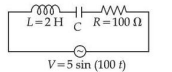
Using a variable frequency a.c. voltage source the maximum current measured in the given LCR circuit is 50 mA for $V = 5\sin(100t)$ The values of L and R are shown in the figure. The capacitance of the capacitor (C) used is ___________ $\mu\text{F}$.
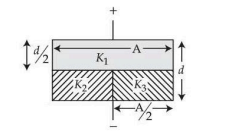
The space between the plates of a parallel plate capacitor of capacitance C (without any dielectric) is now filled with three dielectric slabs of dielectric constants $K_1 = 2$, $K_2 = 3$ and $K_3 = 5$ (as shown in figure). If new capacitance is $\frac{n}{3}C$ then the value of $n$ is ___________.
- The equation of the electric field of an electromagnetic wave propagating through free space is given by : $E = \sqrt{377} \sin(6.27 \times 10^3 t - 2.09 \times 10^{-5} x)\text{ N/C}$
The average power of the electromagnetic wave is $\left(\frac{1}{\alpha}\right)\text{ W/m}^2$. The value of $\alpha$ is ___________.
$\left[ \text{Take } \sqrt{\frac{\mu_0}{\epsilon_0}} = 377\text{ in SI units} \right]$ Combination of four parallel plate air capacitors is shown in figure. Separation between the plate P1 & P2 is $\frac{d}{3}$ and separation between the plates P2 and P3 is d.
The equivalent capacitance of the configuration is _____________$\mu$F.
(Given $\frac{\epsilon_0 A}{d} = 4\mu$F . Where A=Area of plates)
- A plane polarized monochromatic EM wave is traveling in vacuum along z direction such that at $t = t_1$ it is found that the electric field is zero at a spatial point $z_1$. The next zero that occurs in its neighbourhood is at $z_2$. The frequency of the electromagnetic wave is :
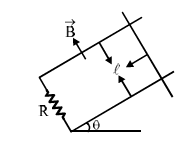
A copper rod of mass m slides under gravity on two smooth parallel rails, with separation $l$ and set at an angle of $\theta$ with the horizontal. At the bottom, rails are joined by a resistance R. There is a uniform magnetic field B normal to the plane of the rails, as shown in the figure. The terminal speed of the copper rod is :
- A copper rod of cross-sectional area A carries a uniform current I through it. At temperature T, if the volume charge density of the rod is $\rho$, how long will the charges take to travel a distance d?
Important Questions from Electricity and Magnetism
- An electromagnetic wave of frequency $100\text{ MHz}$ propagates through a medium of conductivity, $\sigma = 10\text{ mho/m}$. The ratio of maximum conduction current density to maximum displacement current density is __________.
$\left[ \text{Take } \frac{1}{4\pi\varepsilon_0} = 9 \times 10^9\text{ Nm}^2\text{/C}^2 \right]$ - An inductor stores $16\text{ J}$ of magnetic field energy and dissipates $32\text{ W}$ of thermal energy due to its resistance when an a.c. current of $2\text{ A}$ (rms) and frequency $50\text{ Hz}$ flows through it. The ratio of inductive reactance to its resistance is _________. ($\pi = 3.14$)
- A simple pendulum made of mass 10 g and a metallic wire of length 10 cm is suspended vertically in a uniform magnetic field of 2 T. The magnetic field direction is perpendicular to the plane of oscillations of the pendulum. If the pendulum is released from an angle of $60^\circ$ with vertical, then maximum induced EMF between the point of suspension and point of oscillation is ___________ mV. (Take $g = 10\text{ m/s}^2$)
Using a variable frequency a.c. voltage source the maximum current measured in the given LCR circuit is 50 mA for $V = 5\sin(100t)$ The values of L and R are shown in the figure. The capacitance of the capacitor (C) used is ___________ $\mu\text{F}$.
The space between the plates of a parallel plate capacitor of capacitance C (without any dielectric) is now filled with three dielectric slabs of dielectric constants $K_1 = 2$, $K_2 = 3$ and $K_3 = 5$ (as shown in figure). If new capacitance is $\frac{n}{3}C$ then the value of $n$ is ___________.


