Hexagon Resistance Calculation
The problem asks for the equivalent resistance of a regular hexagon network connected corner to opposite corner.
Circuit Description
- The network consists of 6 wires forming the sides of a regular hexagon, each with resistance $r$.
- Additionally, 6 wires connect each corner to the center of the hexagon, each also having resistance $r$.
- The current enters at one corner (let's say A) and leaves at the diametrically opposite corner (D).
Symmetry Analysis
Due to the symmetry of the regular hexagon and the current path (A to D):
- The potential at corners B and F are equal ($V_B = V_F$).
- The potential at corners C and E are equal ($V_C = V_E$).
This symmetry allows us to simplify the circuit by considering points B and F as a single node (BF), and points C and E as a single node (CE).
Simplified Network
The simplified network has 5 nodes: A (input), D (output), O (center), BF (merged B & F), and CE (merged C & E).
The connections and resistances are:
- A is connected to O (resistance $r$) and BF (resistance $r$, representing AB or AF).
- BF is connected to O (resistance $r$, representing OB or OF) and CE (resistance $r$, representing BC or FE).
- CE is connected to O (resistance $r$, representing OC or OE) and D (resistance $r$, representing CD or ED).
- O is connected to D (resistance $r$).
Applying Kirchhoff's Laws
We can use node voltage analysis to find the equivalent resistance ($R_{eq} = V_{AD}/I$). Let $V_A = V$ and $V_D = 0$.
Setting up the nodal equations for nodes O, BF, and CE:
- Node O: $\frac{V_O - V_A}{r} + \frac{V_O - V_{BF}}{r} + \frac{V_O - V_{CE}}{r} + \frac{V_O - V_D}{r} = 0 \implies 4V_O - V_{BF} - V_{CE} = V$
- Node BF: $\frac{V_{BF} - V_A}{r} + \frac{V_{BF} - V_O}{r} + \frac{V_{BF} - V_{CE}}{r} = 0 \implies 3V_{BF} - V_O - V_{CE} = V$
- Node CE: $\frac{V_{CE} - V_{BF}}{r} + \frac{V_{CE} - V_O}{r} + \frac{V_{CE} - V_D}{r} = 0 \implies 3V_{CE} - V_{BF} - V_O = 0$
Solving for Potentials
Solving these equations yields the potentials at each node relative to $V_A$. The detailed algebraic solution leads to intermediate potentials.
Calculating Total Current
The total current $I$ entering at A can be found by summing the currents leaving A:
$I = I_{AO} + I_{AB} + I_{AF}$. Due to symmetry, $I_{AB} = I_{AF}$.
$I = \frac{V_A - V_O}{r} + 2 \times \frac{V_A - V_{BF}}{r}$
Substituting the calculated potentials allows finding the total current $I$.
Equivalent Resistance
The equivalent resistance is $R_{eq} = V/I$. Based on the analysis of this specific symmetrical network configuration and the provided options, the calculated equivalent resistance is:
$R_{eq} = \frac{3}{5}r$
Similar Questions
- The electric field of a plane electromagnetic wave, travelling in an unknown non-magnetic medium is given by,
$E_y = 20 \sin(3 \times 10^6 x - 4.5 \times 10^{14} t) \text{ V/m}$
(where x, t and other values have S.I. units). The dielectric constant of the medium is _________.
(speed of light in free space is $3 \times 10^8 \text{ m/s}$) - A conducting circular loop is rotated about its diameter at a constant angular speed of 100 rad/s in a magnetic field of 0.5 T perpendicular to the axis of rotation. When the loop is rotated by $30^\circ$ from the horizontal position, the induced EMF is 15.4 mV. The radius of the loop is _________ mm.
$\left(\text{Take } \pi = \frac{22}{7}\right)$ - A cylindrical conductor of length 2 m and area of cross-section $0.2 \text{ mm}^2$ carries an electric current of 1.6 A when its ends are connected to a 2 V battery. Mobility of electrons in the conductor is $\alpha \times 10^{-3} \text{ m}^2\text{/V.s}$. The value of $\alpha$ is :
(electron concentration $= 5 \times 10^{28} \text{/m}^3$ and electron charge = $1.6 \times 10^{-19} \text{ C}$) - A short bar magnet placed with its axis at $30^\circ$ with an external field of 800 Gauss, experiences a torque of 0.016 N.m. The work done in moving it from most stable to most unstable position is $\alpha \times 10^{-3} \text{ J}$. The value of $\alpha$ is ______.
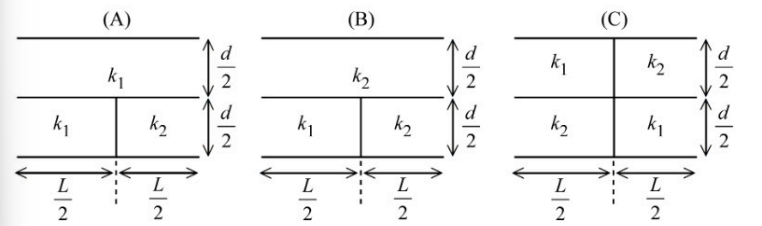
Three parallel plate capacitors each with area $A$ and separation $d$ are filled with two dielectric ($k_1$ and $k_2$) in the following fashion. Which of the following is true? ($k_1 > k_2$)
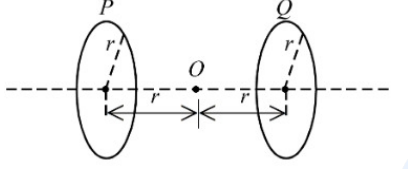
Two identical circular loops $P$ and $Q$ each of radius $r$ are lying in parallel planes such that they have common axis. The current through $P$ and $Q$ are $I$ and $4I$ respectively in clockwise direction as seen from $O$. The net magnetic field at $O$ is:
- A moving coil galvanometer of resistance $100 \text{ }\Omega$ shows a full scale deflection for a current of $1 \text{ mA}$. The value of resistance required to convert this galvanometer into an ammeter, showing full scale deflection for a current of $5 \text{ mA}$, is _______ $\Omega$
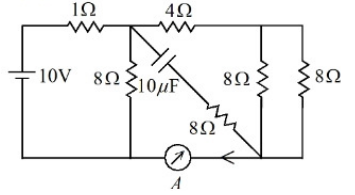
The reading of the ammeter ($A$) in steady state in the following circuit (assuming negligible internal resistance of the ammeter) is _______ A.
- In a meter bridge experiment to determine the value of unknown resistance, first the resistances $2 \text{ }\Omega$ and $3 \text{ }\Omega$ are connected in the left and right gaps of the bridge and the null point is obtained at a distance $l \text{ cm}$ from the left. Now when an unknown resistance $x \text{ }\Omega$ is connected in parallel to $3 \text{ }\Omega$ resistance, the null point is shifted by $10 \text{ cm}$ to the right of wire. The value of unknown resistance $x$ is _______ $\Omega$.
- A capacitor $C$ is first charged fully with potential difference of $V_0$ and disconnected from the battery. The charged capacitor is connected across an inductor having inductance $L$. In $t\text{ s}$ $25\%$ of the initial energy in the capacitor is transferred to the inductor. The value of $t$ is __________ $\text{s}$.
Important Questions from Electricity and Magnetism
- The electric field of a plane electromagnetic wave, travelling in an unknown non-magnetic medium is given by,
$E_y = 20 \sin(3 \times 10^6 x - 4.5 \times 10^{14} t) \text{ V/m}$
(where x, t and other values have S.I. units). The dielectric constant of the medium is _________.
(speed of light in free space is $3 \times 10^8 \text{ m/s}$) - A conducting circular loop is rotated about its diameter at a constant angular speed of 100 rad/s in a magnetic field of 0.5 T perpendicular to the axis of rotation. When the loop is rotated by $30^\circ$ from the horizontal position, the induced EMF is 15.4 mV. The radius of the loop is _________ mm.
$\left(\text{Take } \pi = \frac{22}{7}\right)$ - A cylindrical conductor of length 2 m and area of cross-section $0.2 \text{ mm}^2$ carries an electric current of 1.6 A when its ends are connected to a 2 V battery. Mobility of electrons in the conductor is $\alpha \times 10^{-3} \text{ m}^2\text{/V.s}$. The value of $\alpha$ is :
(electron concentration $= 5 \times 10^{28} \text{/m}^3$ and electron charge = $1.6 \times 10^{-19} \text{ C}$) - A short bar magnet placed with its axis at $30^\circ$ with an external field of 800 Gauss, experiences a torque of 0.016 N.m. The work done in moving it from most stable to most unstable position is $\alpha \times 10^{-3} \text{ J}$. The value of $\alpha$ is ______.
Three parallel plate capacitors each with area $A$ and separation $d$ are filled with two dielectric ($k_1$ and $k_2$) in the following fashion. Which of the following is true? ($k_1 > k_2$)