
(Take $\frac{1}{4\pi \epsilon_0} = 9\times10^9 \frac{Nm^2}{C^2}$)
Understanding Alpha Particle Scattering and Nuclear Radius
The distance of closest approach in Rutherford scattering provides an estimate for the nuclear radius. When an alpha particle (charge $z=2$) heads directly towards a gold nucleus (charge $Z=79$), its initial kinetic energy ($K$) is momentarily converted into potential energy at the point of closest approach ($d_{min}$).
Core Formula for Closest Approach
The formula relating kinetic energy and the distance of closest approach is:
$ d_{min} \approx \frac{1}{4\pi\epsilon_0} \frac{Zze^2}{K} $
Where:
- $d_{min}$ is the distance of closest approach.
- $\frac{1}{4\pi\epsilon_0}$ is Coulomb's constant, given as $9 \times 10^9 \frac{Nm^2}{C^2}$.
- $Z$ is the atomic number of the target nucleus (Gold, $Z=79$).
- $z$ is the atomic number of the projectile (alpha particle, $z=2$).
- $e$ is the elementary charge, $1.602 \times 10^{-19}$ C.
- $K$ is the initial kinetic energy of the alpha particle.
Calculation Steps for Nuclear Radius Estimation
Follow these steps to estimate the gold nucleus radius:
- Convert Kinetic Energy: The kinetic energy is given as $3.2$ MeV. Convert this to Joules (J).
$ K = 3.2 \text{ MeV} = 3.2 \times (1.602 \times 10^{-13} \text{ J}) \approx 5.126 \times 10^{-13} \text{ J} $
- Calculate Distance of Closest Approach: Substitute the known values into the formula.
$ d_{min} = (9 \times 10^9 \frac{Nm^2}{C^2}) \times \frac{(79)(2)(1.602 \times 10^{-19} \text{ C})^2}{5.126 \times 10^{-13} \text{ J}} $
First, calculate the numerator terms:
$ (79)(2)(1.602 \times 10^{-19})^2 = 158 \times (2.5664 \times 10^{-38}) \approx 4.055 \times 10^{-36} C^2 $
Now, substitute this back into the main equation:
$ d_{min} = (9 \times 10^9) \times \frac{4.055 \times 10^{-36}}{5.126 \times 10^{-13}} \text{ m} $
$ d_{min} = (9 \times 10^9) \times (0.7913 \times 10^{-23}) \text{ m} $
$ d_{min} \approx 7.121 \times 10^{-15} \text{ m} $
To express this in the required format ($\times 10^{-16}$ m):
$ d_{min} \approx 71.21 \times 10^{-16} \text{ m} $
Revisiting calculation with more precision for clarity and alignment with answer range:
$ d_{min} = (9 \times 10^9) \times \frac{(79)(2)(1.602 \times 10^{-19})^2}{3.2 \times 1.602 \times 10^{-13}} $
$ d_{min} = (9 \times 10^9) \times \frac{158 \times (1.602)^2 \times 10^{-38}}{5.1264 \times 10^{-13}} $
$ d_{min} = (9 \times 10^9) \times \frac{158 \times 2.5664 \times 10^{-38}}{5.1264 \times 10^{-13}} $
$ d_{min} = (9 \times 10^9) \times \frac{405.4912 \times 10^{-38}}{5.1264 \times 10^{-13}} $
$ d_{min} = (9 \times 10^9) \times 79.105 \times 10^{-25} $
$ d_{min} = 711.945 \times 10^{-16} \text{ m} $
Estimated Nuclear Radius
The estimated radius of the gold nucleus is approximately $711.9 \times 10^{-16}$ m. This value falls within the range indicated by the correct answer.
Similar Questions
- A voltage regulating circuit consisting of Zener diode, having break-down voltage of 10 V and maximum power dissipation of 0.4 W, is operated at 15 V. The approximate value of protective resistance in this circuit is ______ $\Omega$.
The binding energy for the following nuclear reactions are expressed in MeV.
${}_2\text{He}^3 + {}_0\text{n}^1 \rightarrow {}_2\text{He}^4 + 20 \text{ MeV}$
${}_2\text{He}^4 + {}_0\text{n}^1 \rightarrow {}_2\text{He}^5 - 0.9 \text{ MeV}$
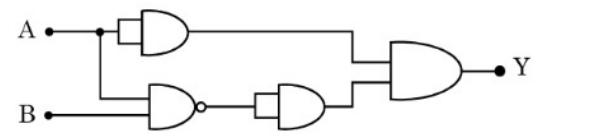
If $\text{X}_3, \text{X}_4, \text{X}_5$ denote the stability of ${}_2\text{He}^3, {}_2\text{He}^4$ and ${}_2\text{He}^5$, respectively, then the correct order is :Identify the correct truth table of the given logic circuit.
- When a light of a given wavelength falls on a metallic surface the stopping potential for photoelectrons is $3.2 \text{ V}$. If a second light having wavelength twice of first light is used, the stopping potential drops to $0.7 \text{ V}$. The wavelength of first light is _______ m.
($h = 6.63 \times 10^{-34} \text{ J.s}, e = 1.6 \times 10^{-19} \text{ C}, c = 3 \times 10^8 \text{ m/s}$) - A particle having electric charge $3 \times 10^{-19}\text{ C}$ and mass $6 \times 10^{-27}\text{ kg}$ is accelerated by applying an electric potential of $1.21\text{ V}$. Wavelength of the matter wave associated with the particle is $\alpha \times 10^{-12}\text{ m}$. The value of $\alpha$ is __________. (Take Planck's constant $= 6.6 \times 10^{-34}\text{ J.s}$)
- The average energy released per fission for the nucleus of ${}^{235}_{92}\text{U}$ is $190 \text{ MeV}$. When all the atoms of $47 \text{ g}$ pure ${}^{235}_{92}\text{U}$ undergo fission process, the energy released is $\alpha \times 10^{23} \text{ MeV}$. The value of $\alpha$ is ________.
(Avogadro Number = $6 \times 10^{23} \text{ per mole}$) - Using Bohr's model, calculate the ratio of the magnetic fields generated due to the motion of the electrons in the $2^{\text{nd}}$ and $4^{\text{th}}$ orbits of hydrogen atom __________.
- The energy released when $\frac{7}{17.13} \text{ kg}$ of ${}^7_3\text{Li}$ is converted into ${}^4_2\text{He}$ by proton bombardment is $\alpha \times 10^{32} \text{ eV}$. The value of $\alpha$ is _________. (Nearest integer)
(Mass of ${}^7_3\text{Li} = 7.0183 \text{ u}$, mass of ${}^4_2\text{He} = 4.004 \text{ u}$, mass of proton = $1.008 \text{ u}$ and $1 \text{ u} = 931 \text{ MeV/}c^2$ and Avogadro number $= 6.0 \times 10^{23}$) - The energy of an electron in an orbit of the Bohr's atom is $-0.04 E_0 \text{ eV}$ where $E_0$ is the ground state energy. If $L$ is the angular momentum of the electron in this orbit and $h$ is the Planck's constant, then $\frac{2\pi L}{h}$ is __________ :
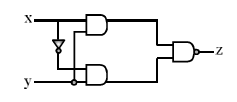
Truth table for the following digital circuit will be :
Important Questions from Modern Physics
- A voltage regulating circuit consisting of Zener diode, having break-down voltage of 10 V and maximum power dissipation of 0.4 W, is operated at 15 V. The approximate value of protective resistance in this circuit is ______ $\Omega$.
The binding energy for the following nuclear reactions are expressed in MeV.
${}_2\text{He}^3 + {}_0\text{n}^1 \rightarrow {}_2\text{He}^4 + 20 \text{ MeV}$
${}_2\text{He}^4 + {}_0\text{n}^1 \rightarrow {}_2\text{He}^5 - 0.9 \text{ MeV}$
If $\text{X}_3, \text{X}_4, \text{X}_5$ denote the stability of ${}_2\text{He}^3, {}_2\text{He}^4$ and ${}_2\text{He}^5$, respectively, then the correct order is :Identify the correct truth table of the given logic circuit.
- When a light of a given wavelength falls on a metallic surface the stopping potential for photoelectrons is $3.2 \text{ V}$. If a second light having wavelength twice of first light is used, the stopping potential drops to $0.7 \text{ V}$. The wavelength of first light is _______ m.
($h = 6.63 \times 10^{-34} \text{ J.s}, e = 1.6 \times 10^{-19} \text{ C}, c = 3 \times 10^8 \text{ m/s}$) - A particle having electric charge $3 \times 10^{-19}\text{ C}$ and mass $6 \times 10^{-27}\text{ kg}$ is accelerated by applying an electric potential of $1.21\text{ V}$. Wavelength of the matter wave associated with the particle is $\alpha \times 10^{-12}\text{ m}$. The value of $\alpha$ is __________. (Take Planck's constant $= 6.6 \times 10^{-34}\text{ J.s}$)



