
Choose the correct logic circuit for the given truth table having inputs A and B.
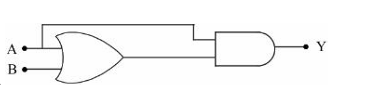
Truth Table Analysis
We are given a truth table with two inputs, A and B, and one output, Y:
| A | B | Y |
|---|---|---|
| 0 | 0 | 0 |
| 0 | 1 | 0 |
| 1 | 0 | 1 |
| 1 | 1 | 1 |
Deriving the Logic Function
By examining the truth table, we can determine the relationship between the inputs (A, B) and the output (Y):
- When A is 0, Y is 0 irrespective of the value of B.
- When A is 1, Y is 1 irrespective of the value of B.
This shows that the output Y is always equal to the input A. Therefore, the logic function is:
$ Y = A $
Selecting the Correct Logic Circuit
The task is to find the logic circuit diagram that implements the function $ Y = A $. This means the circuit should output the value of input A directly, and input B should not affect the output.
Comparing the given truth table with standard logic gates:
- AND gate (Y = A AND B): Output is 1 only when both A and B are 1. (Doesn't match rows 2 and 3).
- OR gate (Y = A OR B): Output is 1 if either A or B (or both) is 1. (Doesn't match row 2 where A=0, B=1, but Y=0).
The function $ Y = A $ is directly implemented by a circuit where A is passed through to Y, and B is effectively ignored. Option D provides the circuit diagram corresponding to this logic.
Similar Questions
Match the LIST-I with LIST-II
LIST-I LIST-II A. $^1_0n + ^{235}_{92}U \rightarrow ^{140}_{54}Xe + ^{94}_{38}Sr + 2^1_0n$ I. Chemical reaction B. $2H_2+O_2\rightarrow 2H_2O$ II. Fusion with +ve Q value C. $^1_1H+^2_1H \rightarrow ^3_2He + ^1_0n$ III. Fission D. $^1_1H+^1_1H \rightarrow ^2_1H+^0_1e$ IV. Fusion with -ve Q value Choose the correct answer from the options given below:
Two coherent monochromatic light beams of intensities 4I and 9I are superimposed. The difference between the maximum and minimum intensities in the resulting interference pattern is xI. The value of x is __________
Considering Bohr's atomic model for hydrogen atom :
(A) the energy of H atom in ground state is same as energy of $He^+$ ion in its first excited state.
(B) the energy of H atom in ground state is same as that for $Li^{++}$ ion in its second excited state.
(C) the energy of H atom in ground state is same as that of $He^+$ ion for its ground state.
(D) the energy of $He^+$ ion in its first excited state is same as that for $Li^{++}$ ion in its ground state.
Choose the correct answer from the options given below :A monochromatic light is incident on a metallic plate having work function $\phi$. An electron, emitted normally to the plate from a point A with maximum kinetic energy, enters a constant magnetic field, perpendicular to the initial velocity of electron. The electron passes through a curve and hits back the plate at a point B. The distance between A and B is:
(Given: The magnitude of charge of an electron is $e$ and mass is $m$, $h$ is Planck's constant and $c$ is velocity of light. Take the magnetic field exists throughout the path of electron)- A zener diode with 5 V zener voltage is used to regulate an unregulated dc voltage input of 25 V. For a 400 $\Omega$ resistor connected in series, the zener current is found to be 4 times load current. The load current ($I_L$) and load resistance ($R_L$) are :
- Given below are two statements :
Statement (I) : The dimensions of Planck's constant and angular momentum are same.
Statement (II): In Bohr's model electron revolve around the nucleus only in those orbits for which angular momentum is integral multiple of Planck's constant.
In the light of the above statements, choose the most appropriate answer from the options given below : - A radioactive material P first decays into Q and then Q decays to non-radioactive material R. Which of the following figure represents time dependent mass of P, Q and R ?
- Consider a n-type semiconductor in which $n_e$ and $n_h$ are number of electrons and holes, respectively.
(A) Holes are minority carriers
(B) The dopant is a pentavalent atom
(C) $n_e n_h \neq n_i^2$
(where $n_i$ is number of electrons or holes in semiconductor when it is intrinsic form)
(D) $n_e n_h = n_i^2$
(E) The holes are not generated due to the donorsChoose the correct answer from the options given below : - For a hydrogen atom, the ratio of the largest wavelength of Lyman series to that of the Balmer series is
- In a hydrogen like ion, the energy difference between the $2^{nd}$ excitation energy state and ground is 108.8 eV. The atomic number of the ion is:
Important Questions from Modern Physics
Match the LIST-I with LIST-II
LIST-I LIST-II A. $^1_0n + ^{235}_{92}U \rightarrow ^{140}_{54}Xe + ^{94}_{38}Sr + 2^1_0n$ I. Chemical reaction B. $2H_2+O_2\rightarrow 2H_2O$ II. Fusion with +ve Q value C. $^1_1H+^2_1H \rightarrow ^3_2He + ^1_0n$ III. Fission D. $^1_1H+^1_1H \rightarrow ^2_1H+^0_1e$ IV. Fusion with -ve Q value Choose the correct answer from the options given below:
Two coherent monochromatic light beams of intensities 4I and 9I are superimposed. The difference between the maximum and minimum intensities in the resulting interference pattern is xI. The value of x is __________
Considering Bohr's atomic model for hydrogen atom :
(A) the energy of H atom in ground state is same as energy of $He^+$ ion in its first excited state.
(B) the energy of H atom in ground state is same as that for $Li^{++}$ ion in its second excited state.
(C) the energy of H atom in ground state is same as that of $He^+$ ion for its ground state.
(D) the energy of $He^+$ ion in its first excited state is same as that for $Li^{++}$ ion in its ground state.
Choose the correct answer from the options given below :A monochromatic light is incident on a metallic plate having work function $\phi$. An electron, emitted normally to the plate from a point A with maximum kinetic energy, enters a constant magnetic field, perpendicular to the initial velocity of electron. The electron passes through a curve and hits back the plate at a point B. The distance between A and B is:
(Given: The magnitude of charge of an electron is $e$ and mass is $m$, $h$ is Planck's constant and $c$ is velocity of light. Take the magnetic field exists throughout the path of electron)- A zener diode with 5 V zener voltage is used to regulate an unregulated dc voltage input of 25 V. For a 400 $\Omega$ resistor connected in series, the zener current is found to be 4 times load current. The load current ($I_L$) and load resistance ($R_L$) are :


