
Radioactive Decay Analysis: P → Q → R
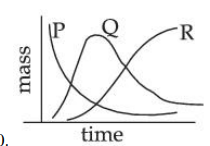
The problem describes a sequential decay chain where radioactive material P decays into another radioactive material Q, which subsequently decays into a stable material R. We need to identify the correct representation of the time-dependent mass of P, Q, and R.
Mass Behavior of P (Parent Nucleus)
Material P is the initial radioactive substance. Its mass decreases over time due to radioactive decay. This decay follows an exponential pattern. Assuming the initial mass of P is $M_0$ at time $t=0$, its mass at time $t$, denoted as $M_P(t)$, can be described by the equation:
$M_P(t) = M_0 e^{-\lambda_1 t}$
Where $\lambda_1$ is the decay constant for P. The graph for P should start at $M_0$ and decrease asymptotically towards zero.
Mass Behavior of Q (Intermediate Nucleus)
Material Q is formed as P decays, so its mass starts increasing from zero. However, Q is also radioactive and decays into R. Therefore, the mass of Q, $M_Q(t)$, increases initially but then decreases as the rate of its decay surpasses the rate of its formation. The graph for Q typically shows an initial rise, reaches a peak concentration, and then decays towards zero. The exact shape depends on the decay constants $\lambda_1$ and $\lambda_2$.
Mass Behavior of R (Final Product)
Material R is the stable end product. It is formed solely from the decay of Q. Its mass, $M_R(t)$, starts at zero and increases over time as Q decays. Theoretically, if the decay chain goes to completion, the total mass of R will approach the initial mass of P ($M_0$). The graph for R should start at zero and increase over time, eventually leveling off.
Identifying the Correct Figure
The figure representing the time-dependent mass of P, Q, and R must show:
- A curve for P starting high and decreasing exponentially.
- A curve for Q starting at zero, rising to a maximum, and then decreasing towards zero.
- A curve for R starting at zero and increasing towards the initial total mass.
The graph provided in Option A matches this expected behavior for a sequential radioactive decay chain (P → Q → R).
Correct Figure: The figure linked in Option A correctly depicts these characteristics.
Similar Questions
Match the LIST-I with LIST-II
LIST-I LIST-II A. $^1_0n + ^{235}_{92}U \rightarrow ^{140}_{54}Xe + ^{94}_{38}Sr + 2^1_0n$ I. Chemical reaction B. $2H_2+O_2\rightarrow 2H_2O$ II. Fusion with +ve Q value C. $^1_1H+^2_1H \rightarrow ^3_2He + ^1_0n$ III. Fission D. $^1_1H+^1_1H \rightarrow ^2_1H+^0_1e$ IV. Fusion with -ve Q value Choose the correct answer from the options given below:
Choose the correct logic circuit for the given truth table having inputs A and B.
\[\begin{array}{|c|c|c|} \hline A & B & Y \\ \hline 0 & 0 & 0 \\ 0 & 1 & 0 \\ 1 & 0 & 1 \\ 1 & 1 & 1 \\ \hline \end{array}\]Two coherent monochromatic light beams of intensities 4I and 9I are superimposed. The difference between the maximum and minimum intensities in the resulting interference pattern is xI. The value of x is __________
Considering Bohr's atomic model for hydrogen atom :
(A) the energy of H atom in ground state is same as energy of $He^+$ ion in its first excited state.
(B) the energy of H atom in ground state is same as that for $Li^{++}$ ion in its second excited state.
(C) the energy of H atom in ground state is same as that of $He^+$ ion for its ground state.
(D) the energy of $He^+$ ion in its first excited state is same as that for $Li^{++}$ ion in its ground state.
Choose the correct answer from the options given below :A monochromatic light is incident on a metallic plate having work function $\phi$. An electron, emitted normally to the plate from a point A with maximum kinetic energy, enters a constant magnetic field, perpendicular to the initial velocity of electron. The electron passes through a curve and hits back the plate at a point B. The distance between A and B is:
(Given: The magnitude of charge of an electron is $e$ and mass is $m$, $h$ is Planck's constant and $c$ is velocity of light. Take the magnetic field exists throughout the path of electron)- A zener diode with 5 V zener voltage is used to regulate an unregulated dc voltage input of 25 V. For a 400 $\Omega$ resistor connected in series, the zener current is found to be 4 times load current. The load current ($I_L$) and load resistance ($R_L$) are :
- Given below are two statements :
Statement (I) : The dimensions of Planck's constant and angular momentum are same.
Statement (II): In Bohr's model electron revolve around the nucleus only in those orbits for which angular momentum is integral multiple of Planck's constant.
In the light of the above statements, choose the most appropriate answer from the options given below : - Consider a n-type semiconductor in which $n_e$ and $n_h$ are number of electrons and holes, respectively.
(A) Holes are minority carriers
(B) The dopant is a pentavalent atom
(C) $n_e n_h \neq n_i^2$
(where $n_i$ is number of electrons or holes in semiconductor when it is intrinsic form)
(D) $n_e n_h = n_i^2$
(E) The holes are not generated due to the donorsChoose the correct answer from the options given below : - For a hydrogen atom, the ratio of the largest wavelength of Lyman series to that of the Balmer series is
- In a hydrogen like ion, the energy difference between the $2^{nd}$ excitation energy state and ground is 108.8 eV. The atomic number of the ion is:
Important Questions from Modern Physics
Match the LIST-I with LIST-II
LIST-I LIST-II A. $^1_0n + ^{235}_{92}U \rightarrow ^{140}_{54}Xe + ^{94}_{38}Sr + 2^1_0n$ I. Chemical reaction B. $2H_2+O_2\rightarrow 2H_2O$ II. Fusion with +ve Q value C. $^1_1H+^2_1H \rightarrow ^3_2He + ^1_0n$ III. Fission D. $^1_1H+^1_1H \rightarrow ^2_1H+^0_1e$ IV. Fusion with -ve Q value Choose the correct answer from the options given below:
Choose the correct logic circuit for the given truth table having inputs A and B.
\[\begin{array}{|c|c|c|} \hline A & B & Y \\ \hline 0 & 0 & 0 \\ 0 & 1 & 0 \\ 1 & 0 & 1 \\ 1 & 1 & 1 \\ \hline \end{array}\]Two coherent monochromatic light beams of intensities 4I and 9I are superimposed. The difference between the maximum and minimum intensities in the resulting interference pattern is xI. The value of x is __________
Considering Bohr's atomic model for hydrogen atom :
(A) the energy of H atom in ground state is same as energy of $He^+$ ion in its first excited state.
(B) the energy of H atom in ground state is same as that for $Li^{++}$ ion in its second excited state.
(C) the energy of H atom in ground state is same as that of $He^+$ ion for its ground state.
(D) the energy of $He^+$ ion in its first excited state is same as that for $Li^{++}$ ion in its ground state.
Choose the correct answer from the options given below :A monochromatic light is incident on a metallic plate having work function $\phi$. An electron, emitted normally to the plate from a point A with maximum kinetic energy, enters a constant magnetic field, perpendicular to the initial velocity of electron. The electron passes through a curve and hits back the plate at a point B. The distance between A and B is:
(Given: The magnitude of charge of an electron is $e$ and mass is $m$, $h$ is Planck's constant and $c$ is velocity of light. Take the magnetic field exists throughout the path of electron)


