
To solve this problem, we need to determine the carrier frequency of the transmitter and then use this to find the frequency range occupied by the sidebands when modulated by an audio signal.
- First, calculate the carrier frequency of the transmitter using the given inductance and capacitance values. The resonance frequency \((f_c)\) of a tank circuit is given by the formula: \(f_c = \frac{1}{2\pi\sqrt{LC}}\) where: - \(L = 49 \, \mu H = 49 \times 10^{-6} \, H\) - \(C = 2.5 \, nF = 2.5 \times 10^{-9} \, F\)
- Substitute these values into the formula: \[ f_c = \frac{1}{2\pi\sqrt{49 \times 10^{-6} \times 2.5 \times 10^{-9}}} \] Simplifying under the square root: \[ f_c = \frac{1}{2\pi\sqrt{1.225 \times 10^{-13}}} \] \[ f_c = \frac{1}{2\pi \times 3.5 \times 10^{-7}} \] \[ f_c \approx \frac{1}{2\pi \times 3.5 \times 10^{-7}} \approx 450.66 \, kHz \]
- The carrier frequency f_c is approximately 450.66 kHz.
- Now, determine the range of frequencies occupied by the sidebands when modulated by an audio signal of 12 kHz. In amplitude modulation, the sidebands extend by the audio frequency around the carrier frequency. Therefore, the sideband frequencies are (f_c - f_m) and (f_c + f_m), where f_m = 12 \, kHz.
- Thus, the range of frequencies occupied by the sidebands is:
- Lower sideband frequency: f_{LSB} = f_c - f_m = 450.66 \, kHz - 12 \, kHz = 438.66 \, kHz
- Upper sideband frequency: f_{USB} = f_c + f_m = 450.66 \, kHz + 12 \, kHz = 462.66 \, kHz
- Therefore, the frequency range occupied by the sidebands is approximately 442 kHz – 466 kHz.
- Checking the options, the correct answer is: 442 kHz – 466 kHz
This frequency range corresponds to the expected sideband distribution for the given carrier and modulation frequencies in amplitude modulation.
Similar Questions
- The average energy released per fission for the nucleus of ${}^{235}_{92}\text{U}$ is $190 \text{ MeV}$. When all the atoms of $47 \text{ g}$ pure ${}^{235}_{92}\text{U}$ undergo fission process, the energy released is $\alpha \times 10^{23} \text{ MeV}$. The value of $\alpha$ is ________.
(Avogadro Number = $6 \times 10^{23} \text{ per mole}$) - A nuclear physicist performed an experiment on the scattering of alpha particles by thin metal foil of gold. The alpha particles were accelerated up to kinetic energy $3.2$ Mev. The estimation of the radius of the nucleus of gold element $(Z = 79)$ by him is $\times 10^{-16}$ m
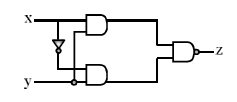
(Take $\frac{1}{4\pi \epsilon_0} = 9\times10^9 \frac{Nm^2}{C^2}$) Truth table for the following digital circuit will be :
- An electron in the hydrogen atom initially in the fourth excited state makes a transition to $n^{th}$ energy state by emitting a photon of energy 2.86 eV. The integer value of n will be __________
- Using Bohr's model, calculate the ratio of the magnetic fields generated due to the motion of the electrons in the $2^{\text{nd}}$ and $4^{\text{th}}$ orbits of hydrogen atom __________.
Muon ($\mu^-$) is a negatively charged ($|q| = |e|$) particle with a mass $m_\mu = 200 m_e$, where $m_e$ is the mass of the electron and e is the electronic charge. If $\mu^-$ is bound to a proton to form a hydrogen like atom, identify the correct statements :
(a) Radius of the muonic orbit is 200 times smaller than that of the electron.
(b) The speed of the $\mu^-$ in the $n^{th}$ orbit is $\frac{1}{200}$ times that of the electron in the $n^{th}$ orbit.
(c) The ionization energy of muonic atom is 200 times more than that of an hydrogen atom.
(d) The momentum of the muon in the $n^{th}$ orbital is 200 times more than that of the electron.
- If the de Broglie wavelengths associated with a proton and an $\alpha$-particle are equal, then the ratio of velocities of the proton and the $\alpha$-particle will be :
- An unstable heavy nucleus at rest breaks into two nuclei which move away with velocities in the ratio of 8 : 27. The ratio of the radii of the nuclei (assumed to be spherical) is:
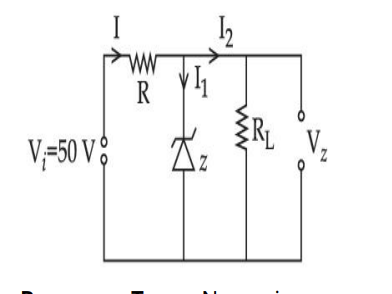
In a given circuit diagram, a 5 V zener diode along with a series resistance is connected across a 50 power supply. The minimum value of the resistance required, if the maximum zener current is 90 mA will be __________ $\Omega$.
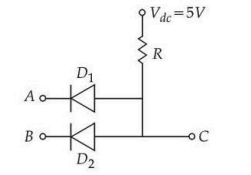
Two p-n junction diodes $D_{1}$ and $D_{2}$ are connected as shown in figure. $A$ and $B$ are input signals and C is the output. The given circuit will function as a _________.
Important Questions from Modern Physics
- The average energy released per fission for the nucleus of ${}^{235}_{92}\text{U}$ is $190 \text{ MeV}$. When all the atoms of $47 \text{ g}$ pure ${}^{235}_{92}\text{U}$ undergo fission process, the energy released is $\alpha \times 10^{23} \text{ MeV}$. The value of $\alpha$ is ________.
(Avogadro Number = $6 \times 10^{23} \text{ per mole}$) - A nuclear physicist performed an experiment on the scattering of alpha particles by thin metal foil of gold. The alpha particles were accelerated up to kinetic energy $3.2$ Mev. The estimation of the radius of the nucleus of gold element $(Z = 79)$ by him is $\times 10^{-16}$ m
(Take $\frac{1}{4\pi \epsilon_0} = 9\times10^9 \frac{Nm^2}{C^2}$) Truth table for the following digital circuit will be :
- An electron in the hydrogen atom initially in the fourth excited state makes a transition to $n^{th}$ energy state by emitting a photon of energy 2.86 eV. The integer value of n will be __________
- Using Bohr's model, calculate the ratio of the magnetic fields generated due to the motion of the electrons in the $2^{\text{nd}}$ and $4^{\text{th}}$ orbits of hydrogen atom __________.


