
Nucleus Radius Ratio from Velocity Ratio
This problem requires finding the ratio of the radii of two nuclei formed after a heavy nucleus splits, given the ratio of their velocities after the split.
Core Physics Concepts
- Conservation of Linear Momentum: When the heavy nucleus splits while at rest, the total momentum before and after the split must be conserved. Since the initial momentum is zero, the momenta of the two resulting nuclei must be equal and opposite.
- Nuclear Mass-Radius Relation: For nuclei, the mass ($m$) is approximately proportional to the cube of its radius ($R$), meaning $m \propto R^3$.
Solution Steps
-
Momentum Conservation: Let the masses of the two nuclei be $m_1$ and $m_2$, and their velocities be $v_1$ and $v_2$. The initial nucleus is at rest. Applying conservation of momentum: $ m_1 v_1 + m_2 v_2 = 0 $ This implies $m_1 v_1 = -m_2 v_2$. Considering the magnitudes, we get $m_1 v_1 = m_2 v_2$.
We are given the velocity ratio $|v_1| : |v_2| = 8 : 27$. From the momentum equation, the ratio of masses is derived as: $ \frac{m_1}{m_2} = \frac{v_2}{v_1} = \frac{27}{8} $
-
Mass-Radius Proportionality: Assuming the nuclei are spherical and have similar density, the mass is proportional to the volume ($V \propto R^3$). Thus, $m \propto R^3$. We can write $m_1 = k R_1^3$ and $m_2 = k R_2^3$ for some constant $k$.
The ratio of masses is then: $ \frac{m_1}{m_2} = \frac{k R_1^3}{k R_2^3} = \left(\frac{R_1}{R_2}\right)^3 $
-
Finding the Radius Ratio: By equating the two expressions for the mass ratio ($m_1/m_2$): $ \left(\frac{R_1}{R_2}\right)^3 = \frac{27}{8} $ Taking the cube root of both sides gives the ratio of the radii: $ \frac{R_1}{R_2} = \sqrt[3]{\frac{27}{8}} = \frac{3}{2} $
Therefore, the ratio of the radii of the two nuclei is $3 : 2$.
Similar Questions
- The average energy released per fission for the nucleus of ${}^{235}_{92}\text{U}$ is $190 \text{ MeV}$. When all the atoms of $47 \text{ g}$ pure ${}^{235}_{92}\text{U}$ undergo fission process, the energy released is $\alpha \times 10^{23} \text{ MeV}$. The value of $\alpha$ is ________.
(Avogadro Number = $6 \times 10^{23} \text{ per mole}$) - A nuclear physicist performed an experiment on the scattering of alpha particles by thin metal foil of gold. The alpha particles were accelerated up to kinetic energy $3.2$ Mev. The estimation of the radius of the nucleus of gold element $(Z = 79)$ by him is $\times 10^{-16}$ m
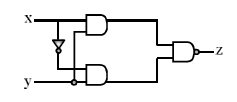
(Take $\frac{1}{4\pi \epsilon_0} = 9\times10^9 \frac{Nm^2}{C^2}$) Truth table for the following digital circuit will be :
- The carrier frequency of a transmitter is provided by a tank circuit of a coil of inductance $49 \mu H$ and a capacitance of 2.5 nF. It is modulated by an audio signal of 12 kHz. The frequency range occupied by the side bands is :
- An electron in the hydrogen atom initially in the fourth excited state makes a transition to $n^{th}$ energy state by emitting a photon of energy 2.86 eV. The integer value of n will be __________
- Using Bohr's model, calculate the ratio of the magnetic fields generated due to the motion of the electrons in the $2^{\text{nd}}$ and $4^{\text{th}}$ orbits of hydrogen atom __________.
Muon ($\mu^-$) is a negatively charged ($|q| = |e|$) particle with a mass $m_\mu = 200 m_e$, where $m_e$ is the mass of the electron and e is the electronic charge. If $\mu^-$ is bound to a proton to form a hydrogen like atom, identify the correct statements :
(a) Radius of the muonic orbit is 200 times smaller than that of the electron.
(b) The speed of the $\mu^-$ in the $n^{th}$ orbit is $\frac{1}{200}$ times that of the electron in the $n^{th}$ orbit.
(c) The ionization energy of muonic atom is 200 times more than that of an hydrogen atom.
(d) The momentum of the muon in the $n^{th}$ orbital is 200 times more than that of the electron.
- If the de Broglie wavelengths associated with a proton and an $\alpha$-particle are equal, then the ratio of velocities of the proton and the $\alpha$-particle will be :
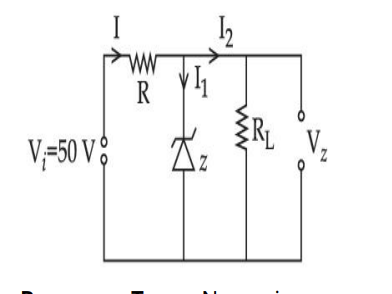
In a given circuit diagram, a 5 V zener diode along with a series resistance is connected across a 50 power supply. The minimum value of the resistance required, if the maximum zener current is 90 mA will be __________ $\Omega$.
- A photoemissive substance is illuminated with a radiation of wavelength $\lambda_i$, so that it releases electrons with de-Broglie wavelength $\lambda_e$. The longest wavelength of radiation that can emit photoelectron is $\lambda_0$. Expression for de-Broglie wavelength is given by :(m: mass of the electron, h: Planck's constant and c: speed of light)
Important Questions from Modern Physics
- The average energy released per fission for the nucleus of ${}^{235}_{92}\text{U}$ is $190 \text{ MeV}$. When all the atoms of $47 \text{ g}$ pure ${}^{235}_{92}\text{U}$ undergo fission process, the energy released is $\alpha \times 10^{23} \text{ MeV}$. The value of $\alpha$ is ________.
(Avogadro Number = $6 \times 10^{23} \text{ per mole}$) - A nuclear physicist performed an experiment on the scattering of alpha particles by thin metal foil of gold. The alpha particles were accelerated up to kinetic energy $3.2$ Mev. The estimation of the radius of the nucleus of gold element $(Z = 79)$ by him is $\times 10^{-16}$ m
(Take $\frac{1}{4\pi \epsilon_0} = 9\times10^9 \frac{Nm^2}{C^2}$) Truth table for the following digital circuit will be :
- The carrier frequency of a transmitter is provided by a tank circuit of a coil of inductance $49 \mu H$ and a capacitance of 2.5 nF. It is modulated by an audio signal of 12 kHz. The frequency range occupied by the side bands is :
- An electron in the hydrogen atom initially in the fourth excited state makes a transition to $n^{th}$ energy state by emitting a photon of energy 2.86 eV. The integer value of n will be __________


