
Hydrogen Atom Transition Calculation
This problem involves calculating the final energy state ($n$) of an electron in a hydrogen atom after it transitions and emits a photon.
Initial State Identification
The electron starts in the fourth excited state. In the Bohr model for hydrogen, the energy levels are quantized by the principal quantum number $n$. The ground state is $n=1$. Therefore:
- Ground state: $n=1$
- First excited state: $n=2$
- Second excited state: $n=3$
- Third excited state: $n=4$
- Fourth excited state: $n_i=5$
Energy of Emitted Photon
The energy of a photon emitted during an electron transition from a higher energy state ($n_i$) to a lower energy state ($n_f$) in a hydrogen atom is given by the difference in energy levels:
$ \Delta E = E_{n_i} - E_{n_f} $
Using the formula for energy levels in a hydrogen atom, $ E_n = -\frac{13.6}{n^2} $ eV, the energy difference is:
$ \Delta E = \left(-\frac{13.6}{n_i^2}\right) - \left(-\frac{13.6}{n_f^2}\right) = 13.6 \left(\frac{1}{n_f^2} - \frac{1}{n_i^2}\right) \text{ eV} $
We are given:
- Initial state $n_i = 5$
- Emitted photon energy $\Delta E = 2.86$ eV
- Final state $n_f = n$ (to be determined)
Calculating the Final State n
Substitute the known values into the energy difference equation:
$ 2.86 \text{ eV} = 13.6 \left(\frac{1}{n^2} - \frac{1}{5^2}\right) \text{ eV} $
Divide both sides by 13.6:
$ \frac{2.86}{13.6} = \frac{1}{n^2} - \frac{1}{25} $
Calculate the left side:
$ 0.2103 \approx \frac{1}{n^2} - \frac{1}{25} $
Rearrange the equation to solve for $ \frac{1}{n^2} $:
$ \frac{1}{n^2} \approx 0.2103 + \frac{1}{25} $
$ \frac{1}{n^2} \approx 0.2103 + 0.04 $
$ \frac{1}{n^2} \approx 0.2503 $
Now, solve for $n^2$:
$ n^2 \approx \frac{1}{0.2503} \approx 3.995 $
Finally, solve for $n$:
$ n \approx \sqrt{3.995} \approx 1.9987 $
Since $n$ must be an integer representing an energy state, we round the result.
Final Answer: The integer value of $n$ is 2.
Similar Questions
- The average energy released per fission for the nucleus of ${}^{235}_{92}\text{U}$ is $190 \text{ MeV}$. When all the atoms of $47 \text{ g}$ pure ${}^{235}_{92}\text{U}$ undergo fission process, the energy released is $\alpha \times 10^{23} \text{ MeV}$. The value of $\alpha$ is ________.
(Avogadro Number = $6 \times 10^{23} \text{ per mole}$) - A nuclear physicist performed an experiment on the scattering of alpha particles by thin metal foil of gold. The alpha particles were accelerated up to kinetic energy $3.2$ Mev. The estimation of the radius of the nucleus of gold element $(Z = 79)$ by him is $\times 10^{-16}$ m
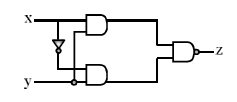
(Take $\frac{1}{4\pi \epsilon_0} = 9\times10^9 \frac{Nm^2}{C^2}$) Truth table for the following digital circuit will be :
- The carrier frequency of a transmitter is provided by a tank circuit of a coil of inductance $49 \mu H$ and a capacitance of 2.5 nF. It is modulated by an audio signal of 12 kHz. The frequency range occupied by the side bands is :
- Using Bohr's model, calculate the ratio of the magnetic fields generated due to the motion of the electrons in the $2^{\text{nd}}$ and $4^{\text{th}}$ orbits of hydrogen atom __________.
Muon ($\mu^-$) is a negatively charged ($|q| = |e|$) particle with a mass $m_\mu = 200 m_e$, where $m_e$ is the mass of the electron and e is the electronic charge. If $\mu^-$ is bound to a proton to form a hydrogen like atom, identify the correct statements :
(a) Radius of the muonic orbit is 200 times smaller than that of the electron.
(b) The speed of the $\mu^-$ in the $n^{th}$ orbit is $\frac{1}{200}$ times that of the electron in the $n^{th}$ orbit.
(c) The ionization energy of muonic atom is 200 times more than that of an hydrogen atom.
(d) The momentum of the muon in the $n^{th}$ orbital is 200 times more than that of the electron.
- If the de Broglie wavelengths associated with a proton and an $\alpha$-particle are equal, then the ratio of velocities of the proton and the $\alpha$-particle will be :
- An unstable heavy nucleus at rest breaks into two nuclei which move away with velocities in the ratio of 8 : 27. The ratio of the radii of the nuclei (assumed to be spherical) is:
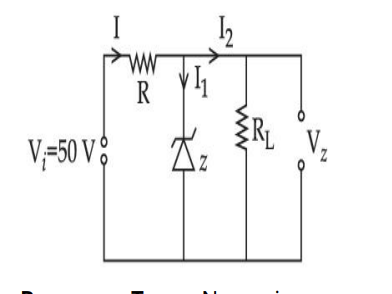
In a given circuit diagram, a 5 V zener diode along with a series resistance is connected across a 50 power supply. The minimum value of the resistance required, if the maximum zener current is 90 mA will be __________ $\Omega$.
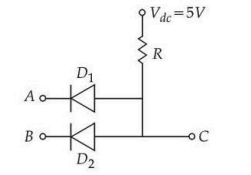
Two p-n junction diodes $D_{1}$ and $D_{2}$ are connected as shown in figure. $A$ and $B$ are input signals and C is the output. The given circuit will function as a _________.
Important Questions from Modern Physics
- The average energy released per fission for the nucleus of ${}^{235}_{92}\text{U}$ is $190 \text{ MeV}$. When all the atoms of $47 \text{ g}$ pure ${}^{235}_{92}\text{U}$ undergo fission process, the energy released is $\alpha \times 10^{23} \text{ MeV}$. The value of $\alpha$ is ________.
(Avogadro Number = $6 \times 10^{23} \text{ per mole}$) - A nuclear physicist performed an experiment on the scattering of alpha particles by thin metal foil of gold. The alpha particles were accelerated up to kinetic energy $3.2$ Mev. The estimation of the radius of the nucleus of gold element $(Z = 79)$ by him is $\times 10^{-16}$ m
(Take $\frac{1}{4\pi \epsilon_0} = 9\times10^9 \frac{Nm^2}{C^2}$) Truth table for the following digital circuit will be :
- The carrier frequency of a transmitter is provided by a tank circuit of a coil of inductance $49 \mu H$ and a capacitance of 2.5 nF. It is modulated by an audio signal of 12 kHz. The frequency range occupied by the side bands is :
- Using Bohr's model, calculate the ratio of the magnetic fields generated due to the motion of the electrons in the $2^{\text{nd}}$ and $4^{\text{th}}$ orbits of hydrogen atom __________.


