
De Broglie Wavelength Calculation
The de Broglie wavelength ($\lambda$) of a particle is given by the formula:
$\lambda = \frac{h}{p}$
where $h$ is Planck's constant and $p$ is the momentum of the particle.
Momentum ($p$) can also be expressed as the product of mass ($m$) and velocity ($v$):
$p = mv$
Substituting this into the de Broglie wavelength formula gives:
$\lambda = \frac{h}{mv}$
Proton and Alpha-Particle Properties
We are comparing a proton and an $\alpha$-particle.
- Proton (p): Let its mass be $m_p$ and its velocity be $v_p$.
- $\alpha$-particle ($\alpha$): An $\alpha$-particle is a Helium nucleus (2 protons, 2 neutrons). Its mass ($m_{\alpha}$) is approximately 4 times the mass of a proton ($m_{\alpha} \approx 4m_p$). Let its velocity be $v_{\alpha}$.
Equal Wavelengths Condition
The problem states that the de Broglie wavelengths associated with the proton and the $\alpha$-particle are equal:
$\lambda_{p} = \lambda_{\alpha}$
Using the de Broglie wavelength formula:
$\frac{h}{m_p v_p} = \frac{h}{m_{\alpha} v_{\alpha}}$
Velocity Ratio Derivation
Since $h$ is a constant, we can cancel it from both sides:
$\frac{1}{m_p v_p} = \frac{1}{m_{\alpha} v_{\alpha}}$
Rearranging the terms to find the ratio of velocities ($v_p / v_{\alpha}$):
$m_p v_p = m_{\alpha} v_{\alpha}$
$\frac{v_p}{v_{\alpha}} = \frac{m_{\alpha}}{m_p}$
Now, substitute the approximate mass relationship ($m_{\alpha} \approx 4m_p$):
$\frac{v_p}{v_{\alpha}} = \frac{4m_p}{m_p}$
$\frac{v_p}{v_{\alpha}} = 4$
Therefore, the ratio of the velocity of the proton to the velocity of the $\alpha$-particle is $4 : 1$.
Similar Questions
- The average energy released per fission for the nucleus of ${}^{235}_{92}\text{U}$ is $190 \text{ MeV}$. When all the atoms of $47 \text{ g}$ pure ${}^{235}_{92}\text{U}$ undergo fission process, the energy released is $\alpha \times 10^{23} \text{ MeV}$. The value of $\alpha$ is ________.
(Avogadro Number = $6 \times 10^{23} \text{ per mole}$) - A nuclear physicist performed an experiment on the scattering of alpha particles by thin metal foil of gold. The alpha particles were accelerated up to kinetic energy $3.2$ Mev. The estimation of the radius of the nucleus of gold element $(Z = 79)$ by him is $\times 10^{-16}$ m
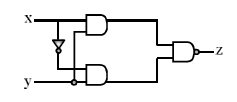
(Take $\frac{1}{4\pi \epsilon_0} = 9\times10^9 \frac{Nm^2}{C^2}$) Truth table for the following digital circuit will be :
- The carrier frequency of a transmitter is provided by a tank circuit of a coil of inductance $49 \mu H$ and a capacitance of 2.5 nF. It is modulated by an audio signal of 12 kHz. The frequency range occupied by the side bands is :
- An electron in the hydrogen atom initially in the fourth excited state makes a transition to $n^{th}$ energy state by emitting a photon of energy 2.86 eV. The integer value of n will be __________
- Using Bohr's model, calculate the ratio of the magnetic fields generated due to the motion of the electrons in the $2^{\text{nd}}$ and $4^{\text{th}}$ orbits of hydrogen atom __________.
Muon ($\mu^-$) is a negatively charged ($|q| = |e|$) particle with a mass $m_\mu = 200 m_e$, where $m_e$ is the mass of the electron and e is the electronic charge. If $\mu^-$ is bound to a proton to form a hydrogen like atom, identify the correct statements :
(a) Radius of the muonic orbit is 200 times smaller than that of the electron.
(b) The speed of the $\mu^-$ in the $n^{th}$ orbit is $\frac{1}{200}$ times that of the electron in the $n^{th}$ orbit.
(c) The ionization energy of muonic atom is 200 times more than that of an hydrogen atom.
(d) The momentum of the muon in the $n^{th}$ orbital is 200 times more than that of the electron.
- An unstable heavy nucleus at rest breaks into two nuclei which move away with velocities in the ratio of 8 : 27. The ratio of the radii of the nuclei (assumed to be spherical) is:
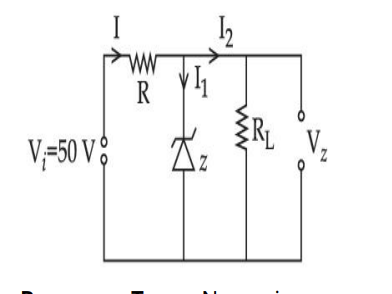
In a given circuit diagram, a 5 V zener diode along with a series resistance is connected across a 50 power supply. The minimum value of the resistance required, if the maximum zener current is 90 mA will be __________ $\Omega$.
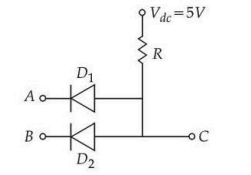
Two p-n junction diodes $D_{1}$ and $D_{2}$ are connected as shown in figure. $A$ and $B$ are input signals and C is the output. The given circuit will function as a _________.
Important Questions from Modern Physics
- The average energy released per fission for the nucleus of ${}^{235}_{92}\text{U}$ is $190 \text{ MeV}$. When all the atoms of $47 \text{ g}$ pure ${}^{235}_{92}\text{U}$ undergo fission process, the energy released is $\alpha \times 10^{23} \text{ MeV}$. The value of $\alpha$ is ________.
(Avogadro Number = $6 \times 10^{23} \text{ per mole}$) - A nuclear physicist performed an experiment on the scattering of alpha particles by thin metal foil of gold. The alpha particles were accelerated up to kinetic energy $3.2$ Mev. The estimation of the radius of the nucleus of gold element $(Z = 79)$ by him is $\times 10^{-16}$ m
(Take $\frac{1}{4\pi \epsilon_0} = 9\times10^9 \frac{Nm^2}{C^2}$) Truth table for the following digital circuit will be :
- The carrier frequency of a transmitter is provided by a tank circuit of a coil of inductance $49 \mu H$ and a capacitance of 2.5 nF. It is modulated by an audio signal of 12 kHz. The frequency range occupied by the side bands is :
- An electron in the hydrogen atom initially in the fourth excited state makes a transition to $n^{th}$ energy state by emitting a photon of energy 2.86 eV. The integer value of n will be __________


