(Take speed of light $= 3 \times 10^8\text{ ms}^{-1}$, charge of electron $= -1.6 \times 10^{-19}\text{ C}$ and mass of electron $= 9 \times 10^{-31}\text{ kg}$)
Energy Conversion
First, convert the given energy from electron volts (eV) to Joules (J). The conversion factor is $1 \text{ eV} \approx 1.6 \times 10^{-19} \text{ J}$.
Energy, $E = 20 \text{ eV} = 20 \times (1.6 \times 10^{-19} \text{ J}) = 3.2 \times 10^{-18} \text{ J}$.
Electron Momentum Calculation
The electron has kinetic energy $K_e = 3.2 \times 10^{-18}$ J. Its mass is $m_e = 9 \times 10^{-31}$ kg. Using the non-relativistic formula relating kinetic energy ($K_e$) and momentum ($p_e$): $K_e = \frac{p_e^2}{2m_e}$.
Rearranging to solve for momentum: $p_e = \sqrt{2 m_e K_e}$
Substitute the known values: $p_e = \sqrt{2 \times (9 \times 10^{-31} \text{ kg}) \times (3.2 \times 10^{-18} \text{ J})}$ $p_e = \sqrt{57.6 \times 10^{-49} \text{ kg}^2 \text{m}^2/\text{s}^2}$ $p_e = \sqrt{5.76 \times 10^{-48} \text{ kg}^2 \text{m}^2/\text{s}^2}$ $p_e = 2.4 \times 10^{-24} \text{ kg m/s}$
Photon Momentum Calculation
For a photon, energy ($E_{ph}$) and momentum ($p_{ph}$) are related by $E_{ph} = p_{ph}c$, where $c$ is the speed of light. The photon's energy is $E_{ph} = 3.2 \times 10^{-18}$ J, and the speed of light $c = 3 \times 10^8$ m/s.
Solving for momentum: $p_{ph} = \frac{E_{ph}}{c}$
Substitute the values: $p_{ph} = \frac{3.2 \times 10^{-18} \text{ J}}{3 \times 10^8 \text{ m/s}}$ $p_{ph} = \frac{3.2}{3} \times 10^{-26} \text{ kg m/s}$
Ratio of Momenta
Calculate the required ratio $\frac{p_e}{p_{ph}}$.
$ \frac{p_e}{p_{ph}} = \frac{2.4 \times 10^{-24} \text{ kg m/s}}{\frac{3.2}{3} \times 10^{-26} \text{ kg m/s}} $
Simplify the expression: $ \frac{p_e}{p_{ph}} = \frac{2.4 \times 3}{3.2} \times \frac{10^{-24}}{10^{-26}} $ $ \frac{p_e}{p_{ph}} = \frac{7.2}{3.2} \times 10^2 $ $ \frac{p_e}{p_{ph}} = 2.25 \times 100 $ $ \frac{p_e}{p_{ph}} = 225 $
Similar Questions
In the first excited state of hydrogen atom, the energy of its electron is $-3.4 \text{ eV}$. The radial distance of the electron from the hydrogen nucleus in this case is approximately :
(Take $1 \text{ eV} = 1.6 \times 10^{-19} \text{ J}, \text{ e} = 1.6 \times 10^{-19} \text{ C}$ and $\frac{1}{4\pi\varepsilon_0} = 9 \times 10^9 \text{ N m}^2/\text{C}^2$)- An unknown nucleus has a nuclear density of $2.29 \times 10^{17} \text{ kg/m}^3$ and mass of $19.926 \times 10^{-27} \text{ kg}$. Its mass number A is approximately :
(Take $R_0 = 1.2 \times 10^{-15} \text{ m}$, $4\pi = 12.56$) Four statements are given (A is mass number) :
A. The volume of a nucleus is proportional to $A^{1/3}$.
B. The volume of a nucleus is proportional to A.
C. The difference in mass of an atom and its nucleus is called the mass defect.
D. The difference in mass of a nucleus and its constituent nucleons is called the mass defect.
Choose the correct answer from the options given below :- For a metal of work function $6.6 \text{ eV}$, which of the following wavelengths of incident radiation does not give rise to the photoelectric effect?
(Take Planck's constant as $6.6 \times 10^{-34} \text{ J s}$) Match List I with List II :
List I List II A. $E = h\nu$ I. de Broglie wavelength B. Interference II. Particle nature of light C. $\lambda = h/p$ III. Wave nature of light D. Compton effect IV. Energy of photon
Choose the correct answer from the options given below :- In Geiger-Marsden experiment, the number of scattered $\alpha$-particles $N(\theta)$ is plotted as a function of scattering angle $\theta$. Which of the following options represents the correct plot ?
- A beam of light falls on a metal surface such that photo-electrons are generated. If power of the light source starts to decrease linearly with time $t$, then variation of the photocurrent $I$ and magnitude of the stopping potential $|V|$ with time is best represented by :
- A ray of light with wavelength $\lambda$ is incident on three different photo-electric cells namely 1, 2 and 3. The threshold wavelength of these photo-electric cells are $\lambda_1$, $\lambda_2$, and $\lambda_3$, respectively and the magnitude of stopping potentials of these cells are $V_1$, $V_2$ and $V_3$, respectively. The relation between $\lambda$ and threshold wavelengths are $\lambda_1 < \lambda$, $\lambda_2 > \lambda$ and $\lambda_3 \gg \lambda$. The correct option is :
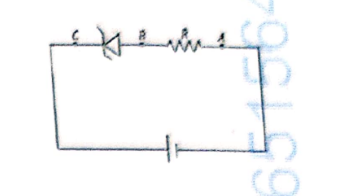
An ideal Zener diode with breakdown voltage of $-3\text{ V}$ is reverse biased with a negative input voltage $V_i = -5\text{ V}$. The magnitude of voltage difference between points B and A is :
- Consider the following nuclear reaction :
$$^{238}\text{U} \rightarrow ^{234}\text{Th} + ^{4}\text{He}$$
Take masses of $^{238}\text{U}$, $^{234}\text{Th}$ and $^{4}\text{He}$ as $238.050\text{ u}$, $234.043\text{ u}$ and $4.003\text{ u}$, respectively. The Q value for the reaction, in keV, is :
[Given : $1\text{ u} = 931.5\text{ MeV c}^{-2}$]
Important Questions from Modern Physics
- A voltage regulating circuit consisting of Zener diode, having break-down voltage of 10 V and maximum power dissipation of 0.4 W, is operated at 15 V. The approximate value of protective resistance in this circuit is ______ $\Omega$.
The binding energy for the following nuclear reactions are expressed in MeV.
${}_2\text{He}^3 + {}_0\text{n}^1 \rightarrow {}_2\text{He}^4 + 20 \text{ MeV}$
${}_2\text{He}^4 + {}_0\text{n}^1 \rightarrow {}_2\text{He}^5 - 0.9 \text{ MeV}$
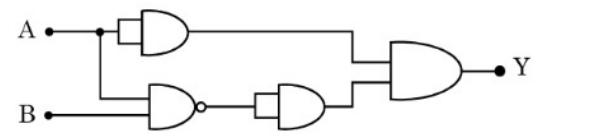
If $\text{X}_3, \text{X}_4, \text{X}_5$ denote the stability of ${}_2\text{He}^3, {}_2\text{He}^4$ and ${}_2\text{He}^5$, respectively, then the correct order is :Identify the correct truth table of the given logic circuit.
- When a light of a given wavelength falls on a metallic surface the stopping potential for photoelectrons is $3.2 \text{ V}$. If a second light having wavelength twice of first light is used, the stopping potential drops to $0.7 \text{ V}$. The wavelength of first light is _______ m.
($h = 6.63 \times 10^{-34} \text{ J.s}, e = 1.6 \times 10^{-19} \text{ C}, c = 3 \times 10^8 \text{ m/s}$) - A particle having electric charge $3 \times 10^{-19}\text{ C}$ and mass $6 \times 10^{-27}\text{ kg}$ is accelerated by applying an electric potential of $1.21\text{ V}$. Wavelength of the matter wave associated with the particle is $\alpha \times 10^{-12}\text{ m}$. The value of $\alpha$ is __________. (Take Planck's constant $= 6.6 \times 10^{-34}\text{ J.s}$)