A ray of monochromatic light is passing through an equilateral prism (ABC) as shown in the figure. The refracted ray (QR) is parallel to the base (BC) and the angle of incidence ($i$) is $50^\circ$. Then the angle of deviation ($\delta$) is :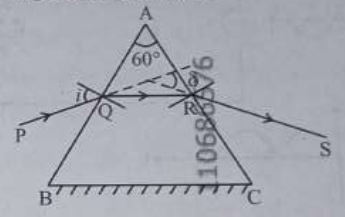
To solve this problem, it is essential to understand the refraction of light through a prism and how the angle of deviation is determined in such scenarios.
Given Data:
- The prism is equilateral, meaning all its angles are \(60^\circ\).
- The angle of incidence \(i = 50^\circ\).
- The refracted ray \(QR\) is parallel to the base \(BC\).
Concept and Calculation:
- In an equilateral prism, the refracted ray \(QR\) being parallel to the base indicates that the angle of refraction at \(Q\) and exit angle at \(R\) combined will equal the angle of the prism. Therefore, the angle of refraction \(r\) at both \(Q\) and \(R\) is \(30^\circ\).
- This situation is depicted by using Snell’s Law at the first surface: \(n \sin i = \sin r\), where \(i = 50^\circ\) and \(r = 30^\circ\).
- The angle of deviation \(\delta\) is given by the formula: \(\delta = i + e - A\), where \(e\) is the angle of emergence and \(A\) is the angle of the prism.
- Since \(r_1 = r_2\) and the angle of the prism \(A = 60^\circ\), the angle of emergence \(e\) is also \(50^\circ\).
- Substituting the values, we have: \(\delta = 50^\circ + 50^\circ - 60^\circ = 40^\circ\).
Therefore, the angle of deviation \(\delta\) is 40°.
Conclusion: The correct answer is 40°, as it matches the angle of deviation calculated.
Similar Questions
- In interference and diffraction, the light energy is redistributed. If it reduces in one region, producing a dark fringe, it increases in another region, producing a bright fringe.
A. As there is no gain or loss of energy, these phenomena are consistent with the principle of conservation of energy.
B. Diffraction and interference are characteristics exhibited only by light waves.
Choose the correct answer from the options given below : - In Young's double slit experiment, using monochromatic light of wavelength $\lambda$, the intensity of light at a point on the screen where the path difference is $\lambda$, is $K$ units. The intensity of light at a point where the path difference is $\lambda/3$ will be :
- In a concave lens, a ray of light emanating from the object parallel to the principal axis of the lens, after refraction :
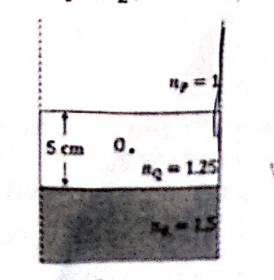
Consider three media P, Q and R with refractive indices $1$, $1.25$, and $1.5$, respectively. The medium Q having a thickness of $5\text{ cm}$ is placed between extended media P and R as shown in the figure. An object O is placed at the center of medium Q. If viewed from medium P near the normal direction, the apparent depth of O is $h_1$. For similar observation from medium R, the apparent depth is $h_2$. The value of $|h_1 - h_2|$, in cm, is :
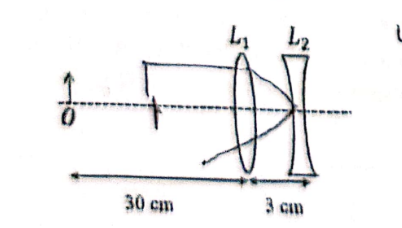
The lens combination as shown in the figure, consists of two lenses, $L_1$ and $L_2$, of the focal lengths $+10\text{ cm}$ and $-10\text{ cm}$, respectively. The position of the image formed is :
Important Questions from Optics
- A point source is kept at the center of a spherically enclosed detector. If the volume of the detector increased by 8 times, the intensity will
- Five persons $\text{P}_1, \text{P}_2, \text{P}_3, \text{P}_4 \text{ and } \text{P}_5$ recorded object distance ($u$) and image distance ($v$) using same convex lens having power $+5\text{D}$ as $(25, 96), (30, 62), (35, 37), (45, 35)$ and $(50, 32)$ respectively. Identify correct statement
- In the Young's double slit experiment the intensity produced by each one of the individual slits is $I_o$. The distance between two slits is $2 \text{ mm}$. The distance of screen from slits is $10 \text{ m}$. The wavelength of light is $6000 \text{ \AA}$. The intensity of light on the screen in front of one of the slits is _______.
- In a microscope the objective is having focal length $f_o = 2 \text{ cm}$ and eye-piece is having focal length $f_e = 4 \text{ cm}$. The tube length is $32 \text{ cm}$. The magnification produced by this microscope for normal adjustment is ____________.
- A collimated beam of light of diameter $2 \text{ mm}$ is propagating along x-axis. The beam is required to be expanded in a collimated beam of diameter $14 \text{ mm}$ using a system of two convex lenses. If first lens has focal length $40 \text{ mm}$, then the focal length of second lens is ____________ $\text{mm}$.