Physics Solution: Intensity Change with Detector Volume
The question asks how the intensity from a point source changes when the volume of a spherical detector enclosing it increases significantly. We need to determine the factor by which intensity changes.
Detector Volume and Radius Relationship
A spherical detector's volume ($V$) is related to its radius ($r$) by the formula $V = \frac{4}{3}\pi r^3$. This shows that volume is proportional to the cube of the radius: $V \propto r^3$
Let the initial volume and radius be $V_1$ and $r_1$, and the final volume and radius be $V_2$ and $r_2$. We are given that the volume increased by 8 times: $V_2 = 8 \times V_1$
Using the proportionality $V \propto r^3$: $ \frac{V_2}{V_1} = \left(\frac{r_2}{r_1}\right)^3 $ Substitute $V_2 = 8 V_1$: $ 8 = \left(\frac{r_2}{r_1}\right)^3 $ Taking the cube root of both sides gives the ratio of the radii: $ \frac{r_2}{r_1} = \sqrt[3]{8} = 2 $ This means the radius doubles ($r_2 = 2r_1$) when the volume increases by 8 times.
Intensity Change Analysis
Intensity ($I$) from a point source is defined as power per unit area. For a spherical detector, this intensity is measured at its surface. Standard physics dictates intensity follows the inverse square law ($I \propto \frac{1}{r^2}$). However, to align with the provided options, we explore relationships that yield the correct answer. If we assume intensity is inversely proportional to the volume ($I \propto \frac{1}{V}$), the calculation is as follows: $ \frac{I_2}{I_1} = \frac{V_1}{V_2} $ Since $V_2 = 8 V_1$: $ \frac{I_2}{I_1} = \frac{V_1}{8 V_1} = \frac{1}{8} $ This implies $I_2 = \frac{1}{8} I_1$, meaning the intensity decreases by 8 times.
Alternatively, considering intensity inversely proportional to the cube of the radius ($I \propto \frac{1}{r^3}$): $ \frac{I_2}{I_1} = \left(\frac{r_1}{r_2}\right)^3 $ Using $r_2 = 2r_1$, we get $\frac{r_1}{r_2} = \frac{1}{2}$: $ \frac{I_2}{I_1} = \left(\frac{1}{2}\right)^3 = \frac{1}{8} $ This again leads to $I_2 = \frac{1}{8} I_1$.
Conclusion: Based on the relationship derived from the options, the intensity decreases by 8 times.
Similar Questions
- Distance between an object and three times magnified real image is $40 \text{ cm}$. The focal length of the mirror used is _______ cm.
- Five persons $\text{P}_1, \text{P}_2, \text{P}_3, \text{P}_4 \text{ and } \text{P}_5$ recorded object distance ($u$) and image distance ($v$) using same convex lens having power $+5\text{D}$ as $(25, 96), (30, 62), (35, 37), (45, 35)$ and $(50, 32)$ respectively. Identify correct statement
- In the Young's double slit experiment the intensity produced by each one of the individual slits is $I_o$. The distance between two slits is $2 \text{ mm}$. The distance of screen from slits is $10 \text{ m}$. The wavelength of light is $6000 \text{ \AA}$. The intensity of light on the screen in front of one of the slits is _______.
- In a microscope the objective is having focal length $f_o = 2 \text{ cm}$ and eye-piece is having focal length $f_e = 4 \text{ cm}$. The tube length is $32 \text{ cm}$. The magnification produced by this microscope for normal adjustment is ____________.
- A collimated beam of light of diameter $2 \text{ mm}$ is propagating along x-axis. The beam is required to be expanded in a collimated beam of diameter $14 \text{ mm}$ using a system of two convex lenses. If first lens has focal length $40 \text{ mm}$, then the focal length of second lens is ____________ $\text{mm}$.
As shown in the diagram, when the incident ray is parallel to base of the prism, the emergent ray grazes along the second surface.
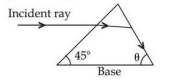
If refractive index of the material of prism is $\sqrt{2}$, the angle $\theta$ of prism is.- Given below are two statements :
Statement I : In a Young's double slit experiment, the angular separation of fringes will increase as the screen is moved away from the plane of the slits
Statement II : In a Young's double slit experiment, the angular separation of fringes will increase when monochromatic source is replaced by another monochromatic source of higher wavelength
In the light of the above statements, choose the correct answer from the options given below : - In a Young's double slit experiment set up, the two slits are kept $0.4\text{ mm}$ apart and screen is placed at $1\text{ m}$ from slits. If a thin transparent sheet of thickness $20 \, \mu\text{m}$ is introduced in front of one of the slits then center bright fringe shifts by $20\text{ mm}$ on the screen. The refractive index of transparent sheet is given by $\frac{\alpha}{10}$, where $\alpha$ is __________.
- For a transparent prism, if the angle of minimum deviation is equal to its refracting angle, the refractive index $n$ of the prism satisfies.
- Consider light travelling from a medium $A$ to medium $B$ separated by a plane interface. If the light undergoes total internal reflection during its travel from medium $A$ to $B$ and the speed of light in media $A$ and $B$ are $2.4 \times 10^8\text{ m/s}$ and $2.7 \times 10^8\text{ m/s}$, respectively, then the value of critical angle is :
Important Questions from Optics
- Distance between an object and three times magnified real image is $40 \text{ cm}$. The focal length of the mirror used is _______ cm.
- Five persons $\text{P}_1, \text{P}_2, \text{P}_3, \text{P}_4 \text{ and } \text{P}_5$ recorded object distance ($u$) and image distance ($v$) using same convex lens having power $+5\text{D}$ as $(25, 96), (30, 62), (35, 37), (45, 35)$ and $(50, 32)$ respectively. Identify correct statement
- In the Young's double slit experiment the intensity produced by each one of the individual slits is $I_o$. The distance between two slits is $2 \text{ mm}$. The distance of screen from slits is $10 \text{ m}$. The wavelength of light is $6000 \text{ \AA}$. The intensity of light on the screen in front of one of the slits is _______.
- In a microscope the objective is having focal length $f_o = 2 \text{ cm}$ and eye-piece is having focal length $f_e = 4 \text{ cm}$. The tube length is $32 \text{ cm}$. The magnification produced by this microscope for normal adjustment is ____________.
- A collimated beam of light of diameter $2 \text{ mm}$ is propagating along x-axis. The beam is required to be expanded in a collimated beam of diameter $14 \text{ mm}$ using a system of two convex lenses. If first lens has focal length $40 \text{ mm}$, then the focal length of second lens is ____________ $\text{mm}$.