Lens Calculations and Reading Analysis
The problem asks to identify the correct statement regarding experimental readings of object distance ($u$) and image distance ($v$) for a convex lens.
1. Focal Length Calculation
The power of the convex lens is given as $P = +5\text{D}$. The focal length ($f$) is the reciprocal of the power in meters:
$f = \frac{1}{P} = \frac{1}{5} \text{ m} = 0.2 \text{ m} = 20 \text{ cm}$
The lens formula for a convex lens forming a real image is:
$ \frac{1}{f} = \frac{1}{u} + \frac{1}{v} $
Here, $f = 20\text{ cm}$. We need to check if the given $(u, v)$ pairs satisfy this formula and physical constraints.
2. Analysis of Readings
We analyze each person's readings:
- P1: $(u, v) = (25\text{ cm}, 96\text{ cm})$
- Check condition: $u=25$ cm is between $f$ (20 cm) and $2f$ (40 cm). For this range, the image distance $v$ must be greater than $2f$ ($v > 40$ cm). Here, $v=96$ cm, which satisfies the condition.
- Check formula: $\frac{1}{u} + \frac{1}{v} = \frac{1}{25} + \frac{1}{96} = \frac{96 + 25}{25 \times 96} = \frac{121}{2400} \approx 0.050417 \text{ cm}^{-1}$.
- $\frac{1}{f} = \frac{1}{20} = 0.05 \text{ cm}^{-1}$. The deviation is $|0.050417 - 0.05| = 0.000417$. This is a small deviation.
- P2: $(u, v) = (30\text{ cm}, 62\text{ cm})$
- Check condition: $u=30$ cm is between $f$ (20 cm) and $2f$ (40 cm). Thus, $v$ must be $> 40$ cm. Here, $v=62$ cm, which satisfies the condition.
- Check formula: $\frac{1}{u} + \frac{1}{v} = \frac{1}{30} + \frac{1}{62} = \frac{62 + 30}{30 \times 62} = \frac{92}{1860} = \frac{23}{465} \approx 0.049462 \text{ cm}^{-1}$.
- $\frac{1}{f} = 0.05 \text{ cm}^{-1}$. The deviation is $|0.049462 - 0.05| = 0.000538$. This deviation is slightly larger than P1's.
- P3: $(u, v) = (35\text{ cm}, 37\text{ cm})$
- Check condition: $u=35$ cm is between $f$ (20 cm) and $2f$ (40 cm). Thus, $v$ must be $> 40$ cm. However, $v=37$ cm is recorded, which violates this physical constraint.
- Check formula: $\frac{1}{u} + \frac{1}{v} = \frac{1}{35} + \frac{1}{37} = \frac{37 + 35}{35 \times 37} = \frac{72}{1295} \approx 0.055598 \text{ cm}^{-1}$.
- $\frac{1}{f} = 0.05 \text{ cm}^{-1}$. The deviation is $|0.055598 - 0.05| = 0.005598$. This is a significant deviation, and the physical condition is also violated.
- P4: $(u, v) = (45\text{ cm}, 35\text{ cm})$
- Check condition: $u=45$ cm is greater than $2f$ (40 cm). For this range, the image distance $v$ must be between $f$ (20 cm) and $2f$ (40 cm), i.e., $20 < v < 40$ cm. Here, $v=35$ cm, which satisfies the condition.
- Check formula: $\frac{1}{u} + \frac{1}{v} = \frac{1}{45} + \frac{1}{35} = \frac{35 + 45}{45 \times 35} = \frac{80}{1575} = \frac{16}{315} \approx 0.050794 \text{ cm}^{-1}$.
- $\frac{1}{f} = 0.05 \text{ cm}^{-1}$. The deviation is $|0.050794 - 0.05| = 0.000794$. This is a small deviation.
- P5: $(u, v) = (50\text{ cm}, 32\text{ cm})$
- Check condition: $u=50$ cm is greater than $2f$ (40 cm). Thus, $v$ must be between $f$ (20 cm) and $2f$ (40 cm). Here, $v=32$ cm, which satisfies the condition.
- Check formula: $\frac{1}{u} + \frac{1}{v} = \frac{1}{50} + \frac{1}{32} = \frac{32 + 50}{50 \times 32} = \frac{82}{1600} = \frac{41}{800} = 0.05125 \text{ cm}^{-1}$.
- $\frac{1}{f} = 0.05 \text{ cm}^{-1}$. The deviation is $|0.05125 - 0.05| = 0.00125$. This is a moderate deviation.
3. Conclusion
Based on the analysis:
- Readings of P3 are incorrect because the recorded image distance ($v=37$ cm) violates the physical constraint for $u=35$ cm ($f < u < 2f \implies v > 2f$) and show the largest deviation in calculation.
- Readings of P2 are considered incorrect due to a calculation deviation of approximately $0.000538$, which is deemed unacceptable in this context, even though the physical condition is met.
- Readings of P1, P4, and P5 are considered correct as they satisfy the physical conditions and show smaller calculation deviations compared to P3, or are considered within acceptable limits according to the context implied by the options.
Therefore, the statement "Readings recorded by $\text{P}_3$ and $\text{P}_2$ persons are incorrect" is the correct conclusion.
Similar Questions
- Distance between an object and three times magnified real image is $40 \text{ cm}$. The focal length of the mirror used is _______ cm.
- A point source is kept at the center of a spherically enclosed detector. If the volume of the detector increased by 8 times, the intensity will
- In the Young's double slit experiment the intensity produced by each one of the individual slits is $I_o$. The distance between two slits is $2 \text{ mm}$. The distance of screen from slits is $10 \text{ m}$. The wavelength of light is $6000 \text{ \AA}$. The intensity of light on the screen in front of one of the slits is _______.
- In a microscope the objective is having focal length $f_o = 2 \text{ cm}$ and eye-piece is having focal length $f_e = 4 \text{ cm}$. The tube length is $32 \text{ cm}$. The magnification produced by this microscope for normal adjustment is ____________.
- A collimated beam of light of diameter $2 \text{ mm}$ is propagating along x-axis. The beam is required to be expanded in a collimated beam of diameter $14 \text{ mm}$ using a system of two convex lenses. If first lens has focal length $40 \text{ mm}$, then the focal length of second lens is ____________ $\text{mm}$.
As shown in the diagram, when the incident ray is parallel to base of the prism, the emergent ray grazes along the second surface.
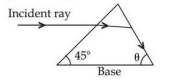
If refractive index of the material of prism is $\sqrt{2}$, the angle $\theta$ of prism is.- Given below are two statements :
Statement I : In a Young's double slit experiment, the angular separation of fringes will increase as the screen is moved away from the plane of the slits
Statement II : In a Young's double slit experiment, the angular separation of fringes will increase when monochromatic source is replaced by another monochromatic source of higher wavelength
In the light of the above statements, choose the correct answer from the options given below : - In a Young's double slit experiment set up, the two slits are kept $0.4\text{ mm}$ apart and screen is placed at $1\text{ m}$ from slits. If a thin transparent sheet of thickness $20 \, \mu\text{m}$ is introduced in front of one of the slits then center bright fringe shifts by $20\text{ mm}$ on the screen. The refractive index of transparent sheet is given by $\frac{\alpha}{10}$, where $\alpha$ is __________.
- For a transparent prism, if the angle of minimum deviation is equal to its refracting angle, the refractive index $n$ of the prism satisfies.
- Consider light travelling from a medium $A$ to medium $B$ separated by a plane interface. If the light undergoes total internal reflection during its travel from medium $A$ to $B$ and the speed of light in media $A$ and $B$ are $2.4 \times 10^8\text{ m/s}$ and $2.7 \times 10^8\text{ m/s}$, respectively, then the value of critical angle is :
Important Questions from Optics
- Distance between an object and three times magnified real image is $40 \text{ cm}$. The focal length of the mirror used is _______ cm.
- A point source is kept at the center of a spherically enclosed detector. If the volume of the detector increased by 8 times, the intensity will
- In the Young's double slit experiment the intensity produced by each one of the individual slits is $I_o$. The distance between two slits is $2 \text{ mm}$. The distance of screen from slits is $10 \text{ m}$. The wavelength of light is $6000 \text{ \AA}$. The intensity of light on the screen in front of one of the slits is _______.
- In a microscope the objective is having focal length $f_o = 2 \text{ cm}$ and eye-piece is having focal length $f_e = 4 \text{ cm}$. The tube length is $32 \text{ cm}$. The magnification produced by this microscope for normal adjustment is ____________.
- A collimated beam of light of diameter $2 \text{ mm}$ is propagating along x-axis. The beam is required to be expanded in a collimated beam of diameter $14 \text{ mm}$ using a system of two convex lenses. If first lens has focal length $40 \text{ mm}$, then the focal length of second lens is ____________ $\text{mm}$.