In a metre bridge experiment, the positions of the cell, E, and galvanometer, G, are interchanged. We shall observe in the galvanometer :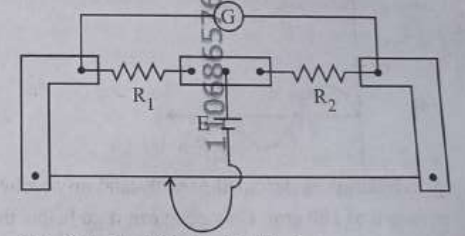
In a metre bridge experiment, the setup involves a balance condition for determining unknown resistance using a known resistance. The key components of the meter bridge are the galvanometer (G), the cell (E), and resistors \(R_1\) and \(R_2\) connected across the bridge.
In this particular problem, the positions of the cell (E) and the galvanometer (G) are interchanged. We need to analyze the effect of this interchange on the galvanometer's deflection.
Explanation:
- When the positions of the galvanometer and the cell are interchanged, the principle of the meter bridge still applies, but the detection of balance point changes.
- Initially, the galvanometer detects the point of zero current flow when the bridge is at balance. However, with the positions interchanged:
- The galvanometer being used at the position of the cell will cause it to deflect when there is any potential difference across the bridge.
- The cell now at the previous position of the galvanometer will maintain a potential difference across the bridge regardless of the deflection.
- Due to these changes, two situations arise when using the jockey (sliding contact) across the wire:
- There will be right-sided and left-sided deflections as the jockey moves across the bridge wire, depending on the current direction.
- At a particular point (the balance point), the potential across both sides is equal, and the galvanometer shows a zero deflection, indicating balance.
Conclusion:
The correct observation in the galvanometer, given the interchange of the cell and galvanometer positions, is: Both right-sided and left-sided deflection and at balance point no deflection.
Similar Questions
- In a vernier callipers, 20 VSD coincide with 16 MSD (each division of length $1 \text{ mm}$). The least count of the vernier callipers is :
- Savitha, a XI standard student, while conducting an experiment to determine the effective length of a simple pendulum L, notes down the data of time taken to complete 30 oscillations as $60 \text{ s}$ and hence calculates the length of the simple pendulum as :
(Take $\pi^2 = 9.8$, and $g = 9.8 \text{ m/s}^2$) - One main scale division of a Vernier calliper is equal to $1\text{ mm}$ and the number of divisions on the Vernier scale is $10$. When both the jaws touch each other, the Vernier scale shifts to the left of zero of the main scale in such a way that $4^{\text{th}}$ Vernier division coincides with a division of the main scale. If this Vernier calliper measures the length of a wire to be $1\text{ cm}$, the actual length of the wire is :
- Which of the following measurements require "index correction" ?
Important Questions from Practical Physics
- For the determination of refractive index of glass slab, a travelling microscope is used whose main scale contains 300 equal divisions equals to 15 cm. The vernier scale attached to the microscope has 25 divisions equals to 24 divisions of main scale. The least count (LC) of the travelling microscope is (in cm) :
- In a vernier callipers, 20 VSD coincide with 16 MSD (each division of length $1 \text{ mm}$). The least count of the vernier callipers is :
- Savitha, a XI standard student, while conducting an experiment to determine the effective length of a simple pendulum L, notes down the data of time taken to complete 30 oscillations as $60 \text{ s}$ and hence calculates the length of the simple pendulum as :
(Take $\pi^2 = 9.8$, and $g = 9.8 \text{ m/s}^2$) - One main scale division of a Vernier calliper is equal to $1\text{ mm}$ and the number of divisions on the Vernier scale is $10$. When both the jaws touch each other, the Vernier scale shifts to the left of zero of the main scale in such a way that $4^{\text{th}}$ Vernier division coincides with a division of the main scale. If this Vernier calliper measures the length of a wire to be $1\text{ cm}$, the actual length of the wire is :
- Which of the following measurements require "index correction" ?